Wednesday, June 6, 2012

Review: BARCHESTER TOWERS by Anthony Trollope


Original Publication Date: 1857

Genre: satire, comedy of manners

Topics: Church of England, ambition, religion


Review:


Barchester Towers is the second of the "Chronicles of Barsetshire" trilogy. It can be read as a stand-alone, although there are occasional references to previous characters, events and places.

Wikipedia, in all its wisdom, says that Barchester Towers, “among other things satirizes the then raging antipathy in the Church of England between High Church and Evangelical adherents.” The truth is that just by reading this I wouldn't be too tempted by the book, and it would be my loss. As someone raised in a almost 100% roman catholic country, the inner workings of the Church of England, with all its branches, are still a mystery to me, no matter how many British classics I read. It was only during my bookclub's discussion that I realize some subtleties of religious conflict in the book had escaped me completely.

The plot of Barchester Towers in general didn’t do much from me - sleepy cathedral town, old bishop dies, everyone expects his son to succeeds him but someone else gets the post, new and ambitious people arrive, rivalries ensue, some people fall in love, others try to get rich by marriage, lots of misunderstandings. It’s as much a comedy of errors as it is a comedy of manners, and most of it revolves around the fight for primacy in the diocese between the Bishop's wife Mrs. Proudie and his chaplain, Mr. Slope. There's also a somewhat meh romantic story in the background.

What did do it for me was the characterization, social commentary and the wonderful wit. Is there a “satire of manners” genre? If there is, Trollope is its King.

He manages to craft characters that have everything to become caricatures, but still feel like someone you’ve met before. There’s Mr. Slope's shameless ambition and sleazy ways, Mrs. Proudie teeth-gritting bullying of her husband and, best of all, the Stanhope family. Dr. Stanhope, went to Italy to treat a “scratchy throat” and, after 12 years (!) of peacefully fishing on the shores of Lake Como, returns at the command of the new Bishop. One of his daughters is the "Signora Madelina Vesey Neroni" (née Madeline Stanhope) and her daughter, “the last of the Neros”.

Trollope should have written a whole book about the Signora. She's escaping from an abusive marriage who left her crippled and even in England is carried around social occasions by a group of Italian men. She's a great beauty, incredibly intelligent, and a cunning flirt who seems to be seeking revenge on Mankind by breaking the heart of every man she finds in her way:
Mrs. Proudie looked at the Signora as one of the lost. One of those beyond the reach of Christian charity, and was therefore able to enjoy the luxury of hating her without the drawback of eventually wishing her well out of her sins.
(Forgive me for absolutely loving this quote ;))

Trollope writes so wonderfully, so precisely. I'm really only sorry that the plot didn’t capture me more. Your enjoyment of the book will also depend on how much you can tolerate an interfering narrator,that talks to you and comments on what’s happening, like this:
And here the author must beg it to be remembered that Mr. Slope was not in all things a bad man. His motives, like those of most men, were mixed, and though his conduct was generally very different from that which we would wish to praise, it was actuated perhaps as often as that of the majority of the world by a desire to do his duty. He believed in the religion which he taught, harsh, unpalatable, uncharitable as that religion was.
And here again, is another delightful scene, where the meek Bishop decides to finally stand up to his domineering wife:
Now, Bishop, look well to thyself and call up all the manhood that is in thee. (…) Thou thyself hast sought the battle-field: fight out the battle manfully now thou art there. Courage, Bishop, courage! [encourages Trollope]
One of the most intense points of discussion during my bookclub was about why Trollope has become more forgotten (or isn't as popular nowadays as) Austen, the Brontës or Hardy. His writing certainly deserves it, yet Barchester Towers, his most popular novel, only has 2.360 ratings on Goodreads, compared to Tess of the D'Urbervilles’ 49.219, Agnes Grey’s 8.101 and Northanger Abbey’s 63.332. We didn't reach any conclusion, so I'd love to hear your views. Is it the lack of a convincing/passionate romance? Is it the focus on the Church of England issues that limits it?

Another recommendation: BBC's adaptation, with Alan Rickman as Mr. Slope.

Barchester Towers and the full Chronicles of Barsetshire (The Warden and The Last Chronicle of Barchester) are available on Project Gutenberg. 

Tuesday, June 5, 2012

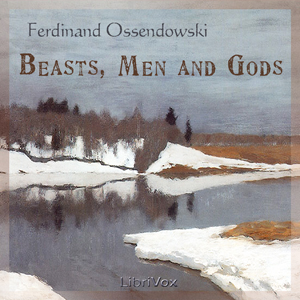
Review: BEASTS, MEN AND GODS by Ferdynand Ossendowski

book cover
Original Publication Date: 1922

Genre: memoir

Topics: Asia, journey, war, Bolshevism, Buddhism


Review:

Pursued by Bolshevik Revolutionaries, Ferdynand Ossendowski, a Polish scientist, resolves to return to his family the only way he can: by traveling through Siberia into Mongolia and China, then back into Western Europe via the United States. Along this epic journey he encounters beasts, men, and gods, sometimes within the same person.

I normally don't go for memoirs, but the summary for Beasts, Men and Gods on Librivox described it as, "an epic journey, filled with perils and narrow escapes, in the mold of The Lord of the Rings. The difference is: it’s all true." A TRUE version of Lord of the Rings? This I gotta see. And there better be effing wizards.

While Beasts, Men and Gods isn't exactly Lord of the Rings, it definitely fulfills its promise as an epic journey--a very fascinating, well-told journey over a country Ossendowski calls "the land of mystery and miracles." Ossendowski had an established history of political dissidence opposing the Bolsheviks before this story began, and even spent time in a Russian prison under a death sentence until it was commuted to a "wolf ticket"--basically papers that prevented him from leaving the country or holding down a regular job, which was why he was in Siberia to start off with. He wrote a book about his time in prison called In Human Dust that Leo Tolstoy declared one of his favorites.


ferdinand ossendowski
Ossendowski can and will kick your ass.

You wouldn't know any of that from reading Beasts, Men and Gods, however. Ossendowski doesn't give us backstory as to why the Bolsheviks are after him, just that he's visiting a friend and receives word soldiers have surrounded his house. With no other options, he escapes into the wilderness of Siberia and lives in the woods on his own for at least a year. Forgoing these details was a smart move on Ossendowski's part--it gives the narrative an everyman feel and underscores the horrors of the Bolshevik Revolution more effectively than if he'd turned the book into a political treatise. And Beasts, Men and Gods isn't really about politics, anyway; it's about a struggle to survive against the chaos of war and nature. Ossendowski wants the reader to feel as if all of this could happen to them, whether or not they're involved in politics, and he succeeds.

The first part of the memoir focuses on his time living more or less alone in Sibera, and it's the best part of the book. You know how the 1965 movie Doctor Zhivago has these incredible visuals that burn themselves into your mind, like the train car covered in ice so thick they have to hack their way through it? Beasts, Men and Gods is kind of like that. Ossendowski's description of the spring thaw is incredible, with the breaking of the ice sounding as loud as a roar and chunks of ice the size of boulders flying up from the river and flattening trees when they land. But the ice carries ugly things in its depths:
Watching this glorious withdrawal of the ice, I was filled with terror and revolt at seeing the awful spoils which the Yenisei bore away in this annual retreat. These were the bodies of the executed counter-revolutionaries... Hundreds of these bodies with heads and hands cut off, with mutilated faces and bodies half burned, with broken skulls, floated and mingled with the blocks of ice, looking for their graves; or, turning in the furious whirlpools among the jagged blocks, they were ground and torn to pieces into shapeless masses, which the river, nauseated with its task, vomited out upon the islands and projecting sand bars.
Yikes! It's easy to understand why Ossendowski was against the Bolsheviks, even though he never comes right out and says that he was.

The book slows down considerably in part two, when Ossendowski makes it into Mongolia and tries to travel into Tibet (with the goal of reaching the coast of India, where he can catch a boat back to Europe), only to be blocked by Chinese revolutionaries. Trapped, liked Mongolia herself, between two countries being taken over by communism, Ossendowski travels here and there, meets people, gets into skirmishes, is shot several times, and attempts to catch us up on Chinese-Mongolian politics. I'm not terribly interested in the politics, and the fights Ossendowski and his traveling companions get into start to feel repetitive. I began to wonder what the heck the point of all this was. But! The story picks up considerably in the part three, when Ossendowski meets Baron von Ungern-Sternberg, also known as the Bloody Baron.

Roman Fyodorovich von Ungern-Sternberg
Baron von Ungern-Sternberg, 1921, in a Mongolian deel uniform with the Russian Order of St. George.

The Baron was a German national who became a general for the White Russian army (the royalist side fighting against the Reds, or Bolsheviks), and the guy was CRAY CRAY. He was an excellent general, but known to be ruthlessly violent as well as believing himself to be the reincarnated Mongolian God of War. For serious. The way Ossendowski describes him makes the Baron sound like a blonde Moriarty from BBC's Sherlock--the high-pitched laugh, the faux bonhomie and latent violence. Ossendowki is as frightened of Ungern-Sternberg as anyone, but at their first meeting he tells the Baron off and demands his respect. After that Ungern-Sternberg decides he's trust-worthy and brings him into his inner circle (Ossendowski apparently taught the Baron's troops how to make poisonous gas, but that is not mentioned in the book).

The Baron is a fascinating guy, and Ossendowki is clearly at once repelled and transfixed by him, as is the reader. Knowing what we know now, it's a little spooky at times how the Baron seems to be predicting WWII, a battle between good and evil, as he describes it. He also knows he won't see that battle, anticipating death at the hands of his own commanders, which was exactly what happened.

Ossendowski himself is an interesting guy, too, and he only gets more interesting as his journey goes on. In his normal life he was an academic and scientist, studied under Marie Curie, and taught classes on physics and chemistry at universities in Russia and Poland. As with politics, he never gives us details about his past, but you can tell he's a scientist just by the way he describes things such as the environment and animals in Mongolia. At a few points in the book he comes across strange phenomena or legends and his reaction is, "The locals believe this is caused by evil spirits, but clearly it is a chemical reaction to blahity blah blah." And yet, one gets the impression that there's also a part of him that buys into the mysticism of Mongolia. He believes true prophecies were made about him, and he never attempts to explain Baron von Ungern-Sternberg's belief that he's a god as delusion or narcissism. The last part of the book, which takes place in the palace of the Living Buddha and describes its treasures and prophecies, are the words of someone who's drunk the kool-aid, not a scientist.

And Ossendowski is SMART. I'm not talking book smarts, either, though obviously he is that. He can read people, and that saves his life more than once. He sizes other men up in seconds and then somehow knows what to say or do to get the reaction he wants from them or inspire their trust.

Which leads me to the end of the book, and the reason why I hate memoirs. Because while I don't doubt the veracity of what Ossendowski wrote (I have no reason to--it's absolutely incredible, but people have incredible and unbelievable experiences during war, as I know from stories my own grandparents have told me), he clearly isn't telling us everything. Even if I hadn't Googled him, I'd still know he was being evasive about certain parts of his journey, especially in part four. That's where I started to go, "What the hell?" because he NEVER says how he gets out of Mongolia. One would think that would be a good conclusion to the story, if only just a sentence to mention it, but there's absolutely nothing. Why? According to Wikipedia, he got a position as a diplomatic envoy to Japan, and from there traveled to the US, supposedly hiding treasure he stole from the Bloody Baron along the way. Is that why Ossendowski skips that portion of his journey entirely? I don't like to think that Ossendowski would steal from anyone; but from the start of Beasts, Men and Gods, he edits out certain facts in order to make the impression he wants, so it's not beyond the realm of possibility that things occured in those final days that he decided were best left unsaid--not even glossed over, but skipped entirely.

Why not just write a fictional novel about it, for heaven's sake?

In any case, it seems appropriate that Ossendowski's journey through "the land of mystery" ends with a mystery for the reader. I think this memoir is incredible, thought-provoking, awe-inspiring, and I definitely think it's worth checking out.


Read Beasts, Men and Gods on Project Gutenberg|Librivox (Mark Smith narrates and does a fabulous job)

Monday, June 4, 2012

The Story of an African Farm by Olive Schreiner

book cover
Original Publication Date: 1883

Genre: General Fiction

Topics: Coming of Age, Feminism, Religion

Review: Olive Schreiner’s The Story of an African Farm is often referred to as one of the earliest feminist novels written in English. It tells the story of three characters growing up together in a farm in South Africa: Lyndall, Waldo, and Em. The novel is loosely divided into three sections and follows the protagonists from childhood into adulthood. Schreiner’s narrative voice is very experimental and dreamlike: it moves freely forwards and backwards in time, it addresses the reader, and it delves into detailed philosophical discussions. This is a novel of ideas rather than a traditional narrative, which makes the plot difficult to summarise. But readers curious about an early feminist’s approach to themes such as religious faith, agnosticism, atheism and existentialism, sexual double standards, marriage and women’s economic dependency, and the social construction of gender roles are likely to find much of interest in this novel.

The Story of an African Farm is a book I felt close to even before I started it: last year I read Letters from a Lost Generation, a collection of WW1 correspondence between Vera Brittain and her brother, her fiancé Roland Leighton, and two close friends. Brittain and Leighton frequently discussed Schreiner’s novel in their letters – the line “a striving, and a striving, and an ending in nothing” became like a metaphor for the futility of WW1 for them. There’s also the fact that The Story of an African Farm was obviously a book that helped shape Brittain’s feminism. Reading it as a woman still puzzling out some of these same questions over a century later made me feel like I was a small part of a large community of readers; of a literary conversation that stretches through time and place.

Lyndall, who functions as a mouthpiece for Schreiner’s feminism, was a particularly interesting character. For much of the novel we see her as an object of desire for the men around her, and the way she’s described (attractive, delicate, nymph-like) conforms to conventional patterns of beauty and femininity. But Schreiner subverts the male gaze by giving readers access to Lyndall’s thoughts, and by making us realise she’s aware of how she’s perceived and of the weight of what’s expected of her as a woman. There’s a long section in which Lyndall passionately exposes her views on gender roles that comes across as considerably aware of its time. Take this excerpt, for example, about the stigma and economic insecurity of unmarried women:
She smiled slightly. “They say that we complain of woman’s being compelled to look upon marriage as a profession; but that she is free to enter upon it or leave it, as she pleases.
“Yes—and a cat set afloat in a pond is free to sit in the tub till it dies there, it is under no obligation to wet its feet; and a drowning man may catch at a straw or not, just as he likes—it is a glorious liberty! Let any man think for five minutes of what old maidenhood means to a woman—and then let him be silent. Is it easy to bear through life a name that in itself signifies defeat? to dwell, as nine out of ten unmarried women must, under the finger of another woman? Is it easy to look forward to an old age without honour, without the reward of useful labour, without love? I wonder how many men there are who would give up everything that is dear in life for the sake of maintaining a high ideal purity.”
Almost as interesting to me was Gregory Rose, a character who embodies modern ideas about the performativity of gender roles in the final section of the novel. I don’t want to give away what happens in case you mind spoilers, but he comes to realise that it’s much easier for him to perform what society deems “women’s work” if he literally disguises himself as a woman.

It was very exciting for me to find these themes in a novel from 1883, and I can only imagine how much more exciting it must have been for someone like Vera Brittain, who was reading it at a time when feminism as we know it today was taking its first steps. I should add, though, that like Eva noted in her review The Story of an African Farm is pretty blatantly racist. It’s quite possible that someone like Schreiner, who is otherwise very progressive, would not have absorbed the troubling attitudes towards race that make their way into this novel if she hasn’t lived in the nineteenth-century – for this reason, I do find it useful to take her historical context into account. But it’s equally useful to bear in mind that the novel’s particular brand of feminism doesn’t give us the full picture, and only champions the rights of one particular group of women. This is common enough in works from this period, and although I still find them interesting and valuable, I also feel the urge to find other sources that can give me an idea of what things were like for the women who are ignored and dehumanised here.

As I said earlier, The Story of an African Farm is primarily a novel of ideas. The ideas it deals with are all ones I’m interested in, which was enough to make it a worthwhile read. However, I must admit that I sometimes felt that the characterisation was sacrificed to Schreiner’s attempt to make everyone into a philosophical spokesperson. Not all of her characters felt like real human beings to me, which was a real pity. In addition to that, her approach is not exactly subtle, and she often tells far more than she shows. When I think of novels such as, say, To The Lighthouse, which combine a focus on ideas (some of the same ideas Schreiner tackles, actually) with subtlety and absolutely masterful characterisation, it becomes obvious that these shortcomings aren’t inevitable.

Then again, The Story of an African Farm was Schreiner’s first novel, so it’s pretty unfair to compare it to one of Woolf’s masterpieces. The good outweighs the bad by far and I really enjoyed it overall – not only for the ideas but also for the lovely writing and sense of place. I own a copy of Schreiner’s later novel Man to Man and I’m really looking forward to reading it sometime soon, as well as to trying some of her non-fiction.

You can download the e-book of The Story of an African Farm for free at Project Gutenberg.

Friday, June 1, 2012

Review: The Window at the White Cat by Mary Roberts Rinehart


book cover
Original Publication Date: 1910

Genre: Mystery

Topics: damsels in distress, crooked politicians, missing relations, stumbling heroes


Review:

Yet another LibriVox pick but my first Mary Roberts Rinehart. A dame walks into lawyer Jack Knox’s office and asks for help. Her father Allan  Fleming, a prominent politician, has disappeared. She’s nervous. Her father’s house has been broken into and a mysterious note with the numbers 11-22 left behind. What does it all mean? She begs Jack to find her father and not involve the police. Jack falls instantly for the lovely Margery Fleming and agrees to help her. Unfortunately, she’s engaged but the lucky man seems to be up to his neck in her old man’s dirty business. He knows more than he’s letting on about the missing Mr Fleming.

Things get stickier when Margery’s Aunt Jane disappears along with the family pearls. The stakes just got higher. As Jack starts putting two and two together, everything points in the direction of the political club The White Cat. The White Cat is a place where shady deals are made across poker tables. A man’s career can be made or broken here. It’s also the kind of place a man can lose his life.

I decided the try The Window at the White Cat by Mary Roberts Rinehart story because Aarti and Tasha had success with their selections of the same author. I think I picked the wrong book. The Window at the White Cat had its good points but I wasn’t enamoured with the story. In fact, I found that I would drift off while listening or wonder what exactly was going on. It was the political side of the story that I didn’t care about. Allan Fleming is a crooked politician, I didn’t really care about him or his cronies. Maybe sleazy politicians and their dealings would have interested readers in 1910 but we’ve all done that and bought the t-shirt.  Now Miss Jane on the other hand, that part of the story, a sort of sidebar to Fleming’s story, was much more appealing. What happened to the lady? I wanted to know.

I did like Jack, with his dry sense of humour and his interesting home life. Jack is that artifact of the last century, the sad bachelor. He lives with his brother, sister-in-law, and their kids. He endures their ribbing and his brother’s grumbling. Jack tries to be Margery’s hero by finding her father but most of the time he’s bumping into people or things in the dark. There are a lot of people breaking into houses and tumbling over each other in the dark actually. Jack also suffers from “don’t worry your pretty head” syndrome when it comes to ladies. What is with these guys trying to shelter pretty women from bad news? What are they scared of? Are they afraid they’ll lose their marbles and jump in a lake? So annoying. Anyway… Margery is kind of blah herself. All she has going for her is looks which I guess is all that’s necessary in a love interest. She’s the least interesting of all the characters.

From the looks of other reviews out there, this might be one of Rinehart’s duds. I’m willing to give her another shot. There was potential in The Window at the White Cat but the execution was off. Any suggestions for other books?

This was an LibriVox recording performed by Robert Keiper. He was so good! The voices he did for each character were hilarious. He really livened the story up. I would listen to his other recordings. The Seventh Man looks like a good one.


Thursday, May 31, 2012

Review: TRIPS TO THE MOON by Lucian of Samosata

trips to the moon cover
Original Publication Date: c. 150

Genre: comedy

Topics: philosophy, history, satire, adventure

Other titles: True History, A True Story


Review:

Lucian of Samosata was a rhetorician in Ancient Rome and, from what I gathered in the introduction to this book, a thorn in the side of everyone he ever met. His modus operandi was to ridicule the practices of other philosophies; in Trips to the Moon, historians are his main victims.

A 2nd-century rhetorical treatise doesn't exactly sound like a laugh riot. The only reason I downloaded Trips to the Moon was because le fabeau Ralph Snelson narrated it. While it wasn't laugh-out-loud funny, it was amusing, and an interesting read.

The book is divided into three parts: first is the introduction from the translator, then "Instructions for Writing History," and finally "True History," which Lucian tells us is completely made-up.

As a disillusioned academic, I have to say I found Lucian's criticisms of historians to be spot-on. Apparently the behavior of over-educated elitists hasn't changed that much in the last 1800 years! Seriously, you put some unimaginative khakis on these guys instead of togas and you've got modern academia in all it's glory, which probably shouldn't surprise me as much as it did.

To boil down his argument, Lucian thinks that historians should only write about things they know from first-hand experience. Obviously, if you're writing about events that happened before you were born, this would be impossible. Thus Lucian argues historians are just using their imaginations to make stuff up, then pretending that what they've written is "fact." Ergo he's going to write the truest history that ever was, by making everything up but being totally honest about what he's doing.

So follows an adventure where Lucian and some companions travel beyond the Straight of Gibraltar and wind up having all sorts of adventures, including being trapped in a giant whale, flying to the sun, meeting gods and goddesses, and traveling to the moon just in time to become embroiled in a war.

Trips to the Moon is categorized as the first science fiction novel and a precursor to Edgar Rice Burroughs and HG Wells, but personally I think that's a total misunderstanding of both Lucian's point and the genre of science fiction. This is a satire of contemporary culture and a story meant to be beyond ridiculous. The appeal of science fiction is that it might happen, which is a conceit Lucian not only doesn't make claim to, but would probably make fun of if he was alive today. Even if you're only passingly familiar with ancient writings, it's easy to see that he's referencing previous works and then upping the ante to make the tales absolutely incredulous.

Also, there are a lot of references in the text that have no purpose other than to mock past and current historians. For instance, Lucian meets Herodotus in the belly of the whale, where he's being eternally tortured for telling lies in his own Histories, and reflects that he's happy he's never told one. Before that Lucian meets Homer, who spends most of his time telling historians who disagree with him to go fuck themselves (in summary).

Overall I found Trips to the Moon very interesting. It does start to drag at the end, but it's very inventive and clever, and occasionally amusing. Every criticism Lucian has of the study of history was and still is completely valid, and I only wish we had our own Lucian to remind academics not to take themselves so seriously.


Read Trips to the Moon at Project Gutenberg|Librivox|Sacred Texts

Wednesday, May 30, 2012

Emily Fox-Seton, by Frances Hodgson Burnett

Original Publication Date:  1901

Genre:  Romance, Historical Fiction

Topics:  Women, Race

Review:  UGH.  This book disgusted me on so many levels.  I couldn't even get through it because I was so heavily offended by the blatant racism present here.  This is actually an omnibus of two books- The Making of a Marchioness and The Methods of Lady Walderhurst.  The Making of a Marchioness is the better of the two books (better = less offensive), but it's an odd one.  The heroine is described many times as being not very clever, overly naive, and somewhat ridiculous in her enjoyment of doing good turns for other people.  Emily Fox-Seton is far too saint-like for my tastes, and Burnett is none too subtle when describing her.  A few quotes:

"She did not know she was humble-minded and of an angelic contentedness of spirit."  Of course she didn't.  Because when you are ANGELIC, you must be completely blind to the fact.

"In fact, she did not find herself interested in contemplation of her own qualities, but in contemplation of those of other people."  Yes, because if one is a truly good person, she must never once think of herself positively.

I think you get the idea.  The book is liberally littered with phrases and comments like these, in which Emily Fox-Seton is described as being angelic.  But that is not enough.  She is also, of course, absolutely beautiful, even though she is thirty-four years old.  And even though she is poor, she has exquisite manners and dresses so well that no one would ever know that she had no money.

Already, Emily of the last name-dash-other last name was getting on my nerves.  But I persevered through to her happy ending, in which she married, as you can imagine, a very rich and kind (though also not very clever, as Burnett unceasingly points out to us) marquis.  I hope I didn't give too much away there, but quite frankly, the title gives it all away.  Don't be jealous of Emily, though, because the marquis, too, is not particularly clever.  He is described as being not that handsome, not that tall, not that aristocratic, and not very memorable.  He's really just rich and polite.  What made him supremely unattractive to me was the ridiculous habit he had of wearing a monocle that magnified his eye.  In fact, he wore the monocle while he proposed to Emily.  Which makes it impossible to take the man seriously, marquis or not.

So.  The first book was overly saccharine and monocle-infested, but somewhat bearable, if only because it made so starkly clear how difficult life for a single woman could be in the early 20th century.  Emily really did live in daily fear of The Future.  How would she provide for herself in old age?  Who could she depend on?  There was so much she couldn't control, but she always tried to present a cheerful demeanor to others.  I also like that this book was not a romance, exactly.  Emily is grateful to the rich people in her life for being generous towards her, but she holds no illusions about her own life.  She clearly is grateful to the Marquis for saving her from a life of scrimping and saving, but theirs isn't a marriage of passion or extreme feeling- they marry each other for comfort, and Emily feels more gratitude than anything else and seems to view her lover as more a benefactor that she wants to please than anything else.

I am confused by the message that Burnett was trying to share here.  Was she saying that very beautiful, poor (white) women who let everyone else walk all over them and are grateful for it are likely to win the attention of a really rich man in the end?  Because I am not on board with that message.  I think she was trying to convey a theme of "The meek shall inherit the earth," but I think she made Emily a little too perfect and idealized to get that across in a manner that seems realistic to her readers.  Still, I was glad that Emily ended the book content.

BUT THE SECOND BOOK.  My God!  Perhaps I was more sensitive to the racism because I am Indian, and the racism was against Indian people.  But no, I think I would be offended on anyone's behalf because it was just so ignorant and horrible.

First, Burnett refers to Hinduism as an "occult" religion.  All Hindus know spells and apparently use those spells to kill other people.  (Using a more direct method is too obvious for us, I guess.)  This was extremely disturbing for me to read, for obvious reasons.  But I was also upset because it reflects a complete disregard for the culture.  Burnett fell completely into stereotype (and I am not sure which stereotype, or perhaps stereotypes against Indians have changed drastically over the past century).  She didn't give the religion or culture any respect in this novel that features two Hindus as fairly prominent characters- these characters are also, as far as I got (which, admittedly, was not far), pretty horrible and shady, vindictive women.  One is proven to be horrible because, of course, she rejects the offer of a Bible and sticks to her "occult" ways.

The point at which I stopped reading?  When I got to the part in which Emily Fox-Seton's loyal and kind and good (and white) maid tries to warn her kind and forgiving and beautiful (and white) mistress that not everyone has good intentions towards her:  "Ameerah," wailed poor Jane, "White ones have no chance against black!"

Yup.  That's where I stopped.

Monday, May 28, 2012

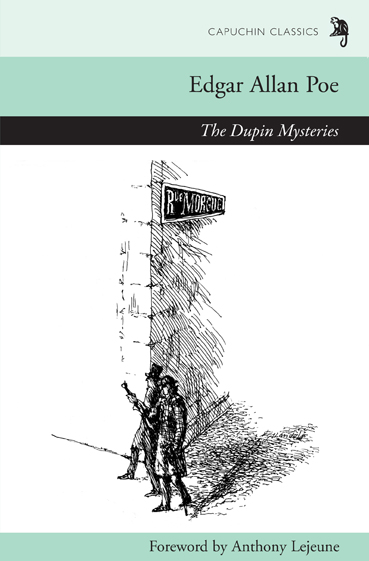
The Dupin Mysteries by Edgar Allan Poe

book cover
Original Publication Date: The Murders in the Rue Morgue, 1841; The Mystery of Marie Rogêt, 1842/43; The Purloined Letter, 1844

Genre: mystery

Topics: intellect versus brutality, morality


Review:

Edgar Allan Poe's C. Auguste Dupin stories are said to be the first mysteries, establishing the basic tenants of the genre. So I thought I should read them.

The Murders in the Rue Morgue starts off the trilogy. Since this story "established a genre," I was expecting a lot out of it. It was... okay. A little odd, really. It starts off with a treatise about logic and chess, then introduces Dupin, who is seen through the eyes of the narrator. The narrator is a normal guy (I assume he's American) who moved to Paris and needed to find an apartment. He met Dupin by chance, moved in with him, and the two became fast friends. Sound familiar--like the set-up to, say, A Study in Scarlet? There are even more similarities between Dupin and Sherlock Holmes.

The murder mystery itself deals with two women--one old, one young--who were found brutally murdered in their apartment. What makes the mystery twisty enough to call in Dupin is that several witnesses heard other voices in the room with the two women, even though no one saw anyone leaving their apartment and the door was still locked on the inside. One voice was variously described as having nearly every accent in Europe, so where could the murderer possibly be from?

Dupin is VERY Sherlockholmes-esque (or perhaps we should say Sherlock Holmes is very Dupin-esque). He can extrapolate specific conclusions about people based on the smallest piece of evidence, like a ribbon. Unlike Holmes, however, Dupin isn't a know-it-all. He never claims to have facts--he makes it very clear he's guessing, and his guesses just happen to be correct most of the time. He doesn't take money for his investigations and instead seems to be doing what he's doing for the pure reasons of exercising his intellect in the pursuit of clearing an innocent man's name.

Although The Murders in the Rue Morgue wasn't the greatest, I do have to say I did not see the solution to the mystery coming AT ALL. And monkeys are way scary.

illustration from the mystery of marie roget

The Mystery of Marie Rogêt is longer than The Murders in the Rue Morgue, and much worser. At first I thought it was going to be awesome, because there was more of a set-up regarding the victim of the crime--a perfumer clerk who (naturally) is female. After disappearing unexpectedly for about a month, she returns to her job claiming she'd been to visit a sick aunt. A few weeks later, she disappears again, and later her body is found in Seine.

The mystery itself is based on the real-life murder case of Mary Cecelia Rogers, which remains one of the most puzzling unsolved crimes in New York City history. THAT mystery is really interesting; The Mystery of Marie Rogêt--or at least the solving of it--is not. Basically Dupin reads the newspaper accounts aloud, debunks whatever they say, then theorizes what might have happened based on what they say, without ever finding the murderer. It's like a novelist imagining what might have happened to a murder victim, which I suppose is what was actually happening here. But the characters themselves never DO anything; they don't even move from the table. IT IS SO BORING. I honestly didn't think Poe was even capable of writing something this boring. I think it's safe to say that unless you're a hard-core EAPic, you can skip this one.

a doubly purloined letter

The Purloined Letter is the last story in the trilogy, the shortest, and the best. As in the last two stories there's a lot of dialog, but the dialog is more clever, as is the twist at the end.

Dupin and the narrator are hanging out in their apartment one night, when Dupin is visited by the Prefect of Police, a man he obviously thinks is an idiot. The narrator describes the Prefect as having, "a fashion of calling every thing 'odd' that was beyond his comprehension, and thus lived amid an absolute legion of 'oddities.'" Oh snap! The Prefect is in search of a letter stolen by a Minister D. that contains compromising information. Try as he might, though, he and his police can't find it anywhere in the minister's rooms.

This mystery is notably different from the last two in several respects: for one, there's no beautiful dead woman. For another, Dupin actually accepts payment for solving the mystery, whereas in the last two mysteries he was simply exercising his intellect. I suppose that makes sense, since finding the letter didn't seem to pose much of a challenge for him. And lastly, Dupin deliberately matches wits with Minister D., whom some have suggested is actually his brother (kind of like Holmes and Mycroft?). I have have to admit that, listening to this on audio, it's easy to confuse D. with Dupin sometimes, because they do share similar personality traits.


For the most part, I really enjoyed Poe's Dupin mysteries (except for The Mystery of Marie Rogêt, that was horrible). Dupin's not a terribly fleshed-out character, and the mysteries are very intellectual and too theoretical sometimes, but overall this was a really fun, short read. I'm happy to finally be familiar with the start of the mystery novel!


You might also enjoy:


Download Poe's short story collections at Project Gutenberg|Librivox