Showing posts with label Mary Roberts Rinehart. Show all posts

Monday, January 14, 2013

Review: THE WINDOW AT THE WHITE CAT by Mary Roberts Rinehart

white cat cover

Original Publication Date: 1910

Genre: mystery

Topics: politics, crazy old ladies, amateur sleuths, lawyers


Review by heidenkind:

Jack Knox is an attorney who, for some strange reason, is constantly asked to investigate things. First the beautiful Margery Fleming walks into his office, asking him to find her father, a disreputable politician (or just politician, as adding "disreputable" as an adjective seems repetitive). Then Margery's two maiden aunts, Lavinia and Jane, start having problems: Lavinia finds her pearls missing and Jane disappears, just as Margery's dad is found dead. Somehow Jack bumbles his way into a solution to both mysteries.

The Window at the White Cat definitely isn't one of Mary Roberts Rinehart's best mysteries, although I did enjoy it. On the surface it has a lot of elements in common with The Man In Lower Ten (review here): a bachelor lawyer who investigates crime and sneaks around dark houses at night; a beautiful woman with a problem whom he's clearly attracted to; and the atmosphere of an olde-timey movie. However, Jack (and really none of the other characters, either, excluding Aunt Lavinia) isn't as charming and interesting as Lollie, the two mysteries don't work that well together, and the book is about twice as long as it should be.

Still, reading The Window at the White Cat wasn't a horrible way to spend a few days. I think my favorite parts of the book were Jack's visits to the Aunts' house, which reminded me of the movie Arsenic and Old Lace (but without the trips to Panama). Crazy old ladies FTW! I also kind of liked the peek into 1910's politics, if only because it's pretty clear the general opinion of politicians has not changed that much in the last century.

While The Window at the White Cat isn't a novel I would unreservedly recommend (unlike The Man In Lower Ten), it's okay. I do have to say that I love Rinehart's titles though: they sound very odd and nonsensical until you read the book, and then they're PERFECT. Here the White Cat is a political club. You'll have to read the rest of the book to find out how the window fits in!


You might also be interested in:

  • Chris' review of The Window at the White Cat here.
  • Melody's review at Redeeming Qualities.
  • My review of The Man In Lower Ten here.
  • My review of The After House by Mary Roberts Rinehart here.
  • Aarti's review of Bab: A Sub-Deb by Mary Roberts Rinehart here.


Download The Window at the White Cat by Mary Roberts Rinehart at Project Gutenberg|Librivox

Thursday, July 19, 2012

Review: THE BAT by Stephen Vincent Benét

Story by Mary Roberts Rinehart and Avery Hopwood

book cover
Original Publication Date: 1926

Genre: mystery

Topics: country house, master criminal, old lady


Review:

All through the city and its neighboring suburbs, wealthy people are being terrorized by a master criminal known as the Bat--so called because of the signature he leaves at every crime scene. He's so elusive the police are convinced he's a respectable gentleman by day, and a criminal by night, hiding in plain sight. The Bat seems to be unstoppable, until he meets his match: a little old lady who refuses to be frightened from her home.

Here's the thing with The Bat: it's actually a play adaptation of The Circular Staircase, Mary Roberts Rinehart's second novel, which she wrote in collaboration with Avery Hopwood. The biggest change she made for the play was the addition of the Bat. And if the cover of this book makes you think of Batman, there's a reason for that: Batman was directly inspired by The Bat.

The Bat was hugely successful, with receipts running into the thousands of dollars per night, and there were several movie adaptations made of it (including a silent film you can watch at Internet Archive) as well as this novelization, which is credited to Rinehart and Hopwood, but was actually written by poet Stephen Vincent Benét.*

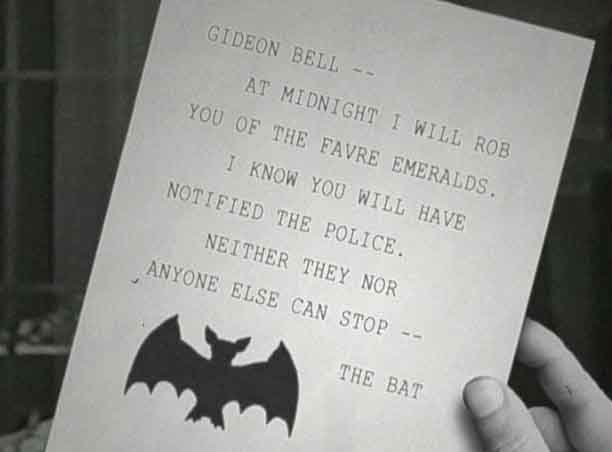
a note from the bat
The Bat likes leaving people notes.

Considering The Bat is an adaptation of an adaptation, it's not that bad. The first third is actually pretty good: it's very cinematic and visual, has lots of humor, and does a good job of setting the scene and presenting the motivations of the central characters in an interesting way. I warmed up to Mrs. Van Gordon, the old lady, immediately; and while her interactions with Lizzie the maid weren't laugh-out-loud funny, they were entertaining.

But The Bat seriously began to lose me in the second third. It started to feel like a play adaptation at that point: everything occurs in Mrs. Van Gordon's living room, which is clearly the set, and the descriptions sound as if Benét is simply telling us what happens on stage. So that was a little dull.

Plus, this is the type of story where there is A LOT of plot going on. Plot upon plot upon plot. Nearly everyone isn't who they say they are, there are tons of people who could be the Bat, and even those who aren't the Bat have their own agenda, which more likely than not involves stealing money out of Mrs. Van Gordon's house. The threads are woven together pretty tightly, but for some reason I found it to be really BORING. The Bat put me to sleep on several occasions. It's strange because I feel like it SHOULD have been interesting; it just wasn't. I think there was too much plot for me and not enough characterization; even watching the movie version I was bored out of my mind. Every single character is more of a "type," and... that's about it. They're types after a thing, and they all keep coming and going from the same room. I think I started to fall asleep just writing that sentence.

In the end, The Bat was a DNF for me. It was beginning to feel like Reading Torture. I did kind of want to find out who the Bat was, but I have a feeling I already know; and anyway, I don't care enough to go through Reading Torture for it.


Get The Bat at Librivox|Project Gutenberg

*Information about The Bat's receipts and contributors comes from Improbable Fiction: The Life of Mary Roberts Rinehart by Jan Cohn (1980, University of Pittsburgh Press).

Wednesday, June 27, 2012

Bab: A Sub-Deb


Original Publication Date:  1916

Genre:  Humor, Coming-of-Age, Romance, America

Topics:  Gilded Age, Debutantes, Lives of the Rich

Review:

Bab:  A Sub-Deb is about Barbara Archibald- a beautiful, slightly ditzy, 17-year-old society miss who is quite annoyed that her "barely older" but officially "out" to society sister Leila gets all the attention (and new clothes and party invites) while Bab must suffer through boarding school for two more years before she can become a debutante.  She is, in her own words, a sub-deb, and it's a rough life.  The problem is that Bab is a very pretty girl who draws all sorts of male attention and gets into a ridiculous number of scrapes and then does her very best to get out of them without any help.  She rarely succeeds at this goal, but gosh, it's fun to watch her try.

The result is a terrifically entertaining romp through pre-WWI (and WWI), upper crust America, with good-hearted, naive "naturaly truthful, as far as possible" Bab, who can't spell to save her life, as our rusted tguide.  From the first adventure (making up a fake fiancee who, to her horror, comes to life and into her life) to the last (saving her father's weapons munitions factory from German spies), I was thoroughly and wildly entertained, often laughing out loud and noting down my favorite lines.

The best thing about Bab is that she balances so well between being a very realistic, overly dramatic teenager and being one of the funniest and most endearing narrators you've ever encountered.  I generally hate ditzy girls in books because they are so overblown and ridiculous.  But I love Bab, even though (or perhaps because) she says things like:
"I shall now put down the events of the day, as although the Manual says nothing of keeping a record, I am sure it is always done. Have I not read, again and again, of the Captain's log, which is not wood, as it sounds, but is a journal or Dairy?"  
I think that's because even though Bab is a little naive, you know that she is also a very resourceful and extremely determined girl.  Even as she gets into mishap after hilarious mishap, she always bounces back and does her best.  She also has fantastically clever methods for getting her own way.  "All is going well, unless our Parents refuse, which is not likely, as we intend to purchase the Tent and Unaforms before consulting them.  It is the way of Parents not to care to see money wasted."

I can tell this is a review that will be littered with quotes everywhere, but I really want you to get a feel for just how wonderful Bab is.  For example, here's a scene Bab describes when she feels that her whole family turned on her when she most needed them (spelling errors and capitalizations are original to the text):
Father was the first down.  HE CAME DOWN WHISTLING.
It is perfectly true.  I could not beleive my ears.
He approached me with a smileing face.
"Well, Bab," he said, exactly as if nothing had happened, "have you had a nice day?"  He had the eyes of a bacilisk, that creature of Fable.
"I've had a lovely day, Father," I replied.  I could be bacilisk-ish also.
I love the way Bab interacts with her family, whom she loves even though she doesn't think they understand her.  "It is always thus in my Familey. They joke about the most serious things, and then get terrably serious about nothing at all, such as overshoes on wet days, or not passing in French grammer, or having a friend of the Other Sex, etcetera."  She particularly loves her father, who is her "only Male Parent and very dear."

I also appreciated how Bab, like all 17-year-olds, confronts some universal fears even in the midst of her crazy escapades.  For example, Bab spends a lot of time contemplating whether she has the capacity to love, "not the ordinery atachment between two married people.  I mean Love - the reel thing."  She sometimes feels like she is a cold-hearted woman because she doesn't feel strongly for any man in her acquaintance.  This is a very real worry for her, and it hints at the broader question of how much a beautiful girl of the early 20th century is allowed to flirt with boys without being deemed a flirt or an ice princess.  But Bab makes sure we don't become too philosophical by ending her contemplation of romance in her life with this rejoinder:  "The terrable thought has come to me that I am fickel.  Fickel or polygamus - which?"

My favorite theme of this book, though, was how feminist it became, without losing the humor and consistency of the character.  Honestly, if Rosie the Riveter were to be made flesh and blood, I think she would come to life as Barbara Archibald.  Bab immediately becomes involved in the war effort, leading a group of girls to form a sort of drill team, learning flag signals, practicing target shooting, and pressuring the young men in their lives to enlist in the war.  Mary Roberts Rineheart was very involved in the war effort, actually going to the front as a reporter, so it was very telling to see her take this light-hearted book and infuse it with some very strident patriotism.  This sometimes bordered on disturbing as Bab suspected all immigrants of being anti-American.  For example, she has a heated exchange with a servant who hails from Germany, and says, "The Emblem of my Country, and I trust of yours, for I understand you are naturalized, although if not you'd better be, floating in the breese AFTER SUNSET."

It's a very humorous exchange in which Bab is bested by said naturalized servant, but also quite telling when you know how Americans acted towards foreigners (particularly the Japanese) during the world wars.

But really, these hints of the very true and difficult problems faced by women and immigrants in the United States during the early 20th century only served to reinforce my love of this book.  It is not only thoroughly entertaining and absolutely hilarious, but it also touches on issues and situations that have universal resonance.  I loved every bit of it, and if I could quote the whole book to you here in this review in the hopes of getting you to download it, I would.  But instead, I will leave you with this slightly longer section:
"Mother, were you ever in Love?" "Love! What sort of Love?"
I sat up and stared at her.  "Is there more than one sort?" I demanded.
"There is a very silly, schoolgirl Love," she said, eyeing me, "that people outgrow and blush to look back on."
"Do you?"
"Do I what?"
"Do you blush to look back on it?"
Mother rose and made a sweeping gesture with her right arm.  "I wash my hands of you!" she said. "You are impertanent and indelacate. At your age I was an inocent child, not troubleing with things that did not concern me. As for Love, I had never heard of it until I came out."
"Life must have burst on you like an explosion," I observed. "I suppose you thought that babies——"
"Silense!" mother shreiked..
I highly recommend that you read this book any time you feel the need for a pick-me-up or a big, hearty laugh.  It's so much fun, and I hope you love it as much as I did.


Monday, May 7, 2012

Review: THE AFTER HOUSE by Mary Roberts Rinehart

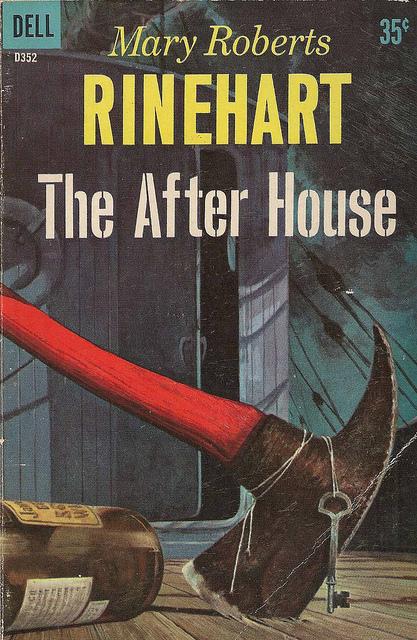
book cover
Original Publication Date: 1914

Genre: mystery

Topics: sailing, Germanic horde


Review:

Ralph Leslie came down with typhoid only a day after graduating from college. Still weak from illness and with only seven dollars to his name, Leslie's friend sets him up with a summer job on a yacht. There's the forecastle, where the crew (including Leslie) sleep; and the after house, which is where the owner of the yacht and his friends have their rooms. Things seem calm on the surface, but tensions are clearly brewing in the after house, due mainly to the owner's endless drinking.

Then one night, three people on board are murdered, chopped to death by a silent, axe-wielding murderer. Trapped on a small vessel and weeks outside of port, everyone wonders who they can trust and who will be next.

Things I learned from The After House:
  1. Don't trust Germans. They have long names that are difficult to pronounce, are argumentative, and spend too much time philosophizing. I know what you're thinking: Tasha, shouldn't you have already known not to trust Germans from watching EVERY MOVIE EVER MADE? And you're right, I actually did know that, but sometimes I forget because 90% of the people I'm related to are, in fact, German. But still. Argumentative, really?!
  2. There's a reason why people are buried at sea.
  3. Don't be stupid like the hero of this book! At first I had high hopes for Leslie, but he makes one gaff after another, from ordering the blood washed away (evidence, hello! Didn't you go to med school?) to telling the women where exactly they can find the key to where the evidence is kept so they can throw it overboard.
  4. Bad things come to those who drink, especially if you drink whiskey.
Honestly, I have mixed feelings about The After House. For the first half I absolutely loved it. Mary Roberts Rinehart's writing was so sparse and perfect, and I was completely drawn into the story. Then the murders take place and they are SO. CREEPY. First everything is fine, if a little tense; and then all of a sudden there are dead people all over the freaking place in little pieces! Not only that, but no one sees or hears anything, even though they're right next door. It's like Lizzie Borden came back from the dead and is all, "I'm on a boat! *chop chop chop*"

In the second half, though, the pacing started to go off, and inconsistencies in the story began jumping out at me. I expected Leslie to solve the murders on board the ship as they made their way back to port, which would have kept the tension high and offered an elegant conclusion: roll into US waters, show the authorities the culprit, and disembark. Instead, Leslie does very little investigating and moons over a girl, who seems really sketchy. They pull into port with the murders still unsolved, and then everything we already know is retold in court. Basically the story lost all momentum at that point, and the conclusion was riDONculous.

It's still a pretty good book, though, because it's by Mary Roberts Rinehart. I have to wonder if Rinehart herself was a teetotaler; there's a definite presentation in the book about the evils of alcohol, what with the owner of the yacht going into delirium tremens and Leslie dumping all the alcohol overboard. Before that even happens, I was thinking the after house had to be a metaphor for something--either success or the American dream--and Leslie's face is pressed against the glass throughout the entire book. Leslie himself never imbibes, and Rinehart definitely contrasts his behavior with that of the thirstier characters.

The women in this novel are also really interesting. When the murders take place, to me they seemed like the obvious suspects (well, there were some other obvious suspects, but they were TOO obviously obvious, if you know what I mean). The ladies had the opportunity, and come on--people are hacked to death with an axe feet from where they're sleeping and they don't hear anything? Way suspicious. But the men folk never consider one of the women might be the killer, even though they order everyone around, defend themselves with guns and knives, accuse random people of the murders for the sole purpose of throwing suspicion on them, and attempt to destroy evidence. These ladies keep it real, yo. It was extremely frustrating that the thought one of them might be a homicidal maniac never even crossed Leslie's mind.

The After House isn't as good as The Man In Lower Ten (review here), and I probably wouldn't recommend starting with it if you haven't read Rinehart before; but it was pretty damn creepy, and had a deliciously claustrophobic atmosphere, so I think it's worth reading for that.


Read The After House at Project Gutenberg
You might want to know: there are some racial slurs in this book.

Tuesday, March 6, 2012

Review: THE MAN IN LOWER TEN by Mary Roberts Rinehart

book cover
Original Publication Date: 1906

Genre: Mystery

Topics: trains, lawyers, femme fatale, wrong man


Review:

Oh my gosh, you guyyyyys. I loved this book!

Lawrence (Lollie to his friends) Blakely is an attorney in Washington, DC. His bestie and law partner, Richie McKnight, wants to see a girl over the weekend, so he asks Lollie to travel to Pittsburgh in his stead and pick up some important documents for a case they're working on. The trip back turns into the Titanic of train travel--first, someone's sleeping in Lawrence's bunk, lower ten, so the porter makes him sleep in a different bunk. Then he wakes up to find he's been robbed of everything, including the important documents he was carrying. At this point Lawrence is pretty annoyed and yelling at everyone, but things only get worse when they discover the man taking up his bunk in lower ten has been murrrrrdered, and the conductor accuses Lawrence of the crime. AND THEN the train crashes, killing practically everyone. And that's just the beginning! Now Lawrence is being followed by the police, who think he's a murderer, as well as some unscrupulous people who think he still has the documents. Everything hinges on him finding out who killed the man in lower ten.

I first heard about The Man in Lower Ten from Melody at Edwardian Promenade. The first chapter was little rocky for me, as Lawrence appeared to be yet another Edwardian bourgeois male hero. I don't have anything against bourgeois male heroes in theory, but come on. There's only so much a girl can take. But then one of the characters mentioned the Cubs, and how can you not like a book where the characters talk about the Cubbies? You can't. Not, that is.

I'm glad I stuck with The Man in Lower Ten, because there's a lot to love in this novel, and it only gets better as you keep reading. First of all, I love the characters. Lawrence is clever, but not smooth at all, and Richie is the bestest. These are two people I'd love to hang out with. You know that thing where you start thinking about characters like they're actual people, to the point where you're worrying about them if they seem upset? YEAH. Was totally doing that here.

The novel is also insanely twisty and fast-paced, with great, snappy dialog. Even if you're not a fan of mystery novels per se, I think if you enjoy olde timey movies such as Alfred Hitchcock's lighter suspense films, you'll enjoy this book. There are several elements in The Man in Lower Ten that are very common in Hitchcock films: for one, there's a MacGuffin, the documents Lollie picks up in Pittsburgh. There's also an amateur sleuth named Hotchkiss who just happens to be in the Pullman car when Lawrence is accused of murder, and applies the investigative techniques of Conan Doyle and Poe to real-life crimes (Lollie's reaction to this: "I nodded tolerantly. Most of us have hobbies"). And there's a "wrong man" element in the story, as Lollie is misidentified as the person who not only stole the documents, but killed the man in lower ten.

There's also a romantic sub-plot with a beautiful woman whom apparently alllll the men in the mid-Atlantic states are in love with, and who is very definitely involved in the murder somehow. Just how far can she be trusted? I think I worried over this a lot more than Lawrence did.

Of course, enjoying all of this requires a definite suspension of disbelief, and there are a few UnPC Moments (calling the porters "darkies," for instance); but despite being written over a hundred years ago, The Man in Lower Ten feels surprisingly modern, and is as much fun to read as any mystery novel I've ever come across. I now want to read ALL THE MARY ROBERTS RINEHART NOVELS. She's called the American Agatha Christie, but personally I think it'd be more accurate to call her the American Female Hitchcock. Definitely recommended!