Showing posts with label coming of age. Show all posts

Monday, July 31, 2017

Review: THE FIRST VIOLIN by Jesse Fothergill

the first violin by jesse fothergill Original Publication Date: 1877

Genre: Romance

Topics: love, music, friendship, honor, fatherhood, coming of age, mysterious past


Review by Rachel S:

In the pre-internet era, when out-of-print books were difficult to find, my grandma would tell me about the books that she loved when she was growing up.  One of her favorites was First Violin by Jessie Fothergill. Of course nowadays this book, which seemed so impossible to locate when I was a child, is easy to access and completely free. I finally got around to reading it, and was very glad I did, because I thoroughly enjoyed it. If I had read it when I was a child or teenager, I can easily imagine it becoming one of my favorite books.

First Violin was originally published in 1877, and was quite popular in the late 19th and early 20th centuries. Although it is rather G-rated by today’s standards, it was apparently somewhat controversial at the time, because it describes (but does not condemn) an affair by a married woman. The main plot line follows a handsome violinist with a mysterious past, Eugen Courvoisier.  Much of the tension in the book comes from slowly discovering his backstory.

The novel is narrated from the perspectives of May Wedderburn, an English girl who travels to Germany for musical training, and of Eugen’s friend Friedhelm Helfen, a fellow musician.  Although several main plot threads involve romantic relationships, Eugen’s love for his son and his friendship with Friedhelm are also central to the story. The following passage from the beginning of the novel gives a sense of the book’s general style. May is distressed here because her malevolent, much older neighbor is pursuing her romantically:

“Shuddering, dismayed, I locked the matter up within my own breast, and wished with a longing that sometimes made me quite wretched that I could quit Skernford, my home, my life, which had lost zest for me, and was become a burden to me. The knowledge that Sir Peter admired me absolutely degraded me in my own eyes. I felt as if I could not hold up my head. I had spoken to no one of what had passed within me, and I trusted it had not been noticed; but all my joy was gone. It was as if I stood helpless while a noisome reptile coiled its folds around me.” 

The prose tends towards melodrama, but May’s dismay and alarm here are not unreasonable given her situation. In general, although the book takes place in a world of heightened emotion, I found the characters’ reactions, descriptions, and conversations convincing.

Less believable are the improbable coincidences on which the plot hinges (several of which involve extreme weather).  It’s probably better not to give spoilers, because part of the fun of the book is finding out how various suspenseful situations resolve. I’ll just say that events are configured for maximum drama in several emotionally tense scenes, and that the book includes multiple highly unlikely encounters that strain credibility.

Nevertheless, I found the book as a whole compelling, with memorable, although somewhat flat, characters. The story raises some interesting questions on the meaning of honor, with the married-woman-affair subplot, dishonorable but utterly sympathetic, providing a counterpoint to Eugen’s rigid acceptance of the constraints of duty.  For the most part, though, it’s just a delightful read, one I didn’t want to put down until the very end.


Download The First Violin by Jesse Fothergill at Project Gutenberg|Librivox|GirleBooks|Internet Archive

Monday, December 28, 2015

Review: MASTER FLEA by ETA Hoffmann

book cover Original Publication Date: 1822

Genre: fairy tale, fantasy

Topics: trust, love, friendship, coming of age, forgotten for a reason


Review by heidenkind:

Peregrinus Tyss is an odd duck. If he was living in the 21st century, he'd probably be diagnosed with Asperger's; but as it is, he lives in 19th-century Frankfurt and people just assume he's stupid.

Since Peregrin is an orphan and has no friends, every Christmas he picks one family and brings a bunch of presents to them dressed as Santa. But while delivering presents to a bookseller and his children, Peregrin is assaulted by a strange, beautiful woman who acts like she knows him. This lady is obviously Bad News (obvious to the reader, that is); fortunately for Peregrin, he's managed to collect Master Flea, whom the woman needs to keep herself alive. Grateful for Peregrin's protection, Master Flea helps him navigate the waters of social life among the muggles and the mythical beings that suddenly surround him.

I enjoyed Master Flea at first, but as the story went on it started to wear on me. First of all, the eponymous Flea doesn't even show up until the "Third Adventure," nearly halfway through the book! Before that, we are introduced to Peregrin, a femme fatale named alternatively "fair Alina," Dörtje Elverdink, and a mythical princess called Gamaheh of Famagusta; a guy named George Pepusch, who's actually the Thistle of Zeherit; Pepusch's bestie, Leuwenhock, who's actually a magician; Peregrin's lodger, who's Leuwenhock's nemesis and fellow magician; and et. al. I probably forgot a few people there, but you get the idea. This is the type of book where everyone has two or three names, like Lord of the Rings, only not as tolerable. And I was never able to get through Lord of the Rings, sooooooooo.

This is also the type of book where there's only one female character, and she's not really a character, more of a MacGuffin. Alllllllll the men in this story are after Alina/Dörtje/Gamaheh, for no reason I could see because she's a total bitch.  But she is beautiful, so I suppose that's all that matters.

There are some fun scenes in Master Flea, like when Master Flea gives Peregrin a glass that lets him see what people are *really* thinking when they talk to him (the glass, incidentally, is a small concave disk that fits over his eye, and to take it out he leans over and blinks very wide and it pops out and back into its box–so, ETA Hoffmann basically invented contact lenses). Naturally, whatever they're thinking is the exact opposite of what they're saying. But this went on for way too long and there was way too much of it.

The book also bounced around a lot and there was a ton of information about other fairies and mythical creatures, most of which I not only didn't care about but was annoyed with, considering keeping the thrice-named circus of the regular characters straight was exhausting enough.

Finally, I found the conclusion to be extremely irritating.

Master Flea a really weird book. Like, REALLY weird. It's over-the-top and all over the place. I probably wouldn't recommend this book to anyone, and I think I'm going to avoid ETA Hoffmann books in the future from now on. Sorry, ETA.


Download Master Flea by ETA Hoffmann at Project Gutenberg|Librivox

Sunday, January 18, 2015

Review: THE GHOST, A MODERN FANTASY by Arnold Bennett

book cover the ghost a modern fantasy Original Publication Date: 1907

Genre: Gothic

Topics: Love, opera, coming of age, ghosts


Review by heidenkind:

Newly minted doctor of medicine, Carl Foster, visits a long-lost cousin who just happens to be friends with the owner of an opera house. While Carl and his cousin and his cousin's wife are enjoying an opera starring two of the greatest opera singers in the world–Signor Alresca and Rosetta Rosa–the primo uomo, Alresca, suffers a mysterious accident on stage and Carl is called on to care for him. As Alresca recovers, it becomes apparent that his malady is tied somehow to Rosa. Will Carl be able to save Alresca–and himself, now that he's fallen in love with Rosa?

The Ghost is another random Librivox find. It's a bit like Phantom of the Opera Lite: it's not as fun and delicious with the drama, but it's in the same wheelhouse. As a pure entertainment read, it was enjoyable, although the ending with the "ghost" part was seriously anticlimactic.

Our narrator, Carl, is a tough character not to like. When the story starts he's not very confident and, as we're reminded frequently, very young. The latter's an important point because it's the excuse for every stupid thing he does during the course of the novel. He's not TSTL, but after awhile one does start to notice a pattern with these things. Even so, he's smart enough and not judgmental or egotistical. Plus, he doesn't go into freak out mode when confronted with the strange and unusual–a useful skill to have in this book.

Then there's the glamorous world of the opera, which Arnold Bennett uses to infuse the story with a sense of mystery and danger. Opera also provides a great excuse for Carl to travel all over Europe, from Bruges to Paris to London to Italy. I think the traveling around and opera scenes were my favorite part of the book.

As for the female characters, I found them well-drawn with their own motivations. Not that The Ghost would pass the Bechdel Test or anything, but there is more than one female character. Huzzah! Naturally the star of the show (both literally and figuratively) is Rosa, who OF COURSE is a gorgeous, misunderstood prima donna with a captivating voice. I actually didn't find her that annoying, but the woman is obviously Bad News. Trouble follows her around like the worst cold in the history of mankind. First Alresca tumbles off the stage, then there's his long-running illness, train accidents, boat accidents, poisonings, etc. Danger, danger Will Robinson.

I also thought Rosa falling in love with Carl was a little too convenient–I mean, I get why Carl, an opera fanboi, would fall for a beautiful opera singer with the voice of an angel, but what's the appeal for her? She's used to hanging out with international men of mystery, which Carl is definitely not. Their relationship was the most obvious deus ex machina in the book.

Aside from that, though, I was really enjoying The Ghost until the last couple of chapters, when the eponymous ghost finally came to the forefront of the story instead of just lurking in the background menacingly. I wanted–and expected–something super creepy and scary. I didn't get it. The ghost, its so-called powers, and the manner in which it was got rid of were really lame and predictable. The conversation at the very end between Carl and Rosa was just odd.

That being said, for the most part I did like The Ghost. I'm glad I read it, even though I'll probably never reread it. Definitely a book for people who enjoy pulpy, vaguely gothic, old-timey novels with a bit of romance.


Download The Ghost, A Modern Fantasy by Arnold Bennett at Project Gutenberg|Librivox

Wednesday, April 2, 2014

Review: THE PIRATES OF ERSATZ by Murray Leinster

book cover Original Publication Date: 1959

Genre: science fiction

Topics: Pirates, economics, civilization, technology, coming-of-age, adventure


Review by heidenkind:

ersatz (adjective): 1. (of a product) made or used as a substitute, typically an inferior one, for something else; 2. not real or genuine.

Bron Hoddan is not a pirate, but he comes from pirates. Instead of following in his family's footsteps, he's decided to try to make his fortune honestly, as an engineer on the most civilized planet in the galaxy, Walden. Unfortunately, the people of Walden aren't interested in his inventions, and when Bron tries to press the issue, they arrest him for creating death rays. WHOMP WHOMP. Fed up with Walden, Bron escapes with the help of the most awesome ambassador ever. But it's only when he meets a band of outcasts like himself that he has an opportunity to accomplish great things, grow rich, marry some delightful girl, and be a great man... somewhere.

I decided to listen to The Pirates of Ersatz because it's narrated by Elliot Miller, the same Librivox narrator who read The Poisoned Pen. Also: Pirates! Who doesn't love pirates? Those lovable scamps. Even though these aren't "real" pirates, they certainly do act like them most of the time. That being said, The Pirates of Ersatz is mainly an adventure novel and coming-of-age tale: Bron goes to a wild, uncivilized world called Zan and discovers his place in the world.

Some of the more interesting parts of the novel are where the characters posit theories about civilization and economics that, despite the fact that they're coming at me from a serialized science fiction novel, I kiiiiind of buy into? Like, even if they're not true, THEY SHOULD BE. Here are some of my favorites:

"Do you realize," [the ambassador] asked, "that the whole purpose of civilization is to take the surprises out of life, so one can be bored to death? ...Government, in the local or planetary sense of the word, is an organization for the suppression of adventure. Taxes are, in part, the insurance premiums one pays for protection against the unpredictable."

"I tell y', piracy's what keeps the galaxy's business thriving! Everybody knows business suffers when retail trade slacks down. It backs up the movement of inventories. They get too big. That backs up orders to the factories. They lay off men. And when men are laid off they don't have money to spend, so retail trade slacks off some more, and that backs up inventories some more, and that backs up orders to factories and makes unemployment and hurts retail trade again...
"But suppose somebody pirates a ship? The owners don't lose. It's insured. They order another ship built right away. Men get hired to build it and they're paid money to spend in retail trade and that moves inventories and industry picks up. More'n that, more people insure against piracy. Insurance companies hire more clerks and bookkeepers. They get more money for retail trade and to move inventories and keep factories going and get more people hired.... Y'see? It's piracy that keeps business in this galaxy goin'!"

Okay, twist my arm, I'll take up piracy. There are similar passages about technology and engineering, since Bron is an engineer. If you're thinking they slow down the story, you'd be right. But there's not a lot of them, and they do become relevant later on.

Aside from Murray Leinster's economic theorizing, there's a lot to like about The Pirates of Ersatz. Both of the characters quoted above—the Ambassador and Bron's grandfather—are awesome, as is Fani, the woman who's obviously sweet on Bron (obvious to everyone except him). And then there's Bron himself—he's like a sci-fi version of Robin Hood (have I mentioned I'm a sucker for Robin Hood stories?). He's definitely a reluctant hero, but he can think himself out of nearly any situation and he uses his powers to steal from the rich and give to the poor. And hey, it's all insured anyway, right? The scene where Bron and his pirates land on Walden to raid a suburb is priceless. You kind of have to read this book just for that.

The Pirates of Ersatz is a fast, fun read with ironic overtones (obviously—it's a book about pirates that aren't really pirates, what can one expect?). It certainly won't change your life, but if you're in the mood for an adventure along the lines of A Princess of Mars by Edgar Rice Burroughs, I highly recommend it.


Download The Pirates of Ersatz by Murray Leinster at Project Gutenberg|Librivox

Tuesday, February 18, 2014

Review: EMMA by Jane Austen

book cover
Proposed alternate title: Mr. Knightley is Always Right

Original Publication Date: 1815

Genre: women's fiction

Topics: marriage, women, coming of age, friendship, class


Review by heidenkind:


The life of young, pretty, clever, and rich Emma Woodhouse is thrown into chaos—or at least discomfort—when her governess and best friend, Miss Taylor, gets married. Lonely, Emma tries to find other friendships in the small town of Highbury, but her managing ways only seem to spread misery, as her neighbor Mr. Knightley delights in pointing out. Will Emma ever be able to settle into a life of happiness, peace, and tranquility?

I actually liked Emma a lot more than I thought I would based on the film and television adaptations I've seen (of which there are an astonishing number, all things considered). In most adaptations, Emma comes across as a spoiled brat. Not to say she isn't, but I found her more sympathetic in the book.

Emma is separated into three parts: Emma vs Harriet Smith, Emma vs Jane Fairfax, and Emma vs Emma. Emma vs Harriet Smith was, quite frankly, REALLY hard to get through. If I hadn't promised Kelly from Reading with Analysis that I would read Emma for Jane Austen January, I probably would have DNF'd it before I got to Part 2. Emma is just SUCH a manipulative bitch. It was so bad I wondered if Jane Austen wasn't making fun of Prince George, whom she hated but was forced to dedicate Emma to (I guess because he asked her to). After all, like Prinny, Emma is the princess of her little village: no other person is her social equal, and that is NOT a benefit for her, personality- or character-wise. Yet everyone inexplicably thinks she's wonderful; and even if they don't, they don't say anything about it. Also like Prinny, Emma's dad is CRAZY. But, I will say this much for her: when Emma realizes she's made a mistake, she owns up to it and apologizes right away. So going into Part 2, I was inclined to think better of her.

emma woodhouse haters to the left


I found Emma vs Jane Fairfax to be more amusing than Part 1. Mostly because I already knew what was going to happen, so I could enjoy the irony. But there was one thing that drove me insane: conversations that went on and on AND ON. Like we get it already! The joke has been made! Let me give you some examples of the fascinating topics under discussion:

The post office. Did you know they ship mail? And the mail often reaches its recipient! It's a wonder of organization, is what it is. Let's discuss this for TEN PAGES.
*silently screaming*<-me

MRS ELTON: Jane, I'm going to find you a governess position.
JANE: No thank you.
REPEAT AD INFINITUM

Gruel! It's a healthy dinner option for anyone who's ill or has completely given up on life. But did you know it shouldn't be too thick? Nor too thin.

In Emma vs Emma, Emma goes into a hate spiral because Harriet tells her Mr. Knightley is in love with her. And since everyone except Knightley has noticed he's a being moody bastard, Emma is inclined to believe her. I do have to admit I found Mr. Knightley pretty attractive and thought he and Emma had great chemistry. That is, at least until the part of the book where Emma gives him Frank Churchill's letter (and people today whine about email forwarding...) and Knightley goes through it line by line, criticizing everything Frank ever did or was wont to do. Because Knightley's not only a good man, a kind man, a beautiful man; he's the most perfect man to have ever walked the earth! At least since Jesus.

mr knightley gif
Look who's talking, buddy.

But enough unnecessary summary. The sculptor Louise Nevelson once said, "Life isn't one straight line. Most of us have to be transplanted, like a tree, before we blossom." And maybe it's because of that quote that I found Emma to be unsuccessful as a coming of age story. There were times when it reminded me of a Georgian version of Seinfeld: nothing changes. Emma's world is very small (though not idyllic—there are robberies and whatnot), and she never expresses even barest hint of a wish to leave or grow beyond it. She doesn't even move into Knightley's house—which is what, a five minute walk away?—after they're married! Emma may not be as wackadoo as her dad, but just like him she doesn't want anything to change, ever, and I would argue that includes herself. Sure, she realizes she's made a few mistakes over the course of the novel, but the ease with which she faces them and moves on makes me doubt she learned anything from them. For example, when she's like, "Mr. Knightley was right, I never should have befriended Harriet Smith!" it's because she thinks Mr. Knightley is in love with Harriet and she wants him for herself, not because she's had some sort inner revelation about how Harriet is significantly less happy now than she was before Emma condescended to notice her. Even in the last part of the novel she's still pretty selfish.

I also found Emma to be a more cynical novel than other Austen novels I've read. In Pride & Prejudice, you really get the sense that even though Darcy and Elizabeth got off on the wrong foot, they come to a true understanding of one another, flaws and all. With Emma, almost the opposite is true: she starts off as a matchmaker, believing she understands the human heart, and ends up thinking that no one can ever really know another human being. But that's cool, since she doesn't really care all that much anyway.

I'm glad I read Emma. It is a well-written book, but I don't think it will ever be my favorite Austen novel. Or even my fourth-favorite.

Incidentally, I listened to the Librivox version of the book narrated by Moira Fogarty, and she did a fantastic job. She gave every character his/her own voice and everything. I highly recommend it!


Download Emma by Jane Austen at Project Gutenberg|Librivox|GirleBooks

Monday, June 10, 2013

Review: ANNE OF GREEN GABLES, by L.M. Montogomery

Original Publication Date:  1908

Genre: children's novel

Topics: coming of age, nature, fantasy world vs. reality


Review by : Patty @ A Tale of Three Cities (http://talethreecities.blogspot.com)


Sometimes I wonder how I went through childhood without any of the "classic" children's books.  True, I had Verne's fantasy novels and Charlotte's web, but I think I jumped too soon on to "adult" literature and am left wondering whether I've missed on something.  Making up for this, then, is to read such novels now - starting with Anne of Green Gables by Lucy Maud Montgomery - and try to imagine whether I could have appreciated them at a younger age...

Anne is an orphan.  As an adult, I could not really see the purpose why all lessons have to be taught through the eyes of a "marginalised" person - no one lives on cloud no. 9 anymore.  I realised, however, that as a child, living under relatively "pampered" circumstances, I would have paid more attention to the experience of another child who did not have my luxuries, whose living conditions would have been new to me.  It's also a very good introduction to the notion of "social exclusion" and the great gift the majority of us have to actually belong to a family, a community, an organised society.

Through a misunderstanding, Anne is delivered to siblings Matthew and Marilla Cuthbert, who were actually looking for a boy to help out with their farm.  After an initial mistrust towards her, she is welcomed in their little family as well as in the village of Green Gables.   She is the typical dreamy girl, ready to escape in her fantasy world within seconds, not understanding why adults cannot use this ability as well.  Having just seen "Peter and Alice" in theatre, which asks the question of when one stops being a child and becomes an adult, I had to rewind and get all the scenes in my mind again.  

The beautiful trait of children is that they have healthy imagination and are able to escape real life, into a world where all is wonderful, safe and warm.  There are no societal constraints yet.  This age is such a great lesson in still believing things can change for the better, that tomorrow is another great day, that we all need to lighten up a little - I myself don't think that often.  Now, don't get me wrong - I don't mean that we should all disregard reality and start living in fantasy worlds.  But this safety mechanism can actually prove a much-needed pillow that can ease the burden.  Just like grown-up Anne, we can find a compromise between our perfect world and the real world.  I would just like children to retain this ability the longest possible.  They'll have to deal with society and harsh reality for plenty more years...

Anne also breaks an unwritten rule:  she's not blonde, she's redhead.  What a scandal this must have brought about at the time of publication!  Of course she hates her hair in the beginning, just like all children hate something about themselves (some even into adulthood...).  After some hilarious incidents, where the colour goes to green instead of black, Anne grows older and accepts the colour of hair and comes to actually like it.  Just as I finally came to like my nose...

The book explores Anne's everyday life - her friends, her studies, her challenges (this is really a Bildungsroman, a coming-of-age-tale).  There is never a dull moment and we get to enjoy every little  mishap that can happen. 


"Next to trying and winning, the best thing is trying and failing"

(what a great sentiment, also disregarded in our present time...)

But Anne also quickly realises her potential:  she receives the Avery Scholarship in English, which will enable her to pursue a Bachelor of Arts degree.  In 1908?  A child's tale that promotes equality?  (That got me thinking and I soon discovered that many more of such children's tales are in reality full of ideas such as equality, compassion, support, tolerance...  Why are such grand schemes only to be found in tales and not reality...)

But life is not always spread with roses.  Anne will in the end decide to return to Green Gables to care for Marilla, who is now alone remaining in the house.  She will agree to tone down her ambitions because she wants to care for the person who cared for her.  Instead of reaching out for the stars, she is looking forward for 


"the bend in (the road). I don’t know what lies around the bend, but I’m going to believe that the best does. It has a fascination of its own, that bend"

And this is the gracious landing into the world of adulthood.  Where we can no longer avoid a nasty situation by slipping into fantasy world.  Rather, we accept our responsibilities, but remain optimistic.  We make decisions based on our convictions and on what we believe is best for us and our loved ones -- and we look forward to the whole great trip called life...


Download Anne of Green Gables by L. M. Montgomery at Project Gutenberg|Librivox|

Wednesday, May 29, 2013

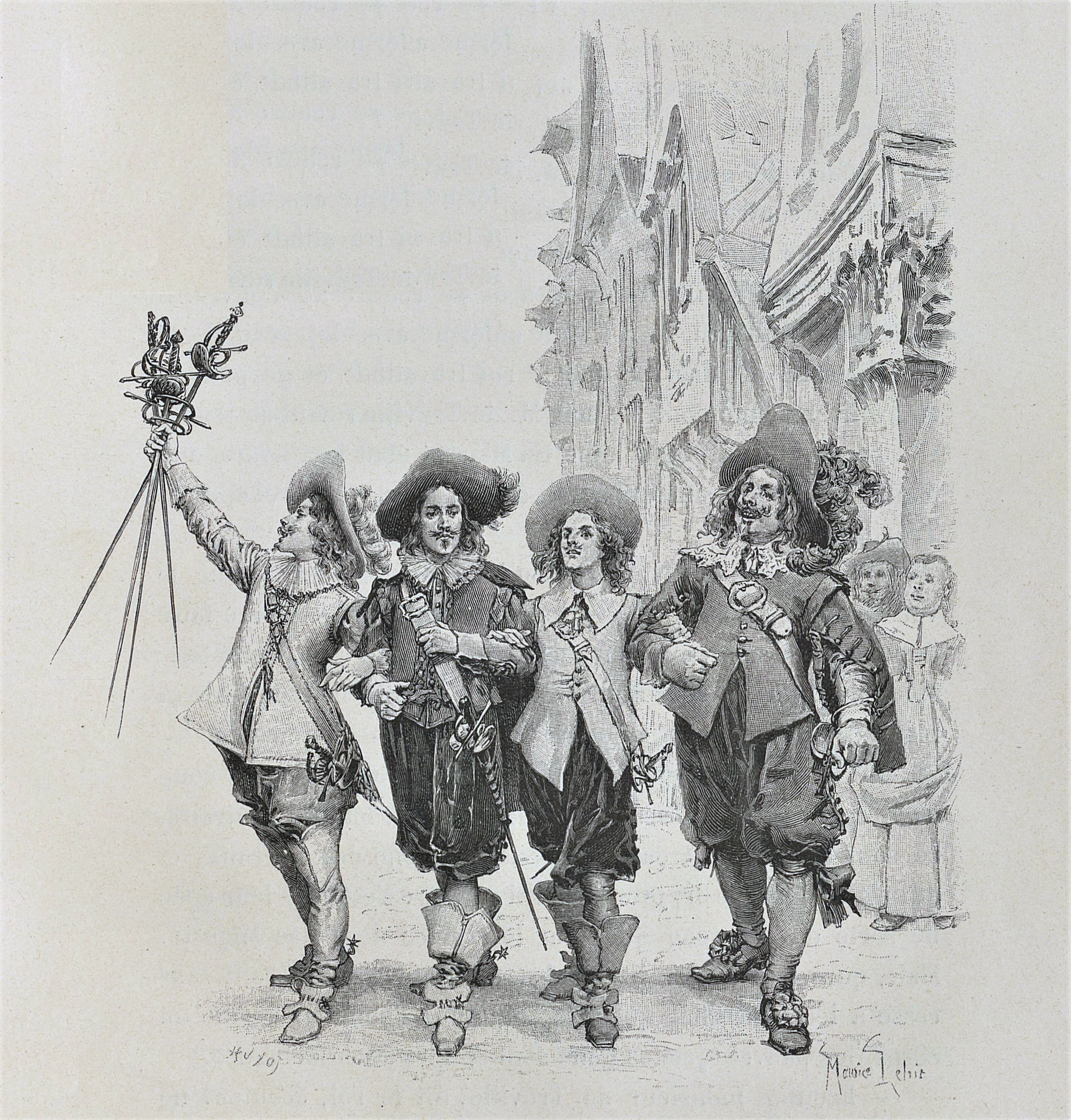
Review: THE THREE MUSKETEERS by Alexandre Dumas

book cover Original Publication Date: 1844

Genre: adventure

Topics: love, coming of age


Review by heidenkind:

Less awesome alternative title: D'Artagnan, the Early Years

A young man from Gascony sets out for Paris with big dreams, namely to join the king's personal guards, the Musketeers. He finds he can't join the Musketeers, but he does befriend three of them: Athos, Porthos, and Aramis. D'Artagnan has one weakness, which is that he falls in love constantly with incredibly unsuitable women, and this winds up getting him and his friends into trouble of the most royal kind.

It took me about six weeks to make my way through this massive book—on audio—but honestly, it didn't FEEL like six weeks. Dumas does go off on one or two tangents, but for the most part the story is so tightly told that it felt like the book was flying by even though it was long. And honestly, if it had went on forever and ever, I WOULDN'T HAVE CARED! I would have happily listened to/read this novel unto eternity, because I loved these characters so much.

D'Artagnan is the main character of the novel (obviously), and I loved how he developed over the course of the story. At first he's very unsure and eager to prove himself, and therefore extremely defensive. He's willing to challenge anyone to a duel for any slight, real or imagined. But after he makes friends with the Musketeers, it quickly become clear he's the brains of the operation. He's super-smart and even wiley, but his heart's in the right place. Most of the time.

Athos is d'Artagnan's bestie. Everyone love Athos because of his Dark Past. I won't say any more about it for fear of spoilers, but he's an awesome character. The scene where he eats and drinks an inn keeper out of house and home while defending himself against all comers is PRICELESS, I tells ye.

Porthos is a playa playa and Aramis never really says anything, so.

I can see why English people love this book, because the only main English character, the Duke of Buckingham, is a total freaking badass and I would totally hit that.

Lady de Winter--ZOMG. LOVE HER LOVE HER LOVE HER LOVE HER. She's the best villainess I've encountered since Lady Audley. She's smart, and resourceful, and I really can't blame her for being pissed at Athos and d'Artagnan and the men folk in general, but she's also SO EVIL! But I love her!

I can't believe it took me this long to read The Three Musketeers just because I was intimidated by the length. Shame on me! It's not the length of the book but the story it tells, and this one tells a rollicking, swashbuckingly, non-stop story from beginning to end. I highly recommend you read it.


Download The Three Musketeers by Alexandre Dumas at Project Gutenberg|Librivox

Monday, April 15, 2013

Review: THIS SIDE OF PARADISE by F. Scott Fitzgerald

Original Publication Date: 1920

Genre: fictional autobiography

Topics: coming of age, status, personal quest

Review by : Patty @ A Tale of Three Cities


Having read The Great Gatsby and fallen in love with Fitzgerlad's story-telling, I couldn't help but wonder whether this was a one-off experience.  
I was so mesmerised by the techniques he used, that I wanted to have more of it - and so chose to read This side of Paradise, Fitzgerald's first novel, semi-autobiographical, and the book that shot him to fame.  

Would I distinguish his brilliance already there? Would I feel the "lost generation" he so eloquently spoke about?
Fitzgerald was in his early 20s when his wrote this book, and used elements from his personal experience to draw the character of Amory Blaine: a well-off, spoilt-rotten mama's boy who grows into a sad, lonely young man, never meant to find happiness...


Having first read the Great Gatsby inevitably puts this book in a stricter, harsher light.  The writer is not yet master of his skill, so the book reads really like a very, very long description - a diary of the main character and everything that happens around him.  This is very analytical and, as it also happens to be autobiographical of Fitzgerald, it was interesting to witness first-hand his character - or lack thereof.

Because Amory is not someone who will have to strive to get ahead in life:  he's from a well-off family, with a father semi-absent and a mother who's just enjoying her personal crises.  I could sense the boredom oozing from every corner of the book and I felt really lucky I did not have such an upbringing:  Blaine cannot escape his destiny.  He's handsome, intelligent and lazy in terms of actually doing something:

"Amory wondered how people could fail to notice that he was a boy marked for glory, and when faces of the throng turned toward him and ambiguous eyes stared into his, he assumed the most romantic of expressions and walked on the air cushions that lie on the asphalts of fourteen"
I was almost ready to dismiss Amory, because I was slightly getting tired about all his "adventures" in prep school.  I could understand his quest to fit in with all the other members of high society, but I was losing interest - fast.  The drama boy was growing into a drama young man:

"I want to be admired"

But, as life proves over and over again, Amory will have to face difficulties in his life - he will eventually lose his great love to money (which, in the meantime, his family has lost), he will fail to find success in work, he will even try to "advocate" Socialism in the hope to profit from an eventual revolution.  Slowly, however, he will realise what his true self is. He's lost everything that would matter in an earlier stage - status, love, money - but now he's come to terms with what really is of essence.  

The book ends with an enigmatic claim Amory makes:  he now knows himself 
"but that is all --"
The dash at the end of that sentence, and not a full stop, is really what marks for me the turning point for Amory.  He's hit bottom, he has accepted his true self, he can no longer hide - and he's now ready to move on...

I would not say I enjoyed This Side of Paradise as much as The Great Gatsby.  While it's not a bad book, I found the inexperience of the pen failed to attract my attention. It is nevertheless a sincere portrayal of Fitzgerald, capturing his youth and his personal quests, and it made me appreciate Gatsby even more...


Download This Side of Paradise by F. Scott Fitzgerald at Project Gutenberg|Librivox|

Wednesday, December 5, 2012

Review: EIGHT COUSINS by Louisa May Alcott

Original Publication Date: 1875

Genre: Young Adults

Topics: Growing up, Morals, Child-reading, Happiness, Health


Review:

“Eight Cousins” is about Rose Campbell, a 13-year-old who shortly after becoming an orphan is put under the guardianship of  her Uncle Alec. He’s a doctor and temporarily away at sea, so until he returns Rose goes to live in “Aunt Hill”, the home of many aunts, great-aunts and seven male cousins. When we first meet her, Rose is treated by the Aunts as the frail and delicate creature every young woman of the should be, but when Uncle Alec comes back, he begins a long process towards a happier and healthier Rose, using very unorthodox methods (he was ready to burn her corset!).


I was already 30 pages in when I realized I’d already read “Eight Cousins”, many, many moons ago. I vividly remember two scenes in particular, but in my mind they became part of ”A Little Princess” (I confused my orphans…): the scene where Uncle Alec creates placebo pills from brown bread, and when he put together Rose’s room, full of exotic objects from his travels. Why these two in particular in a book full of other events? No idea.

The story is pure Alcott in it’s gentleness and focus on strong messages for young people, but it felt rather more outdated than “Little Women” and its sequels. In those more famous works, she seem to be writing for both adults and children, but this one comes across as more infantile. The moralizing and sentimentality in “Eight Cousins” (full of “little dears” that go to “little beds”, with ”little cups of broth”) become too much Tell and not enough Show. Here’s when the kinder of the Aunts tries to dissuade her sons from reading “popular stories”:
”A boot-black mustn’t use good grammar, and a newsboy must swear a little, or he wouldn't be natural,” explained Geordie, both boys ready to fight gallantly for their favourites. 
“But my sons are neither boot-blacks nor newsboys, and I object to hearing them use such words as ‘screamer,’ ‘bully,’ and ‘buster.’ In fact, I fail to see the advantage of writing books about such people unless it is done in a very different way. I cannot think they will help to refine the ragamuffins if they read them, and I’m sure they can do no good to the better class of boys, who through these books are introduced to police courts, counterfeiters’ dens, gambling houses, drinking saloons, and all sorts of low life.”
Still, Uncle Alec’s theories about what a young girl should eat, dress and be taught were radical for the time, and still refreshing now. He forbade corsets and tight belts, he recommended lots of fresh air and exercise, and defended that every girl should be educated on how to handle her financial affairs and (gasp) how her body works.
“Do you think that is a good sort of thing for her to be poking over? She is a nervous child, and I’m afraid it will be bad for her,” said Aunt Myra, watching Rose as she counted vertebrae, and waggled a hip-joint in its socket with an inquiring expression.
“An excellent study, for she enjoys it, and I mean to teach her how to manage her nerves so that they won’t be a curse to her, as many a woman’s become through ignorance or want of thought. To make a mystery or terror of these things is a mistake, and I mean Rose shall understand and respect her body so well that she won’t dare to trifle with it as most women do.”
 I've added “Rose in Bloom”, the sequel to “Eight Cousins”, to the wishlist. They are both available on Project Gutenberg.

Sunday, September 2, 2012

Review: SCARAMOUCHE by Rafael Sabatini

book cover
Original Publication Date: 1921

Genre: historical fiction

Topics: adventure, revenge, coming of age, French Revolution


Review:

"He was born with a gift of laughter and a sense that the world was mad."
--kick-ass opening sentence of Scaramouche
On the brink of the French Revolution, Andre-Louis Moreau is a cynical lawyer living in Brittany who doesn't care about politics AT ALL. His bestie, Philippe, does however, and is very involved with the political reformers of the literary cabinet. One night, the highest-ranking noble in the area, the Marquis de la Tour d'Azyr, provokes the egalitarian Philippe into a duel and kills him because he possesses a "dangerous gift of eloquence." After witnessing the murder, Andre-Louis swears to speak with the voice of his dead friend and seek justice through the destruction of the Marquis and his entire class. But how far will he go in his quest for vengeance?

I love Scaramouche! I really want to live in this novel. It's full of fabulous characters, adventure, romance, and it is definitely unputdownable. If you like reading about theater, history, men with gigantic feathered hats who bow over a lady's hand, sword fights, revenge tales, anything by Alexandre Dumas--The Count of Monte Cristo, The Three Musketeers, etc.--or a great story, you should definitely pick this book up. Even if you don't, I still think you should read it.

scaramouche
Maurice Sand as Scaramouche by Michel Levy Freres, 1860

What is a Scaramouche? you might be asking. Scaramouche is an olde-timey stock character from the Comedie Italienne, kind of like Harlequin. After Andre-Louis stirs things up in Rennes and Nantes, he has to get away from the local heat for a while; so he joins a troupe of players, where he takes on the role and the name of Scaramouche. What makes it a good name for him is that, as soon as he sets out to get justice for Philippe, Andre-Louis is playing a role--that of his friend, of Scaramouche, of a politician, etc. This is definitely an all-the-world's-a-stage sort of book, and Andre-Louis is pressed by necessity into taking on these roles; but there's also a sense that he doesn't know who he is (literally or figuratively) or what he wants until the end of the novel.

There's also a lot of conflict between generations in Scaramouche, which makes the Revolution the perfect setting for the story. Wherever Andre-Louis goes, he meets old men who are like, "Listen to your elders, young sir! That's not the way we do things around here. *huffle huffle huffle*" But Andre-Louis has his own ideas of the way things should be done (which are naturally much better than the old guys'), and the energy to put those ideas into the practice. In the same way Andre-Louis is inevitably going to get his way, France is going to fall to the force revolution.

But all that is just happening in the background. The center of the story is Andre-Louis, who tends to do bad things for the right reasons, and always seems to land on his feet. He's a strange mix of opposites--sarcastic and earnest, canny and dense, idealistic and unforgiving--but always likable and sympathetic. Rafael Sabatini takes every opportunity of making light of the people Andre-Louis meets--judges, politicians, writers, actors, academics--and it really is funny. You don't need to know anything about the French Revolution or the 18th century to recognize these characters and the humor and irony in Sabatini's prose.

As for the female characters, they wouldn't pass the Bechdel Test--this is definitely a male-centric book, and all the women fill the role of either mother, saint, or whore (in fact, that perfectly summarizes the three major female characters in this book)--but I did like all of them. They're all women who behave true to their class, but with their own motivations, and are pretty independent.

Basically, Scaramouche has everything you could possibly ever want in a novel. Have I mentioned you should most definitely read this book? You should.


You might also be interested in Alex's review of Captain Blood by Rafael Sabatini here.
Find Scaramouche on Librivox|Project Gutenberg

Wednesday, May 23, 2012

Review: MY MAN JEEVES by PG Wodehouse

book cover
Original Publication Date: 1919

Genre: humor

Topics: class, coming of age


Review:

Bertie Wooster is a lovable, wealthy young man who is totally delusional. He wouldn't be able to solve any problem if he didn't have his imaginary friend to help him out in form of Jeeves, a factotum. Basically, Jeeves is like SIRI before there were cell phones. Whenever Bertie or one of his friends is in trouble, they ask "Jeeves," who appears out of nowhere in front of Bertie and tells him and his friend how to solve their problem.

Okay, so maybe Bertie isn't delusional. OR IS HE? You don't know. My Man Jeeves is a collection of short stories in which Bertie runs into a lot of mishaps, mostly involving women, and the djinni-esque Jeeves suggests ways for him to get out it, mostly involving lying. Over half of the stories, however, have a fellow (I have adopted the nomenclature) named Reggie as the protagonist. I'm guessing this is Jeeves before he became Jeeves--otherwise, why have the stories in a book titled My Man Jeeves? These were actually more interesting than Bertie's stories, because Reggie REALLY gets himself into some scrapes.

These stories were soooo much fun. I listened to the audiobook from Librivox (read by Mark Nelson, who did a really excellent job) and giggle-snorted through every single one--which is not comfortable when you're trying to hold a yoga position, fyi.

I classify these stories as coming-of-age because nearly every one involves a member of the older generation--dad, aunt, etc.--standing between a younger person and what they want. In one, a poet wants to hang out in the country and watch bugs all day, but his aunt threatens to cut him out of her will unless he lives in NYC and tells her about the all parties he goes to. In another, a young artist feels stifled by the presence of his father's masterpiece in his house, so his wife arranges to have it stolen. Mainly these situations are played for comedic effect, but there's a definite sense that the characters are only just beginning to figure out who they are and what they want.

If you haven't read these stories yet, you should. They are super-funny and -entertaining. And as a bonus, suddenly everything on the internet makes sense.

Other reviews of My Man Jeeves at PGP: Patty from A Tale of Three Cities
Read My Man Jeeves on Project Gutenberg


Tuesday, May 8, 2012

Guest Review: A ROOM WITH A VIEW by E.M. Forster

room with a view cover
Original Publication Date: 1908

Genre: romance?

Topics: love, society, coming of age


Review by Patty from Tale of Three Cities:

Many times, the novels I've read as a teenager seem to lose their appeal when re-reading them as an adult. Others, on the contrary, gain even more allure and highlight new facets to their story.

A Room with a View by EM Forster is one such novel.  Having read it while a teenager (and watching the film about 15+ times...), I was still aware of the main characters and the overall plot, but I could not remember whether it was all that good.  

The first comment I can make on A Room with a View is definitely politically incorrect: I had the impression that I was reading a book written by a woman! I know this is ridiculous, there is no feminine or masculine way of writing, but I honestly found the writing style too focused on petty details, too romantic... too pink!!! (excuse the expression). It didn't make an impression as such, but that made me pay even more attention on the book...

Moving on, Forster presents an array of situations and happenings to showcase comparisons: the two main venues in the book are Italy and England: Italy, the land of freedom, of laughter, of endless meadows with violets, a pure beauty - in sharp contrast with stiff upper-lipped England, full of rules and regulations, with the Church imposing the norms of society, a beauty perhaps only on a first glance... I found the stereotyping very amusing, and mostly spot-on: I believe the intention here was not to shock the audience, but rather  to move across the "sensitive" subjects rather painlessly, while still making the social criticism. Very clever indeed...

Lucy and her warden Charlotte find themselves without rooms with a view in Italy. Such a dramatic event surely cannot be sustained of course, and a respectable complaint starts being heard in the Pensione.  Upon the offer by the Emersons to swap rooms with theirs that do actually have a view, we witness the hardship of  good manners, taking refuge with the vicar, and finally the obedience towards the decision taken by said priest - the fact that this coincides with the original desire of the ladies, need not bother us. First: things are not always what they seem. From the perspective of a woman who knows what her position in society is, but who nevertheless wants to accomplish (tiny) things, the procedure to follow is way too time-consuming and complicated: she has to make everyone think it was their own idea and decision, while she has been plotting the end result since the beginning... 
(the women's) mission was to inspire other to achievement rather than to achieve themselves.
Difficult times... (I really laughed when Charlotte wouldn't give the big room to Lucy because young Emerson had it - that worry for absolute protection is bound to have the opposite results).

This difference between the new generation and the established one is also a main theme in this book. Not only is Lucy rebellious in contrast with her warden Charlotte but also the two Emersons seem to differ immensely - they just don't understand one another. Only novelists are allowed to cross over to the other side, and hence we have the little devil in the story: Miss Lavish. She will inform Charlotte of all possible mischief that can befall Lucy (I believe this is how Charlotte catches Lucy in the meadow and spoils one of the best romantic scenes in literature...) but she is also the source of amusement for Cecil by writing a book on Italy that will inevitably bring George and Lucy together... (I'm starting getting the romance now...)

On to the next set of comparisons, the conservative versus the radical: the Cecils of this world, who will say to whoever will listen how radical they are, how beyond class they've become, only to prove that they keep the status quo and even worse - they are actually misanthropists:
of course, he despised the world as a whole; every thoughtful man should; it is almost a test of refinement.
Fortunately, there are also the Georges and Lucies in this world, who may stray in the beginning, when they're still trying to fit in the norms of society, only to realise that life's too short for "trying": there has to be a rebellion, and it has to be now. Not in the most articulate manner as in Lucy's breaking the engagement off, but all's well that ends well.

Although the novel is full of comparisons / antitheses, it prefers staying on the surface of the matter at the most crucial point - I was surprised when Lucy and Cecil call off their engagement, that the dialogue is plain and civil to the point of being dry - not much information is provided for the inner feelings (or lack thereof) of the two main characters. That was the only point where I felt I wanted more.

In general, I have to say the novel gave me a lot more food for thought. The characters are given much more shine and I got much more information on the main characters: I was surprised, for example, at the very unflattering light Charlotte is portrayed. I had as reference the film, where Charlotte, while a stiff old spinster, is actually a likable stiff old spinster. I did not get that feeling at all with the book. She is to be meaningless, living in a cheerless, loveless world,  
a world of precautions and barriers which may avert evil, but which do not seem to bring good...  
There is only one hint at her good soul at the very end of the book. Interesting to see the difference between writer and filmmaker...

Lucy and Cecil in Florence


For the visual interpretation of this novel, I re-watched the 1985 film by the same name, directed by James Ivory. I have to agree that the film does the novel more than justice - the points where the novel may lack in depth, are compensated by the actors' interpretation.