Showing posts with label thriller. Show all posts

Monday, September 7, 2015

Review: Countess Vera, Or Oath of Vengeance by Mrs Alex McVeigh Miller

countess veraOriginal Publication Date: 1888

Genre: Dime Novel

Topics: Abandonment, secret marriage, bigamy, premature burial, REVENGE!


Review by : Chrisbookarama

Leslie Noble finds his wife of one day dead in her room. Dead! Unwilling to live with a man who does not love her, she committed suicide. Vera Campbell had agreed to marry him to escape her Cinderella-like life of servitude to her aunt Marcia Cleveland and cousin Ivy. After her father abandoned her and her mother, they had nowhere else to go and were dependent upon their ‘kindness.’ Seventeen years of heartbreak were too much for Mrs Campbell, with her last breath she begged Leslie to marry Vera. This was the result.

Shortly after her funeral, Vera’s father (now an Earl) has returned to claim his wife and child, who he mistakenly left to fend for themselves. Too late! Both are dead. But when he unearths his child to gaze upon her face one last time, he discovers that she isn’t dead at all. He whisks her off to England to make up for lost time.

Vera keeps the secret of her marriage to herself, vowing to never remarry. She of course falls in love with a wealthy American. Angst! Then it appears that her husband has died. Yay! But just when happiness is within her reach her father dies and commands her to make an Oath of Vengeance against her cruel aunt. REVENGE!

chuck norris
Chuck Norris approves of your Oath of Vengeance

I’ve never read a dime novel before, which is a shame because this one was fun! Dime novels were cheap entertainment for the masses in the late 1800s-early 1900s. They were a lucrative business at that time. Louisa May Alcott herself wrote a few to make ends meet. The plots were sensational and usually featured a young heroine in peril.

This heroine in peril is Vera Campbell. She doesn’t have much in the personality department, but she does have ‘dark flashing eyes’ and an Oath of Vengeance. Her Aunt Marcia is the worst. She is the most evil of aunts. She could rival Cinderella’s stepmother.

cinderalla stepmother
It's an Evil Off!

The writing is not great, and apparently neither was the editing. The transcriber has a list a mile long of spelling and grammar corrections. The plot is super soapy. It’s like Days of Our Lives but with an ending. It is bonkers with premature burials, bigamy, murder-plots, poisons, and kidnappings. I loved it.

Mrs Alex McVeigh Miller (not her real name) wrote at least 80 dime novels (12 found on Project Gutenberg). A look at the synopsises reveals that some are similar in plot. Reading them could get monotonous. So, I’ll proceed with caution and space them out.  Who can resist a title like The Fatal Birthday though?

If you can put up with third person past tense, cheesy dialogue and repetitive phrases (dark eyes everywhere), you’ll enjoy this potboiler.

Download Countess Vera, or The Oath of Vengeance by Mrs Alex McVeigh Miller at Project Gutenberg

Monday, April 14, 2014

Review: The Dream Woman by Wilkie Collins

shortstoriesOriginal Publication Date: 1909 (in The Lock and Key Library, ed. by Julian Hawthorne)

Genre: short story

Topics: pick ups gone wrong, bad girls, alcoholism, murder, dreams, marriage


Review by Chrisbookarama:

The Dream Woman of Wilkie Collins story is not an angelic creature. Nope. She’s of the nightmare variety.

The Dream Woman is told in 4 parts by 3 different narrators. We are introduced to the story by Percy Fairbanks, who comes upon a groom named Francis while searching for someone to take care of his lame horse. Percy’s wife is intrigued by the man, who appears to be fighting off unseen demons. Since they’ve got time to kill, Mrs Fairbanks persuades Francis to unload his burden and tell her his troubles. It all starts with a dream…

Many years ago, while seeking employment, Francis spends a night at an inn where he has a dream that he’s being murdered by a beautiful woman. The very next year to the day, his birthday no less, he meets a mysterious woman wandering around the streets of his town at night all alone. Of course he instantly falls madly in love with the stranger, but there is something oddly familiar about her. I won’t say any more, but I think you can see where this is headed.

The Dream Woman is subtitled A Mystery in Four Narratives. There’s not much mystery though. It’s more of a tale of what happens when you pick up strangers. The dream woman is a bad girl through and through. She’s rather one note. There’s no explanation for her behaviour, she just is what she is.

The other important woman in this story, Mrs Fairbanks, is much more interesting character and we barely hear from her. It’s because of her that we hear Francis’s story and her pity that drives the plot to the end. However, it’s Percy who tells their part of the story and he has the irritating habit of winking at the reader with a, “Women! Am I right married guys?” Shut up, Percy.

The Dream Woman is a warning to dudes. Bad girls, stay away from them or they’ll make your life hell!

The Dream Woman appears in the Lock and Key Collection mentioned by Tasha in her review of The Lost Duchess.

Download The Dream Woman by Wilkie Collins at Project Gutenberg| Librivox

Tuesday, April 8, 2014

Review: THE GREAT SECRET by E. Phillips Oppenheim

book cover Original Publication Date: 1908

Genre: spy/thriller

Topics: honor, love, secrets (obvs), resurrection, Germanic horde


Review by heidenkind:

Hardross Courage is a professional cricket player. His name is LITERALLY courage (this would be more amusing if his personality was the opposite of that, but no). When playing a cricket match in London, Courage checks into the worst hotel ever, where he meets a man named Guest. HIS NAME IS LITERALLY GUEST. You following me here? It turns out Guest is dying, and there are a bunch of nasties who want to force him to tell them some sort of secret before he kicks off. When a beautiful American woman with an annoying dog convinces Courage to help Guest by letting him spend his final days at Courage's country estate, Hardross can't say no, even though he has a sneaking suspicion he's about to become embroiled in a very sticky situation.

The Great Secret is not to be confused with The Great Impersonation, also by E. Phillips Oppenheim. The man apparently really liked the word great! I thought The Great Secret a much better book than The Great Impersonation, which is crazy because I enjoyed the hell out of The Great Impersonation. Despite the annoying Courage/Guest naming, The Great Secret had a more complex plot than The Great Impersonation, well-rounded characters, and went in a direction I totally wasn't expecting.

My favorite part of The Great Secret was about halfway through the book. I really want to talk about it, but since it's pretty far into the novel, it's a little spoilery. So avert your eyes if you don't want to know...

Still there? Okay, so after Guest dies, Hardross decides to go to America to investigate. It just so happens the woman from the hotel, Adèle, is heading back to America on the same boat! And her matchmaking auntie immediately likes Courage because he's related to a bunch of muckity-muck aristocrats and pretty rich. So he's invited into their circle and discovers that one of Adèle's suitors, M. de Valentin, claims he's the rightful King of France and wants all these wealthy Americans to fund his return to the throne. And no one says, "But isn't France a republic now?" Because 'Merica. In return, de Valentin promises to turn all the wealthy Americans into dukes and duchesses and earls and stuff. They're eating this stuff up with their silver-plated spoons and Hardross is all like:

cumberbatch gif


But politely, because he has the hots for Adèle and doesn't want to tell her her friends and relatives are cucking frazy. And somehow it all leads back to an evil German plot, so there ya go!

Speaking of Adèle, she's 100x better than Rosamund, the love interest in The Great Impersonation. She's like something out of an Edward Gorey illustration—very dark and unapproachable and mysterious. I'm a sucker for Edward Gorey, so I immediately liked her. But it was when she told Hardross that she'd never been in love, never wanted to be, and that his blandishments were annoying her that I decided she was awesome. Of course, she changes her mind about Hardross inexplicably just so he can pine after her once he returns to England to save Europe from the Germanic horde; but at least at no point in the story does Hardross describe her as childlike.

I also really liked Hardross, despite his stupid last name. He's not exactly the sharpest, but he is likable and has a heart of gold.

The extremely meandery plot of The Great Secret started to lose me in the last third of the novel, and the ending is really abrupt, but overall this is a pretty damn entertaining thriller novel. My goal now is to read every Oppenheim book with the word "great" in the title.

great e phillips oppenheim novels


Download The Great Secret by E. Phillips Oppenheim at Project Gutenberg|Librivox

Wednesday, March 6, 2013

Review: THE SECRET HOUSE by Edgar Wallace

book cover Original Publication Date: 1917

Genre: mystery/thriller

Topics: blackmail


Review by heidenkind:

The Secret House might be the weirdest book I have ever read. And you know I reads me some weird books.

I'm not even going to attempt to give a summary of this book because if I did, it would be five hundred words and not make a lick of sense. Basically The Secret House is about a blackmailing scheme that this SUPER odd editor of a gossip magazine has going (he wears a veil and disappears into secret passages in his office), and his sectary, "the adventurer" Poltavo, who's cool with cashing in on that. As for the secret house, it would be more accurate to say it's a house OF secrets rather than a secret house. It's full of secret passages and has more elevators than an Otis factory.

There are several similarities between The Secret House and The Green Rust. One, it's a weird book. Two, it starts with the death of an old guy who just happens to be rich and wants to pass on his monies to a beautiful young woman who has to chose between two men: an honorable hero-type bloke and a super-sketchy foreigner. Unlike in The Green Rust, however, I didn't care at all about the hero-type guy, although there were a lot of statements by him and other characters that made me wonder if Edgar Wallace wasn't a bit of a feminist.

No, the only character I cared about in The Secret House was Count Poltavo (he became a count at some point, whatever, it happens), to the point where I pretty much convinced myself he was the hero of the book. I mean, I knew there was a 99% chance he was actually the villain, because he's Polish. And Poland is adjacent to Germany, so he's practically German and therefore most definitely a bad guy, per Wallace Logic. But I was really kind of hoping he wasn't the villain, because he was awesome. Wallace kept calling him an "adventurer," and there was definitely an Indian Jones-ish, take-no-prisoners, think-my-way-out-of-this-situation-because-I'm-super-clever-and-dashing sensibility to him. Except Wallace was using the term adventurer as an insult. AND THEN THE ENDING HAPPENED. LIKE OMG WTF? It was so ugly and horrible and I don't... I can't even... WTF?!@

Spoilers about the ending because I need to get it off my chest (highlight to read): Poltavo is captured by some stealery dudes and electrocuted to death. Like in a straight-up electric chair. Did you ever see Dead Man Walking? It was kind of like that. HORRIBLE. And then the men who killed him didn't see any retribution for it and everyone was like "Oh well."

Anyway. I might have said I liked The Secret House if it wasn't for the ending, but since the ending WAS so bad and I wish I could buy myself some brain bleach and write Wallace an angry letter, I don't recommend it.


Further Reading:


Download The Secret House by Edgar Wallace from Project Gutenberg|Librivox|Amazon

Sunday, January 6, 2013

Review: THE MAN WHO WAS THURSDAY by GK Chesterton

book cover
Original Publication Date: 1908

Genre: spy/thriller

Topics: religion, reality, politics


Review by heidenkind:


Gregory is an anarchist poet living in London. But then some guy named Gabriel Syme shows up who's ALSO an anarchist poet. Naturally Gregory is threatened by Syme, who is not only honing in on his market but probably better at both poetry and anarchy. So, to prove that he's the REAL anarchist poet, Gregory invites Syme to a meeting of anarchists, where he expects to be elected as the regional anarchist representative, known as Thursday. That's when the twists begin.

The Man Who Was Thursday is seriously one of my favorite reads of the year. Have you ever seen Dark City with Rufus Sewell, or read The Manual of Detection by Jedediah Berry? Well, The Man Who Was Thursday is kind of like that, BUT BETTER. Wikipedia calls it a "metaphysical thriller" and I TOTALLY agree with that description (even if it's slightly anachronistic). The novel has the same sensibility as metaphysical paintings by Giorgio de Chirico, from labyrinthine streets to mysterious towers and creepy figures like the man in The Child's Brain, whom I can totally picture as Sunday. Have I mentioned that I wrote my master's thesis on Giorgio de Chirico? Well, I did; and as a result I've read a lot of surrealist novels in my time, including de Chirico's own Hebdomeros. All of those books were strange, and some of them were nonsensical; but none of them were entertaining or as clever as The Man Who Was Thursday. I have a feeling de Chirico could only wish he'd been able to write a book as a good as this (fortunately he created a lot of awesome paintings, instead).

the child's brain
"The Child's Brain" by Giorgio de Chirico (title probably changed by Andre Breton, the first owner). 1917. National Museum, Stockholm.

All of this probably makes The Man Who Was Thursday sound really inaccessible and difficult to understand. It isn't. When the novel starts out, it seems like a very typical spy thriller. Syme is completely unlikable and Gregory is surprisingly sympathetic. Then everything gets turned on its head: Syme becomes AWESOME (seriously, he may be one of my favorite fictional characters of all time), and the story completely sucks you in. Still, I was only at about the halfway point before I started wondering to myself, "Is this a dream?" (The subtitle of the novel is kind of a hint that it is, but GK Chesterton is clever about twisting the meaning of the word so you're not sure.) By that point I was invested in the characters and the world and willing to go along with whatever Chesterton tossed my way.

Plus, The Man Who Was Thursday is FUNNY. There are lots of laugh-out-loud scenes, my favorite being the duel between Syme and a French anarchist. The anarchists are honestly kind of silly and hilarious. And interspersed with fun adventure are moments that are very creepy and uncanny. It's all woven together in a way that's interesting and clever and entertaining.

Probably the only thing I could say against The Man Who Was Thursday is that there is literally one woman in the entire book. But for some reason that didn't really bother me as much as it has with other books, maybe because the book is curiously asexual--I'm not sure I ever thought of the characters as "men," just characters--or perhaps because the world of novel is so fully realized that I feel like having the expectation for female characters would be nonsensical in the context of the story.

I'm still not entirely sure what the ending of The Man Who Was Thursday was supposed to mean, probably because I don't really know enough about the novel's contemporary context. Or maybe the meaning is supposed to be completely ambiguous. Either way, I enjoyed the hell out of this book and I think other people will too, especially if you like spy stories or mysteries that are slightly strange or uncanny.


Download The Man Who Was Thursday by GK Chesterton at Project Gutenberg|Librivox

Wednesday, September 19, 2012

Random Wednesday: The House of the Vampire by George Sylvester Viereck

Original Publication Date: 1907

Genre: Horror

Topics: Psychic vampires, bisexuality (sort of), art, the artistic life, New York


Review:
Reginald Clarke is not your average vampire, in fact, he takes exception to that word. He doesn’t suck the blood from your body; he steals the ideas from your mind. Any bright young thing with talent that crosses his path is a target. Clarke’s latest victim is Ernest Fielding, a New York playwright. He’s taken young Ernest under his wing and into his home. Poor Ernest has no idea how his play, one he had only dreamed up recently, ended up onstage as Clarke’s latest masterpiece. Is he losing his marbles?

I chose to listen to The House of the Vampire simply because of the title. Doesn’t it sound like a Roger Corman film starring Vincent Price? Well, it’s not really all that scary. I mean, yes, someone stealing your creativity sounds unpleasant (though when I think of some of the TV plots of series out there now, I can’t help but wish someone had sucked that idea right out of the writer’s head), but there’s no bloodshed. Clarke is creepy, in an icky uncle kind of way. He’s charming though and manages to get all these young people to live with him. Perhaps they believe he can advance their careers.
 

Man with book sitting in chair

I can haz ideas?

 
The House of the Vampire gets artsy in places and sometimes reads like a college essay. The characters discuss what is art and question whether or not there are any original ideas or do artists steal from one another all the time. Clarke just takes it to another level. I had to wonder if Viereck had a specific person in mind when he was writing Clarke. Who are the figurative vampires of artists?
 
The House of the Vampire is touted as the first gay vampire story. I don’t know about that. It’s all pretty vague. Obviously, Ernest is bisexual. He has relationships with both men and women throughout the story. The heterosexual relationship he has is the only one where talk of ‘making love,’ in the Victorian sense (“May I hold your hand? Oh, that’s nice!”), is referred. The men have “friendships.” Clarke’s sexuality, in my opinion, is neither here not there, since he’s an equal opportunist idea thief. If he wants your ideas, he doesn’t care what’s in your pants. I was impressed by the female character, Ethel, she’s no dummy. She doesn’t faint or need to be rescued. She is the only one with any sense, actually. I loved her. It did bother me that she kept calling Ernest “child.” She’s “near thirty,” seriously, she’s not an old biddy. But yay! for older ladies!! You go, girl!
 
Viereck prose does get purply; voluptuous is his favorite word. It’s a mercifully short book, so you don’t have to put up with it for too long. Although I dozed off a couple of times, I thought for the most part it was enjoyable and don’t feel like I wasted a day listening to it. The premise was interesting and the ending was unexpected. The setting of New York at the turn of the last century, with its electric lights and exciting cultural life where anyone could put on a play, made me want to go there. I just need a time machine. As long as you aren’t anticipating a traditional vampire tale, I think you’ll enjoy it too.
 
This was a LibriVox recording at just over 5 hours long. The narrator is Elizabeth Klett. She did a lovely job. Nice soothing voice. I suspect she changed venues during recording, or something, because a strange hiss appears during some sections and not in others. I didn’t mind this much though.

Monday, August 6, 2012

Basil by Wilkie Collins

Original Publication Date: 1852

Genre: Mystery

Topics: Secret marriages, classism, secrets, Victorian fears.


Review:

So… in our hands is the confession of Basil who is out on the west coast of England hiding from someone out to get him. It's all very hush, hush with fake names and the whole sha-bang. Basil starts his narrative telling us about his family, specifically his father who is super vain and proud of his lineage. Basil has an older brother, Ralph,  and a sister, Clara, too. More about them later.


One day Basil is on an ominbus and hot pretty girl walks in and sits down. He gets stalkerish, follows her home and skulks around her garden. He does a little sleuthing and finds out that the girl, Margaret Sherwin, is a wealthy linen draper's daughter. A linen draper’s daughter! The Horror! And also, he must have her! Immediately he tells the girl he's going to marry her despite her station. Here's the problem:

  1. He's known her for 5 minutes.
  2. His father is going to freak out.

Basil suggests that he marry Margaret in secret, so he has time to break the news to his father. Margaret's dad isn't too pleased with this but agrees as long as Basil doesn't 'claim' her as his wife (wink, wink) for a year, at which time she'll be 18! This has bad idea written all over it but Basil is so smitten he doesn't care.


Basil spends his evenings with Margaret and her mother as chaperon. Margaret doesn't have much personality but he attributes this to her youth and her station. He figures he can mold her into the woman he wants her to be, so it's all good. Enter Mr Mannion, Mr Sherwin's clerk. He's an enigma. He has no past, no friends or family. No one knows anything about him but he has a strange power over everyone in the house. The year is almost up and Basil still hasn't told his father of his marriage but he's optimistic. Then a scandalous event occurs and Basil is on the run. Then more secrets! and plot twists! right until the end.

The first half of Basil took me awhile to get into. The characters are one dimensional and the foreshadowing is rather obvious. At the beginning, Basil has a dream of a fair woman who makes him feel happy and a darker woman who scares him. The fair woman is clearly his sister and the darker one, Margaret. Clara is meek and gentle, blond and kind. In other words a perfect woman. I found this annoying. Basil himself annoyed me- he's such a schmuck and I didn't think anyone would marry a girl he just met without massive amounts of alcohol being involved. I don't think I'm the first one to feel that way. Collins is quite defensive in his Dedication. He insists such things happen in real life.


Basil touches on the Victorian fears of the classes intermarrying. The whole world will go hell in a hand basket if that happens! And when Basil marries Margaret, well, there you go. It's perfectly fine for his brother Ralph to have a middle class mistress though, as long as precious Clara isn't sullied by her presence.


Basil is quite the melodrama. People swoon, break out into cold sweats, and fall into nervous fevers at the drop of a hat. The bad guy is seriously bad and there is sort of a chase scene. Brother Ralph steals every scene he's in. He adds a little levity to the story. Despite all the negatives, the second half is fast paced and quite entertaining.


I suspect that Basil isn't Wilkie Collins best, but it's still pretty good.


Tuesday, May 22, 2012

The Fortieth Door by Mary Hastings Bradley

book cover
Original Publication Date: 1920

Genre: Adventure

Topics: Forbidden love, hidden identities, marriage customs, Egyptian folklore, harem life


Review:
Jack Ryder is an American archaeologist working in Egypt. He’s been persuaded by his friend Jinny to escort her to a costumed ball in Cairo. Jack is reluctant. He has no interest in balls or even women, to the point he nearly thinks girls=cooties. Jinny isn’t one to listen to excuses though, so he borrows his friend Andrew MacLean’s kilt and attends as a highlander. During the ball, he sulks around the outer fringes until his attention is caught by a mysterious girl in black veils. And she’s something else, all dark eyed loveliness and tiny enough to put in his pocket. He spins her around the dance floor a few times. Maybe girls aren’t so yucky after all.

Suddenly she dashes off but Jack is in pursuit. He follows the girl to the gates of a walled house, where he enfolds her in his arms. But wait, this is no costumed party goer! She’s Aimee, the daughter of a prosperous Muslim merchant. She’s not for you, Jack dear. Jack thinks otherwise and persuades her to see him again. Jack doesn’t know it yet but he’s about to get himself in way over his head.

I had my moments with The Fortieth Door. I wanted to see where this was all headed. I knew they’d get together, but how was this going to be accomplished? Very complicatedly. First of all, there are a lot of coincidences in this book. A LOT. I mean, come on. I wasn’t even surprised by anything after awhile. Some of it doesn’t make much sense either (that ending with the mummy? What?!) So prepare to leave your disbelief at the door.

The Fortieth Door was published in 1920 and was made into a silent film in 1924. I can see why, there is plenty of action. When there’s no action though, there’s little to say about the writing. Was Mary Hastings Bradley the Dan Brown of her time? Possibly. Bradley was a well traveled lady and had been to Egypt, which is obvious in her descriptions and some of the cultural references. She certainly chose the right time to write The Fortieth Door. In 1922, King Tut’s tomb was discovered and the Egyptian craze began.

The Fortieth Door has all the intolerance and racism you would expect for the time. All the good guys are white guys (Brits and Americans), and all the bad guys are Egyptian. Pretty much every character who wasn’t white was a baddie. It was ridiculous actually. Then there is Jack who was so irritating at times. He’s been in Egypt for 2 years, you’d think he’d have caught on to how things work. He gets angry with Aimee when she must do what her father tells her to do. Like she’s got much of a choice. Most of the time I liked Aimee. She does some brave stuff. She’s courageous and quick on her feet. It made it even more frustrating to me when Jack refers to her as a little girl or a child. Dude, did you not just see what she did there? She’s a tough cookie!

Jinny and Andrew were my favorite characters by far. Both see Jack as the reckless youth he is. They actually give Jack’s actions some perspective for the reader. Jack can be immature and thoughtless and it’s not just us who knows it. I liked how Andrew was trying to hide things from poor innocent Jinny (as he thought her), while she saw right through him and knew Jack was in deep do-do. The female characters remain strong, even though the men think they can’t handle all this danger. 

The Fortieth Door is fun despite its problems. It’s full of action and adventure. It’s dated, yes, but if you can keep your eyes from rolling out of your head, it’s enjoyable. I’d love to see that film, but it’s considered lost. Maybe someone can remake it since remakes are all the rage now, maybe Ron Howard could direct.

This review is of the LibriVox recording narrated by JM Smallheer. She puts some life in the text and does a good job with the accents. Her pronunciation is also excellent.

Thursday, February 23, 2012

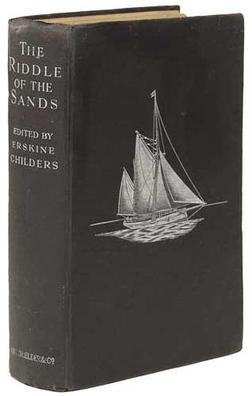
Review: THE RIDDLE OF THE SANDS by Erskine Childers

book cover
Original Publication Date: 1903

Genre: spy, thriller, adventure

Topics: sailing, espionage, Germanic horde


Review:

Carruthers is a bourgeois suit with a desultory job in London with the Foreign Office. He's feeling sorry for himself because he can't enjoy a house party with his friends, when he receives a telegram from a long-forgotten college acquaintance, Davies, inviting Carruthers to join him on his yacht. Carruthers' immediate reaction is that yachting in the Baltic at the end of September sounds like a HORRIBLE idea and he would rather choke; but a few days later, he finds himself on vacation and headed off to meet Davies, towing along a completely random collection of oddly specific items that Davies requested.

When he first arrives, Carruthers' instinct that this trip was a terrible idea seems confirmed. But he soon chills out, only to find Davies invited him to go sailing for a reason: he believes a German spy attempted to kill him in the Frisian Islands, and he needs a partner to help him figure out what the man wanted to hide.

If you picked up this book based purely on the title, you'd probably expect Riddle of the Sands to be some sort of adventure novel or archaeological mystery set in Egypt. You'd be wrong! The "sands" referred to in the title are actually a collection of sandbanks near the Frisian Islands, which are relatively uncharted and difficult to navigate. On board a tiny boat in the middle of a bunch of barren sand banks doesn't sound like the most interesting setting in the world, but the sense of isolation and difficulty Carruthers and Davies face really heightens the tension of the story. It works!

There is a lot of sailing jargon in this novel, which can be a bit difficult for those of us who don't know a jib from a forecastle (*raises hand*), but that's easily overcome because the characters are so awesome. Carruthers, our narrator and protagonist, doesn't know a thing about sailing (even though the author, Erskine Childers, clearly does), and he's so funny it's hard not to enjoy him. He's extremely fussy and a little spoiled, but underneath all his posturing and complaining he's good-hearted. If Karl from An Idiot Abroad was a Victorian gentleman, he'd be pretty similar to Carruthers.

Davies, meanwhile, is a weird combination of a bloke and a fanatic. He really only cares about one thing: sailing. Everything else tends to fall by wayside, and around people who aren't sea-worthy he's awkward, just because he has no idea what to talk about. But he's also basically a good guy, and not as dense as he first seems.

The main thing that I didn't like about Riddle of the Sands was that there were hardly any female characters. I'm a woman; I like to read books with women in them, what can I say. There was one lone female character in this story: the daughter of the German spy. But she didn't do anything; her role in the story was mainly to quell any suspicions that might crop up over Davies' heterosexuality. Or lack thereof.

Aside from that, though, as a espionage thriller this novel is pretty top-notch. Childers knew what he was talking about and put a lot of thought into what role an area like the Frisian Islands might serve in a military conflict between Germany and England, and it shows. Unlike many thrillers, Riddle of the Sands doesn't feel fantastical at all, and I'm not surprised it inspired generations of novelists as well as real-world policy enacted by politicians and military peeps.

I first head about this novel on Evangeline Holland's and Melody B's list of Downton Abbey-era fiction at Edwardian Promenade. I highly recommend you check it out!