Showing posts with label spy. Show all posts

Tuesday, April 8, 2014

Review: THE GREAT SECRET by E. Phillips Oppenheim

book cover Original Publication Date: 1908

Genre: spy/thriller

Topics: honor, love, secrets (obvs), resurrection, Germanic horde


Review by heidenkind:

Hardross Courage is a professional cricket player. His name is LITERALLY courage (this would be more amusing if his personality was the opposite of that, but no). When playing a cricket match in London, Courage checks into the worst hotel ever, where he meets a man named Guest. HIS NAME IS LITERALLY GUEST. You following me here? It turns out Guest is dying, and there are a bunch of nasties who want to force him to tell them some sort of secret before he kicks off. When a beautiful American woman with an annoying dog convinces Courage to help Guest by letting him spend his final days at Courage's country estate, Hardross can't say no, even though he has a sneaking suspicion he's about to become embroiled in a very sticky situation.

The Great Secret is not to be confused with The Great Impersonation, also by E. Phillips Oppenheim. The man apparently really liked the word great! I thought The Great Secret a much better book than The Great Impersonation, which is crazy because I enjoyed the hell out of The Great Impersonation. Despite the annoying Courage/Guest naming, The Great Secret had a more complex plot than The Great Impersonation, well-rounded characters, and went in a direction I totally wasn't expecting.

My favorite part of The Great Secret was about halfway through the book. I really want to talk about it, but since it's pretty far into the novel, it's a little spoilery. So avert your eyes if you don't want to know...

Still there? Okay, so after Guest dies, Hardross decides to go to America to investigate. It just so happens the woman from the hotel, Adèle, is heading back to America on the same boat! And her matchmaking auntie immediately likes Courage because he's related to a bunch of muckity-muck aristocrats and pretty rich. So he's invited into their circle and discovers that one of Adèle's suitors, M. de Valentin, claims he's the rightful King of France and wants all these wealthy Americans to fund his return to the throne. And no one says, "But isn't France a republic now?" Because 'Merica. In return, de Valentin promises to turn all the wealthy Americans into dukes and duchesses and earls and stuff. They're eating this stuff up with their silver-plated spoons and Hardross is all like:

cumberbatch gif


But politely, because he has the hots for Adèle and doesn't want to tell her her friends and relatives are cucking frazy. And somehow it all leads back to an evil German plot, so there ya go!

Speaking of Adèle, she's 100x better than Rosamund, the love interest in The Great Impersonation. She's like something out of an Edward Gorey illustration—very dark and unapproachable and mysterious. I'm a sucker for Edward Gorey, so I immediately liked her. But it was when she told Hardross that she'd never been in love, never wanted to be, and that his blandishments were annoying her that I decided she was awesome. Of course, she changes her mind about Hardross inexplicably just so he can pine after her once he returns to England to save Europe from the Germanic horde; but at least at no point in the story does Hardross describe her as childlike.

I also really liked Hardross, despite his stupid last name. He's not exactly the sharpest, but he is likable and has a heart of gold.

The extremely meandery plot of The Great Secret started to lose me in the last third of the novel, and the ending is really abrupt, but overall this is a pretty damn entertaining thriller novel. My goal now is to read every Oppenheim book with the word "great" in the title.

great e phillips oppenheim novels


Download The Great Secret by E. Phillips Oppenheim at Project Gutenberg|Librivox

Monday, July 1, 2013

Review of THE SECRET ADVERSARY by Agatha Christie

book cover Original Publication Date: 1922

Genre: mystery, adventure
 
Topics: espionage, wwi, love, master criminal


Review by heidenkind:


Tommy and Tuppence are old friends who run into one another in post-WWI London and find themselves in the same boat: they're broke, unable to find work, and on the verge of being thrown out of their respective abodes. As they're musing over their impecunious fortunes, Tuppence has an idea: they should start their own business and be professional adventurers! Tommy agrees to put an ad in the paper just to humor her, but no sooner do they part ways than Tuppence receives a job offer from a very suspicious bloke. Beggars can't be choosers, however, so Tuppence agrees to accept a retainer, and in short order she and Tommy are sucked into a world of international intrigue, missing documents, spies, and master criminals. And that's just in the first few chapters!

This is only the third Agatha Christie novel I've read. The other two were Murder on the Orient Express, which was very good but didn't inspire me to read more Hercule Poirot books; and The Mysterious Affair at Styles, which was just okay. So I wasn't expecting to be wowed by The Secret Adversary.

BUT I TOTALLY WAS.

The Secret Adversary is a very different type of book from Christie's Hercule Poirot novels. For one, it's hilarious. Whenever Tommy and Tuppence get together there's snappy, clever dialog, and the story is delightfully ridiculous with plenty of opportunities for hijinks. The coincidences in this novel are just mind-boggling, but whatever. As long as Tommy and Tuppence continue having adventures, Christie can throw as many incredible happenstances into this book as she wants.

Speaking of Tommy and Tuppence... I LOVE THEM! I need my own Tommy and Tuppence to hang with, you guys. I AM SERIOUS. The other characters in the book are also really fun, from Julius P. Hersheimmer, the American billionaire, to Albert, the elevator operator who loves gangster movies.

As for the mystery, it worked surprisingly well considering the pool of suspects consists of basically two, possibly three, men. Christie does a great job of planting red herrings that had me thinking I knew who Mr. Brown—the criminal mastermind—was, but at the same time not being quite sure.

The Secret Adversary is in no way a realistic book. It is a proudly fluffy, sublimely ridiculous tale. In a lot of ways it reminded me of The Man Who Was Thursday (which I loved), only much less metaphysical: the cabal organization, run by a mysterious man who is everywhere yet whom no one has ever seen; a series of fun, entertaining adventures; and then everyone lives happily ever after. In a word, delightful.

I can't wait to read all of Tommy and Tuppence's other stories! If you haven't read anything by Christie before, The Secret Adversary is a great place to start.


Download The Secret Adversary by Agatha Christie at Project Gutenberg

Sunday, January 6, 2013

Review: THE MAN WHO WAS THURSDAY by GK Chesterton

book cover
Original Publication Date: 1908

Genre: spy/thriller

Topics: religion, reality, politics


Review by heidenkind:


Gregory is an anarchist poet living in London. But then some guy named Gabriel Syme shows up who's ALSO an anarchist poet. Naturally Gregory is threatened by Syme, who is not only honing in on his market but probably better at both poetry and anarchy. So, to prove that he's the REAL anarchist poet, Gregory invites Syme to a meeting of anarchists, where he expects to be elected as the regional anarchist representative, known as Thursday. That's when the twists begin.

The Man Who Was Thursday is seriously one of my favorite reads of the year. Have you ever seen Dark City with Rufus Sewell, or read The Manual of Detection by Jedediah Berry? Well, The Man Who Was Thursday is kind of like that, BUT BETTER. Wikipedia calls it a "metaphysical thriller" and I TOTALLY agree with that description (even if it's slightly anachronistic). The novel has the same sensibility as metaphysical paintings by Giorgio de Chirico, from labyrinthine streets to mysterious towers and creepy figures like the man in The Child's Brain, whom I can totally picture as Sunday. Have I mentioned that I wrote my master's thesis on Giorgio de Chirico? Well, I did; and as a result I've read a lot of surrealist novels in my time, including de Chirico's own Hebdomeros. All of those books were strange, and some of them were nonsensical; but none of them were entertaining or as clever as The Man Who Was Thursday. I have a feeling de Chirico could only wish he'd been able to write a book as a good as this (fortunately he created a lot of awesome paintings, instead).

the child's brain
"The Child's Brain" by Giorgio de Chirico (title probably changed by Andre Breton, the first owner). 1917. National Museum, Stockholm.

All of this probably makes The Man Who Was Thursday sound really inaccessible and difficult to understand. It isn't. When the novel starts out, it seems like a very typical spy thriller. Syme is completely unlikable and Gregory is surprisingly sympathetic. Then everything gets turned on its head: Syme becomes AWESOME (seriously, he may be one of my favorite fictional characters of all time), and the story completely sucks you in. Still, I was only at about the halfway point before I started wondering to myself, "Is this a dream?" (The subtitle of the novel is kind of a hint that it is, but GK Chesterton is clever about twisting the meaning of the word so you're not sure.) By that point I was invested in the characters and the world and willing to go along with whatever Chesterton tossed my way.

Plus, The Man Who Was Thursday is FUNNY. There are lots of laugh-out-loud scenes, my favorite being the duel between Syme and a French anarchist. The anarchists are honestly kind of silly and hilarious. And interspersed with fun adventure are moments that are very creepy and uncanny. It's all woven together in a way that's interesting and clever and entertaining.

Probably the only thing I could say against The Man Who Was Thursday is that there is literally one woman in the entire book. But for some reason that didn't really bother me as much as it has with other books, maybe because the book is curiously asexual--I'm not sure I ever thought of the characters as "men," just characters--or perhaps because the world of novel is so fully realized that I feel like having the expectation for female characters would be nonsensical in the context of the story.

I'm still not entirely sure what the ending of The Man Who Was Thursday was supposed to mean, probably because I don't really know enough about the novel's contemporary context. Or maybe the meaning is supposed to be completely ambiguous. Either way, I enjoyed the hell out of this book and I think other people will too, especially if you like spy stories or mysteries that are slightly strange or uncanny.


Download The Man Who Was Thursday by GK Chesterton at Project Gutenberg|Librivox

Thursday, February 23, 2012

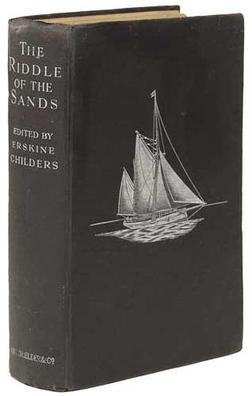
Review: THE RIDDLE OF THE SANDS by Erskine Childers

book cover
Original Publication Date: 1903

Genre: spy, thriller, adventure

Topics: sailing, espionage, Germanic horde


Review:

Carruthers is a bourgeois suit with a desultory job in London with the Foreign Office. He's feeling sorry for himself because he can't enjoy a house party with his friends, when he receives a telegram from a long-forgotten college acquaintance, Davies, inviting Carruthers to join him on his yacht. Carruthers' immediate reaction is that yachting in the Baltic at the end of September sounds like a HORRIBLE idea and he would rather choke; but a few days later, he finds himself on vacation and headed off to meet Davies, towing along a completely random collection of oddly specific items that Davies requested.

When he first arrives, Carruthers' instinct that this trip was a terrible idea seems confirmed. But he soon chills out, only to find Davies invited him to go sailing for a reason: he believes a German spy attempted to kill him in the Frisian Islands, and he needs a partner to help him figure out what the man wanted to hide.

If you picked up this book based purely on the title, you'd probably expect Riddle of the Sands to be some sort of adventure novel or archaeological mystery set in Egypt. You'd be wrong! The "sands" referred to in the title are actually a collection of sandbanks near the Frisian Islands, which are relatively uncharted and difficult to navigate. On board a tiny boat in the middle of a bunch of barren sand banks doesn't sound like the most interesting setting in the world, but the sense of isolation and difficulty Carruthers and Davies face really heightens the tension of the story. It works!

There is a lot of sailing jargon in this novel, which can be a bit difficult for those of us who don't know a jib from a forecastle (*raises hand*), but that's easily overcome because the characters are so awesome. Carruthers, our narrator and protagonist, doesn't know a thing about sailing (even though the author, Erskine Childers, clearly does), and he's so funny it's hard not to enjoy him. He's extremely fussy and a little spoiled, but underneath all his posturing and complaining he's good-hearted. If Karl from An Idiot Abroad was a Victorian gentleman, he'd be pretty similar to Carruthers.

Davies, meanwhile, is a weird combination of a bloke and a fanatic. He really only cares about one thing: sailing. Everything else tends to fall by wayside, and around people who aren't sea-worthy he's awkward, just because he has no idea what to talk about. But he's also basically a good guy, and not as dense as he first seems.

The main thing that I didn't like about Riddle of the Sands was that there were hardly any female characters. I'm a woman; I like to read books with women in them, what can I say. There was one lone female character in this story: the daughter of the German spy. But she didn't do anything; her role in the story was mainly to quell any suspicions that might crop up over Davies' heterosexuality. Or lack thereof.

Aside from that, though, as a espionage thriller this novel is pretty top-notch. Childers knew what he was talking about and put a lot of thought into what role an area like the Frisian Islands might serve in a military conflict between Germany and England, and it shows. Unlike many thrillers, Riddle of the Sands doesn't feel fantastical at all, and I'm not surprised it inspired generations of novelists as well as real-world policy enacted by politicians and military peeps.

I first head about this novel on Evangeline Holland's and Melody B's list of Downton Abbey-era fiction at Edwardian Promenade. I highly recommend you check it out!