Showing posts with label feminism. Show all posts

Monday, February 23, 2015

Review: An English Woman-Sergeant In the Serbian Army by Flora Sandes

 englishwomansergeant_serbianarmy_1407

Original Publication Date: 1916

Genre: Memoir

Topics: Army life, World War I, Serbia, British nurses, soldiers, women soldiers, sisters doing it for themselves, smoking-drinking-shooting

Review by : Chrisbookarama

Have you ever stumbling across something by accident and then instantly became obsessed with it? That is me right now with Flora Sandes. Obsessed! I was just minding my own business, scrolling through the Librivox catalogue, when I came across An English Woman-Sergeant In the Serbian Army. Well, I thought, this sounds intriguing. I started listening and couldn’t believe my ears. Is this real life? Was Flora Sandes a real person? I had to find out for sure. Fool me once, Public Domain! And it was true! This really happened!

flora sandes

Flora begins her story with herself travelling back to Serbia after a brief vacation from the action during World War I. England was an ally to Serbia. Serbians needed all the help they could get. Flora volunteered to be a nurse with St John Ambulance. She quickly became a favorite with the men. She’d smoke, drink, and share a laugh with them, as well as hold their hands as they died.

Flora decided early on to stick with the Serbian Army even though she was British. The Serbians’ ideas about women in the combat were more enlightened than the Brits’. She travelled with the army while they retreated from the Austrian advance, taking care of the wounded and sick men. At some point Flora is asked to make a choice.

They said the journey through Albania would be very terrible, that nothing we had gone through so far was anything approaching it, and that they would send me down to Salonica if I liked.

Flora says Yes! to Albania, though they find the locals very hostile to their presence. They get fired upon a lot. But here Flora finally gets to be a real soldier and holds her own against the enemy.

I had only a revolver and no rifle of my own at that time, but one of my comrades was quite satisfied to lend me his and curl himself up and smoke.

It isn’t all shooting dudes all day long though. The Serbians were constantly on the move. Along the road Flora saw the corpses of horses that died of starvation or exhaustion. The men themselves weren’t doing so good, as the locals put up the prices of food when the soldiers arrive in their towns.

As for the men, they showed her great respect. She says she expected resistance, but never experienced it, even in her interactions with the British commanders. Her Serbian commander makes her a corporal, and eventually a sergeant, making her the only woman to officially serve in the Serbian Army during World War I.

flora and her men

An English Woman-Sergeant In the Serbian Army ends unexpectedly, but this is because Flora wrote it in 1916, while the war was still ongoing, to raise funds for the Serbian Army. Flora ain’t got time for writing memoirs. The writing is what you would expect from a woman like Flora: to the point, honest, unadorned. It’s also pretty short. In 1927, she wrote her autobiography, An Autobiography of a Woman Soldier. I will be reading that, I can tell you.

The only thing I didn’t like about this memoir was the patronizing introduction by a Serbian politician:

But she only took to a rifle when there was no more nursing to be done, as, owing to the Army retreating, the wounded could not be picked up and had to be left behind.

No, dude, she would have “took to a rifle” if that had been an option from the start.

Here are some facts about Flora:

  • She was 38 when World War I began, 40 when she wrote this memoir. (Yay!)
  • After the war, she married a Russian soldier 12 years younger than herself. (Get it, girl!)
  • They lived in Serbia until he died in 1941.
  • When World War II broke out, she joined the army again. She was 65. (A Boss!)
  • The Nazis imprisoned her. (Oh no they didn’t!)
  • She moved back to England and drove around in a motorized wheelchair until she died at age 80. (Only death could stop her.)

Project Gutenberg doesn’t have the text but The University of Toronto has a text version.

Download An English Woman-Sergeant In the Serbian Army by Flora Sandes at |Librivox|

Thursday, September 11, 2014

Review: The Grey Woman by Elizabeth Gaskell

 Grey_Woman_1010
Original Publication Date: 1861

Genre: Gothic short story

Topics: Marriage, murder, secrets, on the run, gender bending.


Review by : Chrisbookarama

The Grey Woman is an excellent Gothic story with a Bluebeard twist. There’s a castle, a damsel in distress, and a husband with a secret. However, the hero of this story isn’t a dude on a white horse but a bad ass older woman: Amante.

A traveller visits a mill/coffeehouse in Germany and notices a portrait of a pale lady.
“It was that of a young girl of extreme beauty; evidently of middle rank. There was a sensitive refinement in her face, as if she almost shrank from the gaze which, of necessity, the painter must have fixed upon her.”
The traveller asks to know her story. The owner replies, “Well, it just so happens that she was my great-aunt Anna and she wrote a manuscript explaining how she ended up so white. Here, read it.” As you do. The traveller sets down to read it, then the story is told in The Grey Woman’s own words.

When Anna was a young lass, her father remarried and the new lady of the house was anxious to get rid of her. Instead of marrying a local yokel, Anna accepts an invitation to her rich friend Sophie’s estate where she meets a handsome French stranger. Monsieur de la Tourelle appears to be a gentleman. He has his sights on Anna. She dances with him at parties when he asks. She’s too shy and overcome by his charms to say no.

tourelle
Anna, you in danger girl!

One day Sophie’s mother tells Anna that she’s written to her father about her impending engagement. Anna is shocked! How could she be getting engaged and not even know it?! She’s informed that it’s too late for protests now. Anna received Monsieur de la Tourelle’s attentions without complaint and that means she’s given herself for life to a perfect stranger. Oh well, what can you do when it’s 1789 and women have no rights. *shrug*

So Anna marries her Frenchman and he ships her off to some castle in the middle of nowhere with no friends or family. He immediately exhibits signs of an abuser. He demands that she keep to only one area of their home where he can keep an eye on her. He’s jealous of even her love of her family and she is never allowed to visit them. Unsurprisingly, she becomes depressed.

In an uncharacteristic act of compassion, Monsieur hires a lady’s maid to keep her company. Amante “tall and handsome, though upwards of forty” instantly takes on the role of Anna’s bodyguard. She runs interference between Anna and the surly servants. Amante is especially helpful now that Anna is pregnant.

Amante discovers that Anna isn’t getting her mail and the two hatch a plan to break into Monsieur’s apartments to retrieve them. In the process, Anna learns her husband’s secret, a secret so terrible that it sends Anna and Amante into hiding!

Amante is The Boss! She’s quick thinking and always one step ahead of the bad guys. She protects her mistress with her life, even changing her identity to protect her. The pair have many hair raising close calls but Amante keeps her head. Talk about a Strong Female Character! Amante is it.

mrs s
Amante: Possible prototype for Mrs S of Orphan Black? 

As for Anna, I’m not sure why she inspires such devotion but the heart wants what the heart wants, I guess. Perhaps it was because of the baby. Amante did love that baby.

Part of why I love blogging for Project Gutenberg Project is discovering long lost gems like this The Grey Woman. Sure, it’s soapy and melodramatic with a Villainous Villain but it’s pure entertainment with some feminism thrown in. Anna and Amante, a disobedient wife and a maid, outwit and outrun ruffians. Courage and cleverness rule the day.

This was another Librivox recording I took in. Jane Greensmith narrates the short story.

Download The Grey Woman by Elizabeth Gaskell at Project Gutenberg|Librivox|

Thursday, June 26, 2014

Review: Patricia Brent, Spinster – Herbert Jenkins

Original Publication Date: 1908
Genre: 20th century English literature
Topics: Marriage, spinster, domestic, boarding house

Review by : Liz Inskip-Paulk at Just One More Page


Published in 1918 by his own publishing company, Herbert Jenkins’s novel, Patricia Brent, Spinster, was a pretty fast read once it got going. It’s a plot that’s been well used before: an unmarried young woman (about early 20’s) lives in a boarding house with the usual cast of misanthropes and narrow-minded “paying guests” having to eat a rotating menu that never changes (similar to how many of their own lives play out, it seems). Small talk and gossip rule the day, and so young Patricia Brent decides that she can’t take the monotony anymore and invents a fiancé for herself.

As the story continues, Brent leaves the boarding house for dinner with her “fiancé” at a well-known restaurant in London without having the faintest idea of how this will turn out in the end. Fortune smiles on her, and she meets a young army officer who, serendipitously, is also dining alone and willing to play along with her plan. Days and weeks go by and the fake fiancé really ends up falling in love with her, except she decides that she can’t have someone actually fall in love with her and rejects him, despite all his intentions otherwise.
His family become involved, his sister comes up with a strategy to make Patricia become more attracted to her brother (the fiancé) and so it goes. It was an ok read, but Patricia was pretty unreasonable in how she acts with the friendly fake fiancé and rejects him for little reason apart from he likes her (which wasn’t in the plan).
It’s a caper novel, which worked for the most part, although at times, I rolled my eyes at the female protagonist’s immature behavior. However, this was written back in 1918 and it’s pretty true to the times for some people (regardless of gender), I would think. Author Jenkins also owned the publishing company who first started to publish all the P. G. Wodehouse spoofs so I don’t think this volume was intended to be deep and meaningful.
It was not a bad read, by any means, but it was somewhat more superficial than I had thought it was going to be. It was a bit uncomfortable to read at times as it was SO mean towards innocent people at times.

Download Patricia Brent, Spinster by Herbert Jenkins at Project Gutenberg|Librivox|

Monday, April 29, 2013

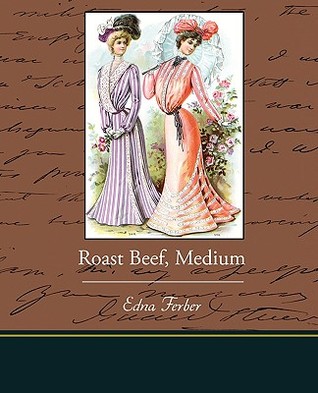
Review: ROAST BEEF, MEDIUM by Edna Ferber

Original Publication Date: 1913

Genre: fiction, adventure

Topics: women, feminist, single mother, independence


Review by : Patty @ A Tale of Three Cities


Roast Beef, Medium by Edna Ferber is simply a great read:  the compelling adventures of an independent woman, out to earn the respect she deserves, single-handedly winning over her male colleagues, while raising  her son on her own.  Simple, little story?  Absolutely not - this is 1913...

While this book could well make the case for being a feminist one, I did not feel this:  there is still a fine line between emerging feminist thoughts and nostalgia for the traditional roles in society expressed by Emma McChesney, our heroine.  I would just say it's a novel way ahead of its time:  Her "adventures" could well have taken place in modern times, which made me wonder:  if these descriptions apply today and the problems are still in existence today, what was the situation back in 1913?  How could Emma, any Emma, survive, when even today women can still fail facing such challenges?

I liked that the book is split in chapters focusing on a type of adventure.  I believe it gets us to know all facets of Emma's life, from the purely professional to the purely personal and all in between.
Emma has been now working for 10 years as a salesperson (to be politically correct) at a firm selling petticoats.  She married young, divorced not too long afterwards and has been left on her own ever since to struggle for herself and her son, Jock.

We follow her as she makes her way across the country (in those days, there was no wireless communication, so everything was carried out on a person-to-person basis...).  Emma has done it all, seen it all - that's why she sticks with a roast beef, medium:  once you have witnessed all of life's ups and downs, you get to appreciate life's staples, the standard values that, though unexciting, will serve you very well and provide a much-needed cushion from the world's troubles.  

"it's all very well to trifle with the little side-dishes at first, but there comes a time when you've got to quit fooling with the minced chicken, and the imitation lamb chops of this world, and settle down to plain, everyday, roast beef, medium. That other stuff may tickle your palate for a while, but sooner or later it will turn on you, and ruin your moral digestion"

The simile is spot-on and I really appreciated the simplicity with which Ferber can make her point.  How many times have I declined the flavour of the month in whichever domain, because I know I can rely to the tried-and-tested values that will remain true for the future?

Emma has to deal with her male competitors, who do not expect her to last long (funny, given she outwits them all...).  She has a "mentor" in her boss, who is the first to see through her and realise the potential she has.  From then, everyone else is an obstacle Emma can surely tackle, over and over again:

"now, a man would -""But I'm not a man", interrupted Emma McChesney. "I'm only doing a man's work and earning a man's salary and demanding to be treated with as much consideration as you'd show a man"

And yes, we're still in 1913, however much this could be said in 2013 as well (the realisation that the novel is 100 years old just hit me - not much progress in this respect, eh?)

There is a favourable disposition vis-a-vis Emma.  However much she's shown to struggle through life's adventures, she always manages to save the day and her composure:  
Long practice had made her perfect in the art.
Her only weakness is her son, but this is a tough love - she's not scared to let him know what the truth is:

Your mother is a working woman, Jock.  You don't like that idea, do yo?  But you don't mind spending the money that the working woman provides you with, do you?

And, of course, among everything else, there is always a suspicion of a love interest... Be it her fellow salespersons who want to just have a good time during their visits to all these remote towns, to her new boss, who could have honest intentions (the ending is not revealed, so the jury's out on this!).  But, Ferber is very good at keeping our interest alive throughout the pages:  she know she has a lonely heroine and she knows we want her to find someone, and at every chance she gets, she just loves to play with this idea:

"Great, ain't it?" said a voice in the darkness. (Nay, reader.  A woman's voice)

Emma will rise up the corporate ladder and ensure the company's future by innovative products - a relatively believable ending, not too exciting but remarkable nevertheless.  This book was a very nice discovery, truly recommended for an insight into the makings of independent women...


Download Roast Beef, medium by Edna Ferber at Project Gutenberg|Librivox|Girlebooks

Thursday, April 4, 2013

VERA by Elizabeth von Arnim

book cover Original Publication Date: 1921

Genre: satire/comedy

Topics: love, marriage, feminism, Gothic


By heidenkind

Ten signs you shouldn't marry that guy you're going to marry according to Elizabeth von Arnim:

  • He's old enough to be your father.
  • Your friends hate him. ALL your friends.
  • Your family also hates him; but even worse, he doesn't give a shit if they do or not.
  • When he talks politics, he bears an eerie resemblance to Dick Cheney.
  • His last wife died under mysterious circumstances.
  • The only thing that upsets him about this is it infringes on his schedule.
  • He has absolutely no imagination.
  • Or sense of humor.
  • He reminds you of a two-year-old, but requires even more attention.
  • His library consists entirely of expensive books he bought in bulk, keeps locked behind glass, has never read, and has no intention of ever reading.


Vera is often called a satire of Gothic romance in summaries of the novel, and it is--but not in a silly Airplane! sort of way, more in a here's-what-it-would-really-be-like-bitches sort of way. It's the story of Lucy, a young girl who meets Everard Wemyss literally hours after her father has died, leaving her an orphan. It goes without saying she's in a vulnerable state. Coincidentally, Wemyss himself has recently lost his wife, Vera, under mysterious circumstances. Was it suicide or an accident? No one really knows, but the two deaths pull Everard and Lucy together. It's almost like they're meant to be! But how long will Lucy survive once Everard takes her back to his ominous estate and the site of Vera's death?

What makes Vera different from other Gothic romances--such as, for example, Rebecca--is that Everard really is as awful as he seems. Worse, actually. The man has no redeeming qualities WHATSOEVER. He's a narcissistic, selfish bastard and an emotional vampire. Lucy's constant excuses for his controlling behavior and acceptance of his insults are MIND BOGGLING.

I know right now you're thinking Vera is probably depressing, but weirdly it's not. It is actually funny, if only because Arnim is so clever and takes such delight in making us hate Everard (fun fact: he is supposedly based on her second husband). You also can't help but laugh at Everard because he is so ridiculously awful.

I'm not sure I would recommend Vera to fans of Rebecca, because the purpose of the two books is completely different, despite the similarities in plot. I would definitely recommend it to people who enjoyed The Yellow Wallpaper by Charlotte Perkins Gilman, found Twilight infuriating, or if the heroes of Gothic romances annoy you with their douchey-ness. It is a really good book.


Download Vera by Elizabeth von Arnim at GirleBooks|Librivox|Project Gutenberg

Tuesday, December 18, 2012

Review: THE YELLOW WALLPAPER by Charlotte Perkins Gilman

book cover
Original Publication Date: 1892

Genre: short story

Topics: feminism, madness


Review by heidenkind:

THE PAPER, THE OMINOUS WALLPAPER.

A young wife is sentenced to forced inactivity by her husband and doctor because she has a predilection for hysterics. Left alone in a room with incredibly ugly wallpaper, she gradually goes mad.

For the longest time I was under the impression The Yellow Wallpaper was a novel--so much has been written about it, much more than the actual story itself, which is actually pretty short. But The Yellow Wallpaper definitely packs a punch. I don't know about y'all, but if I was trapped in a room all day, I'd definitely go crazy, with or without ugly wallpaper. Although the wallpaper certainly wouldn't help.

yellow wallpaper comic

The wallpaper, of course, is a metaphor. Personally I think it represents the outside world. At first the narrator wants to change the wallpaper, but her hubby is like, "If we change the wallpaper in here, then we'll have to change in it the kitchen, and the living room, and the dining room [strange that he assumes she'll want to redecorate rooms she's not allowed to go into]; besides, we're just renting this house! Can't you deal with the wallpaper for a little while longer?" No one give this guy a copy of If You Give a Mouse a Cookie, he'd go crazy with it. Since his wife can't exercise any control over her own small sphere and change the wallpaper that she hates, she retreats into her own mind.

I also found the role of Jennie really interesting in this story. Apparently she's the housekeeper or some sort of servant, but she's allowed much more leeway than the narrator is. Was Charlotte Perkins Gilman making some sort of statement about class and the oppression of women? If she was saying lower class women enjoyed more freedom than upper-class women, I'd have to say that's patently ridiculous. However, Gilman might simply be making a statement about the importance of women contributing to society through work.

This was a very well-written story that fostered a feeling of paranoia and reminded me a lot of The Bell Jar, which I read in high school. It has a Gothic feeling to it, what with the untrustworthy servants and suspicious husband, and ominous house. I kind of wish we'd read this in high school instead of The Bell Jar.


Download The Yellow Wallpaper by Charlotte Perkins Gilman at Librivox|Project Gutenberg