Showing posts with label civilization versus savagery. Show all posts

Wednesday, April 2, 2014

Review: THE PIRATES OF ERSATZ by Murray Leinster

book cover Original Publication Date: 1959

Genre: science fiction

Topics: Pirates, economics, civilization, technology, coming-of-age, adventure


Review by heidenkind:

ersatz (adjective): 1. (of a product) made or used as a substitute, typically an inferior one, for something else; 2. not real or genuine.

Bron Hoddan is not a pirate, but he comes from pirates. Instead of following in his family's footsteps, he's decided to try to make his fortune honestly, as an engineer on the most civilized planet in the galaxy, Walden. Unfortunately, the people of Walden aren't interested in his inventions, and when Bron tries to press the issue, they arrest him for creating death rays. WHOMP WHOMP. Fed up with Walden, Bron escapes with the help of the most awesome ambassador ever. But it's only when he meets a band of outcasts like himself that he has an opportunity to accomplish great things, grow rich, marry some delightful girl, and be a great man... somewhere.

I decided to listen to The Pirates of Ersatz because it's narrated by Elliot Miller, the same Librivox narrator who read The Poisoned Pen. Also: Pirates! Who doesn't love pirates? Those lovable scamps. Even though these aren't "real" pirates, they certainly do act like them most of the time. That being said, The Pirates of Ersatz is mainly an adventure novel and coming-of-age tale: Bron goes to a wild, uncivilized world called Zan and discovers his place in the world.

Some of the more interesting parts of the novel are where the characters posit theories about civilization and economics that, despite the fact that they're coming at me from a serialized science fiction novel, I kiiiiind of buy into? Like, even if they're not true, THEY SHOULD BE. Here are some of my favorites:

"Do you realize," [the ambassador] asked, "that the whole purpose of civilization is to take the surprises out of life, so one can be bored to death? ...Government, in the local or planetary sense of the word, is an organization for the suppression of adventure. Taxes are, in part, the insurance premiums one pays for protection against the unpredictable."

"I tell y', piracy's what keeps the galaxy's business thriving! Everybody knows business suffers when retail trade slacks down. It backs up the movement of inventories. They get too big. That backs up orders to the factories. They lay off men. And when men are laid off they don't have money to spend, so retail trade slacks off some more, and that backs up inventories some more, and that backs up orders to factories and makes unemployment and hurts retail trade again...
"But suppose somebody pirates a ship? The owners don't lose. It's insured. They order another ship built right away. Men get hired to build it and they're paid money to spend in retail trade and that moves inventories and industry picks up. More'n that, more people insure against piracy. Insurance companies hire more clerks and bookkeepers. They get more money for retail trade and to move inventories and keep factories going and get more people hired.... Y'see? It's piracy that keeps business in this galaxy goin'!"

Okay, twist my arm, I'll take up piracy. There are similar passages about technology and engineering, since Bron is an engineer. If you're thinking they slow down the story, you'd be right. But there's not a lot of them, and they do become relevant later on.

Aside from Murray Leinster's economic theorizing, there's a lot to like about The Pirates of Ersatz. Both of the characters quoted above—the Ambassador and Bron's grandfather—are awesome, as is Fani, the woman who's obviously sweet on Bron (obvious to everyone except him). And then there's Bron himself—he's like a sci-fi version of Robin Hood (have I mentioned I'm a sucker for Robin Hood stories?). He's definitely a reluctant hero, but he can think himself out of nearly any situation and he uses his powers to steal from the rich and give to the poor. And hey, it's all insured anyway, right? The scene where Bron and his pirates land on Walden to raid a suburb is priceless. You kind of have to read this book just for that.

The Pirates of Ersatz is a fast, fun read with ironic overtones (obviously—it's a book about pirates that aren't really pirates, what can one expect?). It certainly won't change your life, but if you're in the mood for an adventure along the lines of A Princess of Mars by Edgar Rice Burroughs, I highly recommend it.


Download The Pirates of Ersatz by Murray Leinster at Project Gutenberg|Librivox

Tuesday, March 18, 2014

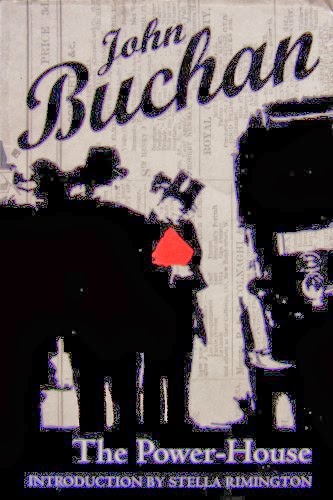
Review: THE POWER HOUSE by John Buchan

book cover Original Publication Date: 1913

Genre: mystery

Topics: civilization, espionage


Review by heidenkind:

Sir Edward Leithen, barrister and MP, is hunting with his friends in Scotland. After a few drinks, the men folk start trading stories of all the adventures they've had in exotic locales like Spain, Greece, and Jamaica. Then Sir Edward's like, "You guys are so lucky, I never get to go anywhere or do anything. Oh, right, except for that one time I SINGLE-HANDEDLY BROUGHT DOWN A CABAL ORGANIZATION OF ANARCHISTS INTENT ON THE DESTRUCTION OF WESTERN CIVILIZATION."

drop the mic
BOOM, bitches.

I enjoyed The 39 Steps, John Buchan's most well-known novel, and have been planning to dig into more of Buchan's work for awhile now (awesome random thing that has nothing to do with this review: When I first read The 39 Steps I tweeted about how much I liked it, and Buchan's great-grandson tweeted me back out of the blue to say thank you! That's one of the cooler things that's happened to me on Twitter). The problem was I didn't know where to start. Then I ran across The Power House, the first in the Leithen series, on Librivox and decided to give it a try. It wasn't as gripping a read as The 39 Steps, but it was fun.

Sir Edward Leithen is a very different character from Richard Hannay, the hero of The 39 Steps. In fact, it would be fair to say he's almost the polar opposite. Hannay is a dashing, witty rogue and outsider, while Leithen is a steady, conventional member of the British gentry whose life is an unvarying carousel of "flat, chambers, club, flat." Leithen's life would probably make Hannay want to blow his brains out, but Leithen is 100% down with the drudgery. That actually makes sense in the context of the novel, because Leithen represents civilization, with all its boring steadiness and routine. So who better to defend civilization against the Power House and its ominously polite leader, Andrew Lumley?

As a mystery, The Power House reminded me of The Pelican Brief. Leithen gathers clues through random pieces of information in the course of his lawyering that don't seem particularly important, but eventually lead him to a huge conspiracy. Suddenly people are chasing him all over London and trying to kill him! Improbable? Yes. But, in consideration of the two World Wars England was about to face, a lot of the stuff in the book was creepily prescient. I also liked the fact that the major baddie wasn't German, although his ideas are tied to Germans.

The Power House was a good read, although I wouldn't call it unputdownable. It's very short and fast-moving, and once Leithen starts getting into scrapes he takes to danger like a fish to water. Nothing fazes this guy! Not that there are a whole bunch of action scenes; The Power House is more of an intellectual puzzle (Leithen IS really smart) than a spy thriller like The 39 Steps. I think I probably would have prefered it if Leithen started freaking out, but keep calm and all that. I also thought the ending was a bit of a let-down—it seemed like the organization of the Power House collapsed too easily, and everything settled back to normal as if nothing had happened. Which I guess was the goal on Leithen's part, but COME ON DUDE. At least take a vacation or something.

So I can see why The 39 Steps is more well-known than The Power House. But I'd still recommend it to fans of spy novels/thrillers or even Edwardian fiction.


Download The Power House by John Buchan at Gaslight|Librivox

Wednesday, January 22, 2014

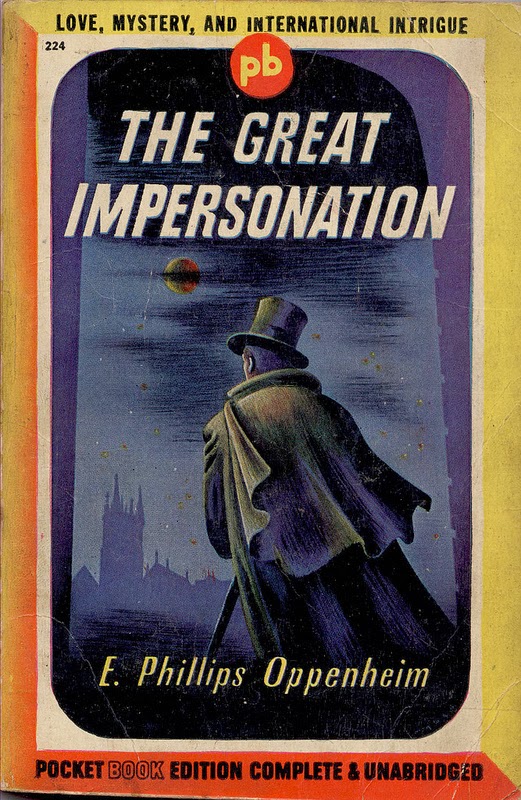
Review: THE GREAT IMPERSONATION by E. Phillips Oppenheim

book cover Original Publication Date: 1920

Genre: Mystery

Topics: Espionage, Germanic horde, WWI, love, civilization vs savagery


Review by heidenkind:

Sir Everard Dominey, living in self-exile in Africa, wakes up after a night of drinking too much whiskey to find himself the guest of Leopold von Ragastein, his doppelganger. The two have many similarities beside their appearance: they both have a natural gift for languages, and Ragastein is also in exile after killing his mistress' husband in a duel. The only major difference between them is that Ragastein is German and therefore EVIL. After spending the night prying into the life of Everard Dominey, Ragastein and his friend, Dr. Schmidt, send Dominey out into the African desert with no water and nothing but extremely salty food, never to be heard from again. Then, taking on the identity of his double, Ragastein goes to England, where he, impersonating Everard Dominey, is in the perfect position to be the greatest and most insidious German spy of all time. But will he have the heart to do what the Kaiser asks of him? And is Everard Dominey really dead?

I decided to read The Great Impersonation after I "overheard" Melody from Redeeming Qualities and Evangeline from Edwardian Promenade talking about it on Twitter. I'm so glad I did! The Great Impersonation is an absolutely great story, good enough for me to overlook the constant references to Rosamund Dominey, Everard's homicidally insane wife, as "childlike" (yes, his wife is insane and homicidal, YET CHILDLIKE. You're hooked now, aren't you?).

As soon as "Dominey" returns to England, the reader is sure two things are going to happen: Leopold's going to fall in love with Dominey's wife, and the real Everard Dominey is going to show up and spoil everything. Of course, this should be something the reader wants to happen, since Leopold is GERMAN and therefore EVIL. But in actuality, Leopold is kind of upstanding and honorable, and—now that he's in England—demonstrates some divided loyalties between England and Germany. It's almost enough to make one think The Great Impersonation might be the only book in all of 20th century English literature where there's a good German character. Almost.

I also liked how The Great Impersonation is a cross between several genres. Yes, you have the whole spy/WWI plot; but it could also arguably be classified as a gothic mystery, what with the ominous Dominey homestead (filled with secret passages, hauntings, superstitious locals, and an adjacent cursed forest, OF COURSE) and the disappearance of Roger Unthank; as well as a coming of age tale.

Basically, if you're looking for an entertaining, fast-paced novel with mystery, romance, and twists, you can't go wrong with The Great Impersonation. I'll definitely be reading more of E. Phillips Oppenheim's work in the future!


Download The Great Impersonation by E. Phillips Oppenheim at Project Gutenberg|Librivox

Thursday, September 6, 2012

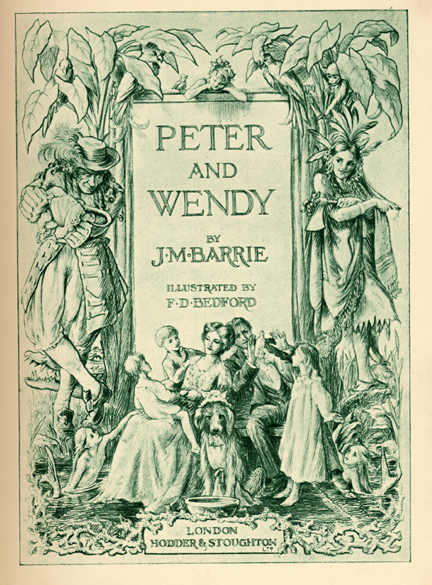
Guest Review: PETER PAN by JM Barrie

book cover
Also known as Peter and Wendy and Peter Pan and Wendy.

Original Publication Date: 1911

Genre: fantasy

Topics: children, civilization versus savagery


Review by Liz Inskip-Paulk:

Happened upon the title of classic children’s lit, Peter Pan by J. M. Barrie (1904) and thought I would read and see how it was. Having grown up (along with thousands of others) on the Disney version, I was surprised by how dark and violent the original story really was. It’s still classified as children’s literature, but wow – it’s a bit rough around the edges.

Some of the new information for me that differed from the Disney version:
  • Captain Hook was “black”
  • The crocodile who bit off Cap’n Hook’s hand (and thus gave him the moniker) was a female and had eaten a clock. So long as Captain Hook could hear the ticking of the clock, he would know where this murderous crocodile was, but the minute it stopped ticking… “Ay…That’s the fear that haunts me…”
  • Peter was the cause of Captain Hook’s hook hand and it was he (Peter) who gave the bitten-off hand to the crocodile. (Not sure why it was bitten off in the first place though…)
  • Tinker Bell is actually really mean, jealous and spiteful – none of this little gentle flickering light fluttering around….
  • The “Pan” mentioned in the title refers (I think) to the Pan, the god of Nature etc., he who played the pipes and danced around. This god was a common image in lit for about the fifty years between late 1800’s and early 1900’s. In fact, one of the chapter titles in “The Wind in the Willows” is called something to do with Pan…
Assuming you know the basic story, I was really intrigued by all the details of the story and how the characters behaved. The group of Lost Boys who follow (and worship) Peter Pan have some serious psychological issues with regard to mothers (and thus Wendy), and the boys rely far too much on Peter’s direction when it is actually a case of “the blind leading the blind”… They are all a case of extremely arrested development, and can only remember snippets of their lives before Neverland, so using this spotty knowledge only gets them into more trouble.

There is a lot of violent murder on the island: at least a murder a day (done by the Lost Boys or the Indian tribe on the island, the pirates or maybe a mermaid or two), but the population doesn’t seem to shrink – ever. They never seem to run out of people to kill.

The fairies are over-indulgent and greedy, limping home after having an orgy (presumably with the definition of eating/drinking too much as opposed to otherwise, although who knows with this book?)… Mermaids, who had always before had a pretty benign reputation with me, were actually rude and bullies, especially for poor old Wendy. (Wendy regretted that she “had never had a civil word from one of them” the entire time she was on the island.)

And speaking of Wendy, I had no idea that the English phrase of “Wendy House” (referring to a child’s play house) was related to this (although it seems obvious in hindsight). The Lost Boys built a house around Wendy when she arrived and was unconscious, so it was a Wendy House. I even think the play school my siblings and I attended was called the Wendy House, but that might be wrong.

And the misery doesn’t even end when they Darling/human children return home to their parents. Mother agrees to let Wendy go back with Peter for one week a year to do his Spring Cleaning. (Yeah for parenting skills!)  And then, years later, when Peter comes back, un-aged as he is, he sweeps up Wendy’s kids and future kids “as long as children are gay and innocent and heartless”…  And apparently this is ok with everyone.

wendy darling
Hmm.

So – the author J. M. Barrie (Sir James Matthew Barrie, 1st Baronet). Who was the guy with this twisted imagination? (Or is it me looking with unreasonable 21st century eyes?)  He lived from 1860-1937 and was a playwright and author. He wrote Peter Pan, Or the Boy who Wouldn’t Grow Up in 1904, calling it a “fairy play” and although he had other work, this was the play that made him famous. (It also popularized the name Wendy as that was unusual before this play was published.)

Barrie’s childhood was not an easy one, being the ninth of ten children, and on the accidental death of his next oldest brother, Barrie tried to help his mother’s grief by wearing the dead brother’s clothing and whistling like he used. (Psychological problem #1.) Along with this came the idea of a boy who would never get old (a la Peter Pan) as the brother who died was only 14 when the accident occurred. (Psychological problem #2.)  This big dead brother’s influence would continue on for years, even affecting the career choice his parents wanted for Barrie. He wanted to be a writer, but his parents told him that his dead brother would have been a minister and so that’s what he should do as well. They eventually reached a compromise. (Psychological problem #3.)

Additionally, Barrie was exceptionally small in stature for his family reaching only about five feet tall at adulthood. This led to other problems for him. However, as an adult and writer, he moved in elite literary circles: Robert Louis Stephenson, George Bernard Shaw, Thomas Hardy, Jerome K. Jerome... he told stories to the young Princess Elizabeth and Princess Margaret. Barrie also made friends with Antarctica explorer Robert Falcon Scott, and Scott, when his expedition was falling apart, wrote one of his last letters to Barrie asking him to look after his wife and son if he could not get home…

Linked with friendship is the fact that in 1897, Barrie was in London’s Kensington Gardens when he came across five young boys, all brothers and called the Llewelyn Davies family. “Uncle Jim” (as Barrie became known to the family) was a frequent visitor to the boys’ home and would entertain them with stories during his visits, and it is thought that he based the story of Peter Pan on these young boys. The boys’ father died in 1907 and their mother in 1910, Barrie (in a somewhat bizarre manner) ended up being the boys’ guardian for the rest of their lives (though most of them wouldn’t live too long). It’s all rather strange and Wiki has the details here (as true as Wiki can be): http://en.wikipedia.org/wiki/J._M._Barrie

Before Barrie’s death, he gave the rights to the Peter Pan works to Great Ormond Street Hospital, the children’s hospital, which, if you saw the London Olympic Games opening ceremony the other day, was referenced frequently (sometimes as GOSH). This was the first hospital in the English-speaking world to provide in-patient beds for children and was supported by several royals, including Queen Victoria and Princess Diana (who acted as President for a while).

It seems that Barrie was basically a good guy, but any good psychologist would have had a field day with him. (But then who is to say who is normal and who is not? :)


Find Peter Pan by JM Barrie at Project Gutenberg|Librivox