Showing posts with label forgotten for a reason. Show all posts

Monday, December 28, 2015

Review: MASTER FLEA by ETA Hoffmann

book cover Original Publication Date: 1822

Genre: fairy tale, fantasy

Topics: trust, love, friendship, coming of age, forgotten for a reason


Review by heidenkind:

Peregrinus Tyss is an odd duck. If he was living in the 21st century, he'd probably be diagnosed with Asperger's; but as it is, he lives in 19th-century Frankfurt and people just assume he's stupid.

Since Peregrin is an orphan and has no friends, every Christmas he picks one family and brings a bunch of presents to them dressed as Santa. But while delivering presents to a bookseller and his children, Peregrin is assaulted by a strange, beautiful woman who acts like she knows him. This lady is obviously Bad News (obvious to the reader, that is); fortunately for Peregrin, he's managed to collect Master Flea, whom the woman needs to keep herself alive. Grateful for Peregrin's protection, Master Flea helps him navigate the waters of social life among the muggles and the mythical beings that suddenly surround him.

I enjoyed Master Flea at first, but as the story went on it started to wear on me. First of all, the eponymous Flea doesn't even show up until the "Third Adventure," nearly halfway through the book! Before that, we are introduced to Peregrin, a femme fatale named alternatively "fair Alina," Dörtje Elverdink, and a mythical princess called Gamaheh of Famagusta; a guy named George Pepusch, who's actually the Thistle of Zeherit; Pepusch's bestie, Leuwenhock, who's actually a magician; Peregrin's lodger, who's Leuwenhock's nemesis and fellow magician; and et. al. I probably forgot a few people there, but you get the idea. This is the type of book where everyone has two or three names, like Lord of the Rings, only not as tolerable. And I was never able to get through Lord of the Rings, sooooooooo.

This is also the type of book where there's only one female character, and she's not really a character, more of a MacGuffin. Alllllllll the men in this story are after Alina/Dörtje/Gamaheh, for no reason I could see because she's a total bitch.  But she is beautiful, so I suppose that's all that matters.

There are some fun scenes in Master Flea, like when Master Flea gives Peregrin a glass that lets him see what people are *really* thinking when they talk to him (the glass, incidentally, is a small concave disk that fits over his eye, and to take it out he leans over and blinks very wide and it pops out and back into its box–so, ETA Hoffmann basically invented contact lenses). Naturally, whatever they're thinking is the exact opposite of what they're saying. But this went on for way too long and there was way too much of it.

The book also bounced around a lot and there was a ton of information about other fairies and mythical creatures, most of which I not only didn't care about but was annoyed with, considering keeping the thrice-named circus of the regular characters straight was exhausting enough.

Finally, I found the conclusion to be extremely irritating.

Master Flea a really weird book. Like, REALLY weird. It's over-the-top and all over the place. I probably wouldn't recommend this book to anyone, and I think I'm going to avoid ETA Hoffmann books in the future from now on. Sorry, ETA.


Download Master Flea by ETA Hoffmann at Project Gutenberg|Librivox

Wednesday, February 4, 2015

Review: HER DARK INHERITANCE by Mrs. E. Burke Collins

her dark inheritance Original Publication Date: 1892

Genre: dime novel

Topics: Love, secrets, beauty, economics, sins of the father, forgotten for a reason


Review by heidenkind:

On a dark and stormy night, Beatrix Dane is abandoned at the offices of Dr. Frederick Lynne, with a note promising an allowance for the doctor and his family if he raises the baby as his own. But when the money stops coming 17 years later, Beatrix faces resentment from her evil step-mom and -sister, as well as (even worse!) a horrible wardrobe. When a dashing cousin of Mrs. Lynne, Keith Kenyon, arrives on the scene, Beatrix is sure he's her prince charming. But Mrs. and Miss Lynne have other plans, especially after Dr. Lynne dies. Will Beatrix and Keith ever be together? And what was up with Beatrix's mom and dad?

Her Dark Inheritance is one of those books where being beautiful=good and unattractive=horrible person. Case in point: Beatrix is a shallow little bitch, yet I'm supposed to root for her because attractiveness. Mmmr, no. Keith also falls in love with her, seemingly just because she's beautiful. Meanwhile, Beatrix's "sister," Serena, is vilified largely because of her looks. Every single time she's mentioned in this book, the author takes care to point out that she's "ugly," "not very attractive," "ungraceful," and so on. Yet character-wise there doesn't seem to be much difference between Serena and Beatrix; at least Serena appears to be marginally more intelligent.

This would be bad enough, if I cared even a little bit about the characters or felt like the story had any connection to reality at all, but I didn't. I did like the beginning of Her Dark Inheritance, in a this-book-is-going-to-be-really-cheesy! sort of way, and I liked that it was clearly framed as a fairy tale (at one point early in the book, Beatrix thinks, "Oh, dear! I wish my fairy prince would come!"–literally, that is a direct quote–and a paragraph later Tall Dark and Handsome rides up on his trusty steed), but the story quickly descended into over-the-toppiness with a love triangle between Serena and Beatrix, and Beatrix going to live with some distant relative, who ALSO was involved in a love triangle in his youth and his now seeking revenge through Beatrix and Keith. It reminded me of Wuthering Heights in a way, although I gave marginally less fucks and thought it was way more stupid than Wuthering Heights, a challenge (not a fan of Wuthering Heights, incidentally).

And then there was the writing. Oh lordy lordy. Her Dark Inheritance is filled with long, tortured sentences that contain a whole lot of tell and not show. Another reason why it was impossible to connect to the characters on any level.

In the end, despite all the gossipy, juicy drama going on, I was really bored. If I had been reading the book I'd have skimmed to the very end; but since I was listening to it on audiobook I just DNF'd it.

But here's an interesting thing I discovered while I was trying to figure out when the heck Her Dark Inheritance was published: Mrs. E. Burke Collins was a very successful writer of dime novels for women. This was apparently a thing. A passage in a book I found on Google Books described her as, "one of the small band of women writers who earn more than $6,ooo a year." And says that, "Mrs Sharkey [Collins' legal name] is the only professional story writer in the far South and her salary is larger than that received by any other person in the state of Louisiana not even excepting its State officials."

Hard to believe. There were a bunch of other female dime novelists, too, of course. The American Women's Dime Novel Project contains some hip, retro covers from women's dime novels published between 1870 and 1934, but only a few links to where you can read them online and no discussion or critique of the books themselves, which is a bit disappointing.

There's also this article by Deidre A Johnson on Collins' short story, "Dare the Detective," and how it drew from her life experience.

Overall I get the impression Collins was following in the footsteps of Anna Katharine Green, only she wasn't as good of a writer. But I would be interested in exploring more dime novels from this time period, as long as they're not by Collins. Do you guys have any recommendations?


Download Her Dark Inheritance by Mrs. E. Burke Collins at Project Gutenberg|Librivox

Sunday, August 17, 2014

Review: Le Petit Nord by Anne Grenfell and Katie Spalding

le petit nordOriginal Publication Date: 1920

Genre: ??? (See my review)

Topics: Newfoundland, travel, orphans, wily missionaries,


Review by : Chrisbookarama

Le Petit Nord is a collection of letters written by an unknown narrator to her British friend Joan during her year as missionary in St Anthony, Newfoundland.

Long before airplanes and the Trans-Canada Highway, travel to the northern parts of Newfoundland was a long and arduous journey. The narrator first sails into St John’s and from there takes a train to Run By Guess as a little diversion before her heading north. The trip does not go well, as soon as she steps outside she is attacked by mosquitos and “the roadbed was not constructed on the principles laid down by the Romans.” This is her first experience on “the Rock.”

After her short vacation, the lady heads to Come By Chance and her journey begins in earnest as she boards a steamer for St Anthony. The little ship avoids ice floes and storms (by the way it’s now the end of June). Though she finds the scenery beautiful, she can’t get used to “the language of the people.” They do not say “How are you?” but “How’s da fish by’?”

When she finally lands in St Anthony, one of her first duties is to feed thirty-six orphaned children with one herring, a feat to put Jesus to shame. By this time, she’s learned not only is the pantry empty but she’s lost her luggage during the trip. She has nothing but it’s still more than what these children have. Many were found in isolated homes where the parents had died or disappeared, often long before the children were discovered; they were dirty, starving, and frightened. Unsurprisingly, the children are difficult and have developmental issues. She loves them all in her own way. She is firm with them but kind. She has lots stories of their shenanigans for Joan!

Speaking of Joan, she must have insulted Newfoundland in a letter, because  the lady takes her to task: “I want to violently controvert your disparaging remarks about this "insignificant little island."” She, in a short time, has come to love St Anthony and its people. They have no school, and the closest hospital is in St John’s. The poverty is extreme but:

When I look about me and see this poverty, the ignorance born of lack of opportunity, the suffering, the dirt, and degradation which are in so large a measure no fault of these poor folk, I am overwhelmed at the wealth of opportunities. Here at least every talent one has to offer counts for double what it would at home.

She greatly admires the women. When a road was needed to be built and the men were away fishing,  they chopped a path through the wilderness for it. In her letters, she speaks of characters like the kitchen maids Senath and Tryphena, a crewman of the ship The Northern Light she calls The Prophet (Prophet of Doom), and a Feminist named Elmira, who “had the courage of her convictions, and did not marry.” Her letters contain the tales and beliefs of the people, including stories of sled dogs, polar bears, and a creature called Yoho.

As for the lady herself, she has many adventures. She witnesses the Aurora Borealis and hears the sounds they make. She weathers a variety of storms, and takes a ‘cruise’ by dog sled. During her final days as missionary, she travels around the other ports of Le Petit Nord onboard The Northern Light and sees puffins, icebergs, whales, and dolphins. Everything you’d expect to find in a Newfoundland and Labrador Travel brochure!


When I first read Le Petit Nord, I was under the impression that these were actual letters written by Anne Grenfell.* However, upon going over the story again for my review, I started to get the feeling something else was going on. First of all, who is Katie Spalding? What does she have to do with this? Anne Grenfell was the American wife of Dr Wilfred Grenfell, the founder of the St Anthony Mission. The narrator never mentions her own name nor does she mention the year. The narrator is English not American, so she can’t be Anne who was born in Chicago. I did some internet digging and found this thesis in Collections Canada that points out that Katie Spalding was the secretary for the Grenfell Association. Both she and Anne created "a collection of pseudo-letters” that was Le Petit Nord. They were writing propaganda to get money out of people in England for the Mission. Ruh-roh! I had fallen for it hook, line and sinker. I am scandalized! I just thought Anne was a really great letter writer.

Of course, even if it is propaganda, it’s entertaining propaganda. The foreword claims that all these events happened, only the names have been changed. Maybe these things did happen, or maybe they didn’t, but even of they did probably not to one person. I found the whole book delightful nonetheless, even if the narrator is Lady Von Fakerson. It’s funny and full of adventure. Any damage it did was well before my reading of it. Wily missionaries.

So, what is the genre? Fictionalized memoir? A epistolary novel?

This was a Librivox recording narrated by a real Newfoundlander, Sean Michael Hogan. Please listen to it, it’s great!

Download Le Petit Nord by Anne Grenfell and Katie Spalding at Project Gutenberg|Librivox|

*I had used the name Anne in this review before my discovery, I then changed it to ‘the narrator” or “the lady.”

Monday, August 20, 2012

Review: LADY MOLLY OF SCOTLAND YARD by Baroness Emmuska Orczy

lady molly book cover
Original Publication Date: 1910

Genre: mystery

Topics: female detective


Review:

Lady Molly and her uncomfortably devoted assistant, Mary, are part of a new group of female detectives in Scotland Yard. They solve mysteries.

After I finished The Experiences of Loveday Brooke (review here), Anastasia from Birdbrain(ed) Book Blog asked if I'd read the series about a female detective written by Baroness Orczy. I didn't even know Orczy wrote mysteries, let alone mysteries with a woman detective! Considering my enjoyment of The Scarlet Pimpernel, I had high expectations for Lady Molly of Scotland Yard, but wound up being pretty disappointed. Let's just say mysteries were obviously not Orczy's raison d'etre.

In my review of The Experiences of Loveday Brooke, I complained that although the mysteries were entertaining and twisty, Loveday didn't have much personality. After reading Lady Molly, however, I'd like to apologize to CL Pirkis for that statement, because Lady Molly has even less personality than Loveday did, and the mysteries and the way they're solved are super-boring.

The stories are all narrated by Mary, Lady Molly's assistant, kind of like the Sherlock Holmes stories. With Sherlock Holmes, though, having the stories narrated by someone else makes sense because it would be difficult to capture the quirkiness of Holmes' personality if they were told from his point of view. There's no way Holmes is going to be an "everyman" in the way John Watson is. Lady Molly, on the hand, doesn't really seem to have any personality, so the only effect of having Mary narrate is that we're completely removed from the action and investigation. At least Loveday squinted when she had an idea and we got to witness her investigating things; with Lady Mary, she just seems to giggle and order Mary around.

In every story, Mary tells us about the crimes under investigation, with an astonishing amount of detail considering she never actually witnessed any of them. Then Lady Molly sends her off to investigate, pops up at the very end, and pinpoints the perpetrator. Her "investigative technique" of choice is emotional manipulation, something no one objects to as long as she's manipulating women and not men. Since Mary is the narrator, we hardly ever see Lady Molly investigate anything, and the solutions to the mysteries never quite make sense. With Loveday Brooke, one can see how she got from point A to point B to point C; with Lady Molly, she just pulls a solution out of her butt and one is never quite sure how she got there, even with the after-the-fact explanation of the "clues" only she knew about. There are a few mysteries where this doesn't happen, but they're very predictable.

The best story is probably "The End," since we do get to see a lot of Lady Molly in action, and find out some interesting back story about her. But even in "The End," Lady Molly's investigation is suspect, and the conclusion to the mystery doesn't completely make sense.

I would say if you're looking for a female detective story, Loveday Brooke is still your best bet. If you do want to try Lady Molly, I'd recommend sticking with "The Ninescore Mystery" and "The End" and ignoring the other stories entirely


Find Lady Molly of Scotland Yard by Baroness Orczy at UPenn Library|Librivox

Monday, May 21, 2012

Review: The Log Cabin Lady by Anonymous

Original Publication Date:  1922

Genre:  Non-Fiction, Women, Wild West

Topics:  Women, Class System, America, World Wars

Review:  This is a true life account of one woman's difficult transition from frontier girl to society girl.  It really appealed to me because we so often hear about Cinderella stories- beautiful poor, young girls swept off their feet by handsome rich men and go off to live happily ever after in a castle.  And that may be true to an extent, but it ignores the very real difficulties those women faced in needing to learn all of the etiquette, rules and complex interactions that regulated life in high society.  This is the only book that I've encountered that really approaches this issue in an honest and sympathetic way.  Nowadays, most historical romance novels are written with heroines that roll their eyes at convention and are bored by learning how to properly address a Duke and don't care to know how many times one should curtsey in front of the Queen of England.  But those heroines ignore the very real consequences that arise when a person doesn't behave correctly.  This anonymous writer is well aware of those consequences. 

I am not entirely sure why she wrote this short book in the manner that she did.  For example, she doesn't set down all the rules for young girls to follow.  She doesn't give them advice on what to do in certain situations.  She just relates her own early bloopers and then pleads with her readers to teach women how to behave properly in Society.  It's a strange thing to do, I feel, because her writing doesn't actually help any girls that may be in the same situation as her.  She just wants other people to help them.

Because of this, I think The Log Cabin Lady is very dated.  It would be an interesting and useful read if it actually gave specific directions.  I think I would be pretty fascinated to learn exactly what a woman should wear in her presentation to the Queen of England, what topics are appropriate for dinnertime conversation, how you should seat people at dinner, etc.  But none of that is touched upon here, except very peripherally, when our narrator makes a blunder.

So instead, this journal is more a group of vignettes written with the weirdly desperate hope of giving girls etiquette training at home while they're young so that they won't embarrass themselves overseas by doing something as ghastly as asking a general to sit down in the presence of a standing king. 
If any one had told that girl the sacredness of the convention she had ignored, she would have suffered as keenly as I had suffered in my youth. It was such a simple thing to learn; yet who in the middle of a war would think of stopping to run a class in etiquette? The point is that any girl capable of crossing half the world to do a big job and a hard one in a foreign land should have been given the opportunity to learn the rules of social intercourse.
I personally would turn that statement around on its head and say, "Why, in the middle of a war, are you so worried about a girl requesting a general to sit down in a king's presence?"  But perhaps I am not the target audience.

The Log Cabin Lady also gets strangely patriotic- not about America as a whole, but about the Midwest.  As a born and bred Midwesterner, I completely sympathize with her, but it is bizarre because the woman keeps talking about how Americans need to cultivate good manners so that we can impress Europeans, but then on the other hand, she really prides Americans are being down-to-earth and not caring about such things.
It was like a bath for my soul. Brains count out West. Anybody who tries to show off is snubbed.
You must do something to be anything in the Middle West; just to have something doesn't count. You don't list your ancestors as you must in Virginia or the Carolinas, but to feel self-respecting you must do something.
So really... not sure what the Log Cabin Lady wants.  Refined European manners that will make even the most awkward Illinois girl feel comfortable in drawing rooms around the world?  Or good old American honesty and integrity, where class and ancestry don't matter nearly so much as the work you do yourself?  It seemed to me like she wanted both, and her narrative was very winding and misguided because of it.

Also, her rich and handsome diplomat husband seemed like a first-class jerk to me, so I am not sure I trust her taste in all things, anyway.
 

Wednesday, March 21, 2012

Random Wednesday: BUNNY RABBIT'S DIARY by Mary Frances Blaisdell

book cover
Original Publication Date: 1915

Genre: children's book

Topics: anthropomorphizing, adventure


Review:

In the interest of reading more obscure books for this blog, I decided to randomly select a few books and highlight them in a feature called Random Wednesday! To select the book, I randomly chose a letter of the alphabet, went to the Project Gutenberg page with all the author names starting with that letter, divided the page in to eighths and randomly chose a section, and then selected a book based on the title.

My first choice was Bunny Rabbit's Diary by Mary Frances Blaisdell, because I like bunnies (yes, I am THAT much of a grown-up). It's an illustrated children's book basically in the style of Wind in the Willows or Peter Rabbit. I'm not a huge fan of either, to be honest, but they're both a damn sight better than this book, which is snoregastic.

For a present, Bunny Rabbit received a journal made out of leaves and wrote down all his adventures with the other animals. Then he stuck it in a tree, where the author found it and transcribed it. How did Blaisdell read the tiny rabbit writing? I don't know.

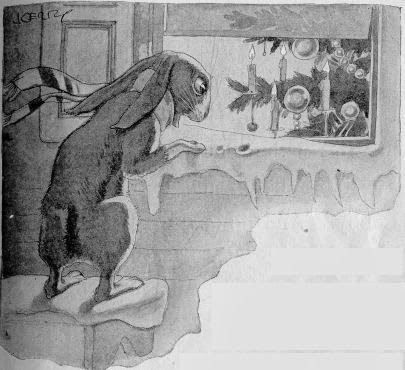
The problem is, as Bunny Rabbit himself observed, he doesn't know how to write stories (also: why is he writing his own stories in the third person? Another mystery). All the stories are good beginnings, but they never go anywhere. For example, one time Bunny Rabbit and his other bunny friend are hanging out in a tree, when they see two humans. The humans want to cut down a tree! Bunny Rabbit wonders why, and a sparrow tells him it's for Christmas, and explains what a Christmas tree is. Bunny Rabbit is intrigued, so he follows the humans to their house to see a Christmas tree for himself.

bunny rabbit seeing a christmas tree


The end.

See what I mean? This is the START of a story. In any other decent book I can think of, this would be the set up for a series of hi-larious hijinks undoubtedly involving either a cat or dog, trashcans, being chased around the kitchen by a knife-wielding cook, and the children wanting to adopt him as a pet. In Bunny Rabbit's Diary, it's THE ENTIRE STORY.

I was also less than impressed with the illustrations.

So, if you're in the mood to read a book about a rabbit, I'd stick with Peter Rabbit.