Showing posts with label war. Show all posts

Monday, February 23, 2015

Review: An English Woman-Sergeant In the Serbian Army by Flora Sandes

 englishwomansergeant_serbianarmy_1407

Original Publication Date: 1916

Genre: Memoir

Topics: Army life, World War I, Serbia, British nurses, soldiers, women soldiers, sisters doing it for themselves, smoking-drinking-shooting

Review by : Chrisbookarama

Have you ever stumbling across something by accident and then instantly became obsessed with it? That is me right now with Flora Sandes. Obsessed! I was just minding my own business, scrolling through the Librivox catalogue, when I came across An English Woman-Sergeant In the Serbian Army. Well, I thought, this sounds intriguing. I started listening and couldn’t believe my ears. Is this real life? Was Flora Sandes a real person? I had to find out for sure. Fool me once, Public Domain! And it was true! This really happened!

flora sandes

Flora begins her story with herself travelling back to Serbia after a brief vacation from the action during World War I. England was an ally to Serbia. Serbians needed all the help they could get. Flora volunteered to be a nurse with St John Ambulance. She quickly became a favorite with the men. She’d smoke, drink, and share a laugh with them, as well as hold their hands as they died.

Flora decided early on to stick with the Serbian Army even though she was British. The Serbians’ ideas about women in the combat were more enlightened than the Brits’. She travelled with the army while they retreated from the Austrian advance, taking care of the wounded and sick men. At some point Flora is asked to make a choice.

They said the journey through Albania would be very terrible, that nothing we had gone through so far was anything approaching it, and that they would send me down to Salonica if I liked.

Flora says Yes! to Albania, though they find the locals very hostile to their presence. They get fired upon a lot. But here Flora finally gets to be a real soldier and holds her own against the enemy.

I had only a revolver and no rifle of my own at that time, but one of my comrades was quite satisfied to lend me his and curl himself up and smoke.

It isn’t all shooting dudes all day long though. The Serbians were constantly on the move. Along the road Flora saw the corpses of horses that died of starvation or exhaustion. The men themselves weren’t doing so good, as the locals put up the prices of food when the soldiers arrive in their towns.

As for the men, they showed her great respect. She says she expected resistance, but never experienced it, even in her interactions with the British commanders. Her Serbian commander makes her a corporal, and eventually a sergeant, making her the only woman to officially serve in the Serbian Army during World War I.

flora and her men

An English Woman-Sergeant In the Serbian Army ends unexpectedly, but this is because Flora wrote it in 1916, while the war was still ongoing, to raise funds for the Serbian Army. Flora ain’t got time for writing memoirs. The writing is what you would expect from a woman like Flora: to the point, honest, unadorned. It’s also pretty short. In 1927, she wrote her autobiography, An Autobiography of a Woman Soldier. I will be reading that, I can tell you.

The only thing I didn’t like about this memoir was the patronizing introduction by a Serbian politician:

But she only took to a rifle when there was no more nursing to be done, as, owing to the Army retreating, the wounded could not be picked up and had to be left behind.

No, dude, she would have “took to a rifle” if that had been an option from the start.

Here are some facts about Flora:

  • She was 38 when World War I began, 40 when she wrote this memoir. (Yay!)
  • After the war, she married a Russian soldier 12 years younger than herself. (Get it, girl!)
  • They lived in Serbia until he died in 1941.
  • When World War II broke out, she joined the army again. She was 65. (A Boss!)
  • The Nazis imprisoned her. (Oh no they didn’t!)
  • She moved back to England and drove around in a motorized wheelchair until she died at age 80. (Only death could stop her.)

Project Gutenberg doesn’t have the text but The University of Toronto has a text version.

Download An English Woman-Sergeant In the Serbian Army by Flora Sandes at |Librivox|

Monday, May 13, 2013

Review: THE THIRTY-NINE STEPS, by J. Buchan


Original Publication Date: 1915


Genre: adventure, suspense

Topics: war, espionage, duty, man on the run


Review by : Patty @ A Tale of Three Cities


John Buchan is a well-known Scottish author who wrote The Thirty-nine Steps while recuperating from an illness.  The title of the book came from a flight of 39 steps found in this nursing home...


It is considered one of the first "shockers" - combining personal and political drama -, but I actually watched Hitchcock's film adaptation by the same name first:  though not one of his best and memorable, it was adventurous enough to let 1.5 hours pass by.   As I came across the book, though, I wanted to see whether the plot there would be "flat" compared to the film, or whether it would be just as thrilling?

The novel describes the "man on the run", which would later become something of a standard in films noirs. We always identify with him and follow his adventures, and rejoice in his redemption in the end...

I said I liked Hitchcock's version, but next to the actual book, it simply pales in comparison:  the book starts with a general overview of the political climate at the time - Europe is on the verge of war and various political alliances form and threaten others.  It was very interesting to see (this is 1915) how well aware Buchan was of the little intrigues that were formed and how the would contribute to the deterioration of society, and I could even detect some early comments against the Jews that I could well imagine continued, increased and contributed to another war as well...

But this is just the setting of the story.  Already from the beginning the plot does not resemble at all the film, and I find I like the book more:  we get to know a little about Hannay first and become aware of his weaknesses and we understand better all that will ensue.  The initial meeting with the victim that will trigger the rest of the plot is in the building where Hannay lives (it's a neighbour), and not in a theatre with a total stranger.  All is more believable in the book, and more focused on the details that will explain the steps to follow.

I continue reading and I start getting upset with Hitchcock.  He has managed to distort the plot in every possible manner.  And while I understand that in a black & white film one cannot see much of nature, Buchan's novel is full of beautiful descriptions of the Scottish landscape that provide the background elements for the chase, the capture, the escape and all other action scenes with Hanney.

This is a story of a bored man (well-off, naturally and recently back from Rhodesia) who seizes the opportunity to do something for his country and thus come to realise the greatest interest one can have:  the good of society in general.  The United Kingdom's military secrets are in danger of being communicated to the enemies and that can have disastrous consequences with regard to its role and position in an eventual war.   Given the time this novel is written, this was a well-received message for those directly involved with the war:  we need to go beyond our petty, individual interests and see how and where we can help for the general good. 

Of course, throughout all of his adventures, Hannay always emerges the winner:  I would not have expected anything else, and although I did miss some negative spots in the story, I understand the need for such a hero. He never questions his involvement, he actually does more than his fair share, and in the end it will be him to confront the conspirators.  The UK thus enters the 1st World War, with its military secrets intact and Hannay will enlist as a captain.

Despite dealing with war issues (not my favourity subject), I really enjoyed this book - especially after watching the movie adaptation and appreciating Buchan's penmanship.  But also because of the humanity that can be found in all of us (Hannay encounters some beautiful people along the way), and the lack of the necessary love interest that had to be present in the movie - the novel wins!


Download The Thirty-nine Steps by J. Buchan at Project Gutenberg|Librivox|

Wednesday, June 27, 2012

Bab: A Sub-Deb


Original Publication Date:  1916

Genre:  Humor, Coming-of-Age, Romance, America

Topics:  Gilded Age, Debutantes, Lives of the Rich

Review:

Bab:  A Sub-Deb is about Barbara Archibald- a beautiful, slightly ditzy, 17-year-old society miss who is quite annoyed that her "barely older" but officially "out" to society sister Leila gets all the attention (and new clothes and party invites) while Bab must suffer through boarding school for two more years before she can become a debutante.  She is, in her own words, a sub-deb, and it's a rough life.  The problem is that Bab is a very pretty girl who draws all sorts of male attention and gets into a ridiculous number of scrapes and then does her very best to get out of them without any help.  She rarely succeeds at this goal, but gosh, it's fun to watch her try.

The result is a terrifically entertaining romp through pre-WWI (and WWI), upper crust America, with good-hearted, naive "naturaly truthful, as far as possible" Bab, who can't spell to save her life, as our rusted tguide.  From the first adventure (making up a fake fiancee who, to her horror, comes to life and into her life) to the last (saving her father's weapons munitions factory from German spies), I was thoroughly and wildly entertained, often laughing out loud and noting down my favorite lines.

The best thing about Bab is that she balances so well between being a very realistic, overly dramatic teenager and being one of the funniest and most endearing narrators you've ever encountered.  I generally hate ditzy girls in books because they are so overblown and ridiculous.  But I love Bab, even though (or perhaps because) she says things like:
"I shall now put down the events of the day, as although the Manual says nothing of keeping a record, I am sure it is always done. Have I not read, again and again, of the Captain's log, which is not wood, as it sounds, but is a journal or Dairy?"  
I think that's because even though Bab is a little naive, you know that she is also a very resourceful and extremely determined girl.  Even as she gets into mishap after hilarious mishap, she always bounces back and does her best.  She also has fantastically clever methods for getting her own way.  "All is going well, unless our Parents refuse, which is not likely, as we intend to purchase the Tent and Unaforms before consulting them.  It is the way of Parents not to care to see money wasted."

I can tell this is a review that will be littered with quotes everywhere, but I really want you to get a feel for just how wonderful Bab is.  For example, here's a scene Bab describes when she feels that her whole family turned on her when she most needed them (spelling errors and capitalizations are original to the text):
Father was the first down.  HE CAME DOWN WHISTLING.
It is perfectly true.  I could not beleive my ears.
He approached me with a smileing face.
"Well, Bab," he said, exactly as if nothing had happened, "have you had a nice day?"  He had the eyes of a bacilisk, that creature of Fable.
"I've had a lovely day, Father," I replied.  I could be bacilisk-ish also.
I love the way Bab interacts with her family, whom she loves even though she doesn't think they understand her.  "It is always thus in my Familey. They joke about the most serious things, and then get terrably serious about nothing at all, such as overshoes on wet days, or not passing in French grammer, or having a friend of the Other Sex, etcetera."  She particularly loves her father, who is her "only Male Parent and very dear."

I also appreciated how Bab, like all 17-year-olds, confronts some universal fears even in the midst of her crazy escapades.  For example, Bab spends a lot of time contemplating whether she has the capacity to love, "not the ordinery atachment between two married people.  I mean Love - the reel thing."  She sometimes feels like she is a cold-hearted woman because she doesn't feel strongly for any man in her acquaintance.  This is a very real worry for her, and it hints at the broader question of how much a beautiful girl of the early 20th century is allowed to flirt with boys without being deemed a flirt or an ice princess.  But Bab makes sure we don't become too philosophical by ending her contemplation of romance in her life with this rejoinder:  "The terrable thought has come to me that I am fickel.  Fickel or polygamus - which?"

My favorite theme of this book, though, was how feminist it became, without losing the humor and consistency of the character.  Honestly, if Rosie the Riveter were to be made flesh and blood, I think she would come to life as Barbara Archibald.  Bab immediately becomes involved in the war effort, leading a group of girls to form a sort of drill team, learning flag signals, practicing target shooting, and pressuring the young men in their lives to enlist in the war.  Mary Roberts Rineheart was very involved in the war effort, actually going to the front as a reporter, so it was very telling to see her take this light-hearted book and infuse it with some very strident patriotism.  This sometimes bordered on disturbing as Bab suspected all immigrants of being anti-American.  For example, she has a heated exchange with a servant who hails from Germany, and says, "The Emblem of my Country, and I trust of yours, for I understand you are naturalized, although if not you'd better be, floating in the breese AFTER SUNSET."

It's a very humorous exchange in which Bab is bested by said naturalized servant, but also quite telling when you know how Americans acted towards foreigners (particularly the Japanese) during the world wars.

But really, these hints of the very true and difficult problems faced by women and immigrants in the United States during the early 20th century only served to reinforce my love of this book.  It is not only thoroughly entertaining and absolutely hilarious, but it also touches on issues and situations that have universal resonance.  I loved every bit of it, and if I could quote the whole book to you here in this review in the hopes of getting you to download it, I would.  But instead, I will leave you with this slightly longer section:
"Mother, were you ever in Love?" "Love! What sort of Love?"
I sat up and stared at her.  "Is there more than one sort?" I demanded.
"There is a very silly, schoolgirl Love," she said, eyeing me, "that people outgrow and blush to look back on."
"Do you?"
"Do I what?"
"Do you blush to look back on it?"
Mother rose and made a sweeping gesture with her right arm.  "I wash my hands of you!" she said. "You are impertanent and indelacate. At your age I was an inocent child, not troubleing with things that did not concern me. As for Love, I had never heard of it until I came out."
"Life must have burst on you like an explosion," I observed. "I suppose you thought that babies——"
"Silense!" mother shreiked..
I highly recommend that you read this book any time you feel the need for a pick-me-up or a big, hearty laugh.  It's so much fun, and I hope you love it as much as I did.


Tuesday, June 5, 2012

Review: BEASTS, MEN AND GODS by Ferdynand Ossendowski

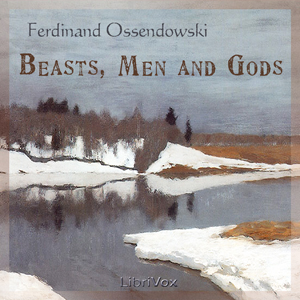
book cover
Original Publication Date: 1922

Genre: memoir

Topics: Asia, journey, war, Bolshevism, Buddhism


Review:

Pursued by Bolshevik Revolutionaries, Ferdynand Ossendowski, a Polish scientist, resolves to return to his family the only way he can: by traveling through Siberia into Mongolia and China, then back into Western Europe via the United States. Along this epic journey he encounters beasts, men, and gods, sometimes within the same person.

I normally don't go for memoirs, but the summary for Beasts, Men and Gods on Librivox described it as, "an epic journey, filled with perils and narrow escapes, in the mold of The Lord of the Rings. The difference is: it’s all true." A TRUE version of Lord of the Rings? This I gotta see. And there better be effing wizards.

While Beasts, Men and Gods isn't exactly Lord of the Rings, it definitely fulfills its promise as an epic journey--a very fascinating, well-told journey over a country Ossendowski calls "the land of mystery and miracles." Ossendowski had an established history of political dissidence opposing the Bolsheviks before this story began, and even spent time in a Russian prison under a death sentence until it was commuted to a "wolf ticket"--basically papers that prevented him from leaving the country or holding down a regular job, which was why he was in Siberia to start off with. He wrote a book about his time in prison called In Human Dust that Leo Tolstoy declared one of his favorites.


ferdinand ossendowski
Ossendowski can and will kick your ass.

You wouldn't know any of that from reading Beasts, Men and Gods, however. Ossendowski doesn't give us backstory as to why the Bolsheviks are after him, just that he's visiting a friend and receives word soldiers have surrounded his house. With no other options, he escapes into the wilderness of Siberia and lives in the woods on his own for at least a year. Forgoing these details was a smart move on Ossendowski's part--it gives the narrative an everyman feel and underscores the horrors of the Bolshevik Revolution more effectively than if he'd turned the book into a political treatise. And Beasts, Men and Gods isn't really about politics, anyway; it's about a struggle to survive against the chaos of war and nature. Ossendowski wants the reader to feel as if all of this could happen to them, whether or not they're involved in politics, and he succeeds.

The first part of the memoir focuses on his time living more or less alone in Sibera, and it's the best part of the book. You know how the 1965 movie Doctor Zhivago has these incredible visuals that burn themselves into your mind, like the train car covered in ice so thick they have to hack their way through it? Beasts, Men and Gods is kind of like that. Ossendowski's description of the spring thaw is incredible, with the breaking of the ice sounding as loud as a roar and chunks of ice the size of boulders flying up from the river and flattening trees when they land. But the ice carries ugly things in its depths:
Watching this glorious withdrawal of the ice, I was filled with terror and revolt at seeing the awful spoils which the Yenisei bore away in this annual retreat. These were the bodies of the executed counter-revolutionaries... Hundreds of these bodies with heads and hands cut off, with mutilated faces and bodies half burned, with broken skulls, floated and mingled with the blocks of ice, looking for their graves; or, turning in the furious whirlpools among the jagged blocks, they were ground and torn to pieces into shapeless masses, which the river, nauseated with its task, vomited out upon the islands and projecting sand bars.
Yikes! It's easy to understand why Ossendowski was against the Bolsheviks, even though he never comes right out and says that he was.

The book slows down considerably in part two, when Ossendowski makes it into Mongolia and tries to travel into Tibet (with the goal of reaching the coast of India, where he can catch a boat back to Europe), only to be blocked by Chinese revolutionaries. Trapped, liked Mongolia herself, between two countries being taken over by communism, Ossendowski travels here and there, meets people, gets into skirmishes, is shot several times, and attempts to catch us up on Chinese-Mongolian politics. I'm not terribly interested in the politics, and the fights Ossendowski and his traveling companions get into start to feel repetitive. I began to wonder what the heck the point of all this was. But! The story picks up considerably in the part three, when Ossendowski meets Baron von Ungern-Sternberg, also known as the Bloody Baron.

Roman Fyodorovich von Ungern-Sternberg
Baron von Ungern-Sternberg, 1921, in a Mongolian deel uniform with the Russian Order of St. George.

The Baron was a German national who became a general for the White Russian army (the royalist side fighting against the Reds, or Bolsheviks), and the guy was CRAY CRAY. He was an excellent general, but known to be ruthlessly violent as well as believing himself to be the reincarnated Mongolian God of War. For serious. The way Ossendowski describes him makes the Baron sound like a blonde Moriarty from BBC's Sherlock--the high-pitched laugh, the faux bonhomie and latent violence. Ossendowki is as frightened of Ungern-Sternberg as anyone, but at their first meeting he tells the Baron off and demands his respect. After that Ungern-Sternberg decides he's trust-worthy and brings him into his inner circle (Ossendowski apparently taught the Baron's troops how to make poisonous gas, but that is not mentioned in the book).

The Baron is a fascinating guy, and Ossendowki is clearly at once repelled and transfixed by him, as is the reader. Knowing what we know now, it's a little spooky at times how the Baron seems to be predicting WWII, a battle between good and evil, as he describes it. He also knows he won't see that battle, anticipating death at the hands of his own commanders, which was exactly what happened.

Ossendowski himself is an interesting guy, too, and he only gets more interesting as his journey goes on. In his normal life he was an academic and scientist, studied under Marie Curie, and taught classes on physics and chemistry at universities in Russia and Poland. As with politics, he never gives us details about his past, but you can tell he's a scientist just by the way he describes things such as the environment and animals in Mongolia. At a few points in the book he comes across strange phenomena or legends and his reaction is, "The locals believe this is caused by evil spirits, but clearly it is a chemical reaction to blahity blah blah." And yet, one gets the impression that there's also a part of him that buys into the mysticism of Mongolia. He believes true prophecies were made about him, and he never attempts to explain Baron von Ungern-Sternberg's belief that he's a god as delusion or narcissism. The last part of the book, which takes place in the palace of the Living Buddha and describes its treasures and prophecies, are the words of someone who's drunk the kool-aid, not a scientist.

And Ossendowski is SMART. I'm not talking book smarts, either, though obviously he is that. He can read people, and that saves his life more than once. He sizes other men up in seconds and then somehow knows what to say or do to get the reaction he wants from them or inspire their trust.

Which leads me to the end of the book, and the reason why I hate memoirs. Because while I don't doubt the veracity of what Ossendowski wrote (I have no reason to--it's absolutely incredible, but people have incredible and unbelievable experiences during war, as I know from stories my own grandparents have told me), he clearly isn't telling us everything. Even if I hadn't Googled him, I'd still know he was being evasive about certain parts of his journey, especially in part four. That's where I started to go, "What the hell?" because he NEVER says how he gets out of Mongolia. One would think that would be a good conclusion to the story, if only just a sentence to mention it, but there's absolutely nothing. Why? According to Wikipedia, he got a position as a diplomatic envoy to Japan, and from there traveled to the US, supposedly hiding treasure he stole from the Bloody Baron along the way. Is that why Ossendowski skips that portion of his journey entirely? I don't like to think that Ossendowski would steal from anyone; but from the start of Beasts, Men and Gods, he edits out certain facts in order to make the impression he wants, so it's not beyond the realm of possibility that things occured in those final days that he decided were best left unsaid--not even glossed over, but skipped entirely.

Why not just write a fictional novel about it, for heaven's sake?

In any case, it seems appropriate that Ossendowski's journey through "the land of mystery" ends with a mystery for the reader. I think this memoir is incredible, thought-provoking, awe-inspiring, and I definitely think it's worth checking out.


Read Beasts, Men and Gods on Project Gutenberg|Librivox (Mark Smith narrates and does a fabulous job)

Wednesday, February 29, 2012

MACBETH by William Shakespeare

Original Publication Date: 1623

Earliest Known Performance: 1611

Genre: play, tragedy

Topics: free will, leadership, ambition, war, human nature

(image by brekkers)


Review:

How exactly do you “review” Macbeth? Especially if it’s only the second Shakespeare play you’ve ever read? Surely every original thought about it must have already been published, built-upon, attacked and defended.

Now that I’ve read it, I can finally understand the fuss. If you just want a good story you’ll take great pleasure in the spooky atmosphere and the bloody scenes, if you’re a philosopher you can revel in the Grand Issues like free will, ambition and leadership and if you’re a language buff there’s lots of passages to underline.

Just like with A Midsummer’s Night Dream, I took great pleasure in the words, even though they were more archaic and harder to follow (it’s after all a historical play, set in the 11th century). Here are some great examples, the kind you want to memorize and use to impress people at parties:
Where the Norweyan banners flout the sky
And fan our people cold

I have begun to plant thee, and will labor
To make thee full of growing

Start, hide your fires!
Let not light see my black and deep desires

Infected minds
To their deaf pillows will discharge their secrets
Macbeth is the story of a great and respected warrior that once upon a time comes across three witches that give him a vision of the future: he will be King! Macbeth believes them and starts making sure that history bends to this prophecy. Thus begins a bloody chain of events, which starts with regicide, but certainly doesn’t end there.

It’s so spooky that it became a sort of theater-Voldemort: in the acting business it’s only referred to as “the Scottish play”, never by its name, which is said to be CURSED *cue high-pitched violins*.

(credits: Kate Beaton at Hark, a Vagrant!)

The play also has the potential to sparkle great conversations, the type I remember having with friends after watching Donny Darko: would have Macbeth been King, if he didn’t take matters in his own hands? Why didn’t he just sit and wait for the crown to fall on his lap? Was the prophecy just an excuse to bring out everything that was mad and evil in him? What about the Lady Macbeth, another Eve figure, that tempts her man into sin?

Lady Macbeth is an interesting one. She’d also like to be Queen, but knows she doesn’t have the cold blood that’s needed to kill those in her path. And she’s right, because shortly after helping to cover Macbeth’s crime, she rapidly descends into madness and commits suicide. Her power lies in influencing her husband, but even that was too much for her. Still, Lady Macbeth has the best speeches, my favorite being the creepy scene where she asks the spirits to maker stronger, colder… and less womanly:
Come, you spirits
That tend on mortal thoughts! unsex me here,
And fill me from the crown to the toe top full
Of direst cruelty; make thick my blood,
Stop up the access and passage to remorse,
That no compunctious visitings of nature
Shake my fell purpose, nor keep peace between
The effect and it!
As Macbeth himself becomes insane and more brutal, his speeches also become more frantic, and even more spectacular:
I have almost forgot the taste of fears:
The time has been, my senses would have cool’d
To hear a night-shriek
There weren’t as many insults as in Midsummer’s Night Dream (only “rump-fed ronyon”, “shag-haar’d villain” and “lily-liver’d boy”), but there were many little expressions that I immediately recognize. It was such a great experience to think “So that’s where it comes from!” Examples:
that shalt be king hereafter
“King Hereafter” is the name of a novel by Dorothy Dunnett, about the life of the Scottish King that lightly influenced Macbeth’s story.
To wear a heart so white
“A Heart so White”, is a novel by Javier Marias, which my bookclub read a few years ago.
The weird sisters, hand in hand
“The Weird Sisters”, is a recent and very popular novel by Eleanor Brown
Something wicked this way comes
Same title as a Ray Bradbury novel.

One last thought (and a question): I thought it was very cleaver the way Shakespeare made the prophecy make sense. It’s certainly the same level as most Hollywood twists. Was he the first one to use a “literary quibble“?

Macbeth, as well as all other plays by Shakespeare, is available on Project Gutenberg and on LibriVox (in audio).

This post was also published at The Sleepless Reader.