Wednesday, April 30, 2014

Review: Herbert West, Reanimator

reanimator

 Original Publication Date: 1922

Genre: Horror, Science Fiction

Topics: Reanimation, scientific experimentation, God complex, unreliable narrators, the undead


Review by Chrisbookarama:

Herbert West, Reanimator is one of the few H.P. Lovecraft stories in the public domain. It was first published as a series for Home Brew in 1922. In it, the narrator tells of the experiments conducted by Herbert and witnessed by himself alone. The narrator’s story is told in six parts. At the beginning of each instalment, he sums up what’s happened in the previous ones. Just in case you didn’t save enough pennies for the last issue of Home Brew you won’t be lost. Herbert is a doctor of the mad scientist variety. He concocts a special solution that he injects into his deceased human subjects in the hopes of bringing them back to life. He and the narrator must continually find “fresh” bodies to reanimate. The results aren’t pretty. Basically, these guys are making homemade zombies.

Let’s talk about the narrator for a moment. This guy’s story is sketchy. He says he was afraid of Herbert. He “shudders” at some of the things he does, but he still hangs out with him. He knows the guy has no scruples and committed at least one murder. Why doesn’t he catch a train to As Far From Herbert As Possibleville? Does he owe Herbert money? I think he’s way more into it than he says.

As for the experiments, I would think that after the first couple of times I created an uncontrollable monster, I’d reconsider the whole endeavour. Herbert wants to reanimate a human with the former intellect intact but all he makes are Hulk Monsters. His obsession with finding the right solution and obtaining enough bodies to test those solutions turns him into a monster himself. Herbert finds opportunities for body snatching disguised as a physician treating the sick or wounded. He even resorts to murder. Herbert’s reasons for reanimating corpses don’t stem from some noble cause like curing his poor old mother or anything. It’s just scientific curiosity. While the narrator believes in the soul, Herbert doesn’t. The soul isn’t a factor. The bodies just aren’t fresh enough, in his opinion.

Be warned that H.P. Lovecraft’s terrible racism and xenophobia reveals itself big time about halfway through the story. You’ll be happy to know, however, that we’re all human-flesh eating monsters under the reanimated skin.

Herbert West, Reanimator is an interesting literary artifact as it’s an early zombie story. In it, the undead run amuck munching on the living, until they are destroyed and disposed of. The viral zombie trope appears later in the literary canon (I Am Legend’s zombie-vampire is the first one I can think of). Herbert has the power to create the undead through his solution only, the bite of his creation will not infect others. The creature will live through various states of decomposition, until shot and “killed.” The 1985 film Re-Animator is based on Lovecraft’s story.

This was a Librivox recording by Phil Chenevert. He doesn’t have quite the chilling voice I’d expect for this story. The audio version is about 90 minutes long.

Download Herbert West- Reanimator by H.P. Lovecraft at Librivox

Monday, April 28, 2014

Review: THE OAKDALE AFFAIR by Edgar Rice Burroughs

book cover Original Publication Date: 1918
 
Genre: mystery, -ish
 
Topics: journey, honor among thieves, hidden in plain sight


Review by heidenkind:


In the sleepy town of Oakdale, a small thief called the Oskaloosa Kid enters the home of Jonas Primm, the president of the Oakdale Bank, and makes off with some valuables belonging to his daughter. As the thief tries to leave Oakdale, he runs across a gang of much nastier thieves and is nearly killed, only to be saved by a gentleman hobo named Bridge. It's clear both the Oskaloosa Kid and Bridge are more than they appear to be, but who are they? And will they be able to save themselves from a mob that wants to hang them for murder?

The Oakdale Affair isn't the typical story one would expect from Edgar Rice Burroughs. Burroughs is known for sci fi novels like A Princess of Mars or The Land That Time Forgot. I didn't even know he wrote mysteries until I downloaded this novel, mainly because my man Ralph Snelson narrates it. And now I know why he's not known for them.

Not that The Oakdale Affair was awful—well, the ending was definitely awful and completely annoying. But beyond that it was okay. It was like Burroughs was writing an adventure novel for 12-year-old boys. You've got your thievery, your stranger danger, hobos, things that go bump in the night, gypsies, an angry mob, and mistaken identity. It's a lot going on for a short book, and it can get pretty episodic.

That said, The Oakdale Affair was never boring, even when I was like, "Gypsies, REALLY?" or getting pissed off because cruelty to animals. Bridge was an awesome character, a poetry-spouting hobo supposedly inspired by Jack London, who's protective of the kids and tough enough to keep the baddies away. Kind of like a father figure, really, which only made the ending that much worse.

As for the Oskaloosa Kid, the person who started this entire mess—borderline TSTL. I gave the kid a pass because I assumed he was 10 or 12-ish and in over his head, but maybe I shouldn't have. Again: HORRIBLE ENDING.

Overall I liked The Oakdale Affair, but not as much as would have liked it without the twist at the end, and not enough to recommend it unless you're a hardcore Burroughs fan.


Download The Oakdale Affair by Edgar Rice Burroughs at Project Gutenberg|Librivox|ERBzine

Friday, April 25, 2014

Review: The Republic


Original Publication Date: 380 BC

Genre: Socratic Dialogue

Topics: Society, Government, Justice

Review by: Melissa at Avid Reader's Musings

The Republic
by Plato
★★★★☆

This famous piece of literature introduces readers to the Socratic method. Socrates was a famous Greek philosopher and his student Plato wrote about his method of teaching. Instead of informing or explaining things, Socrates would ask questions and open a dialogue with his students.

He shared his philosophical view by asking questions and making his students reach the conclusions on their own. His political theories and observations are still relevant, though the book was written in 300 BC. In The Republic Socrates discusses the way to create a perfect society. They work their way through the different rules and regulations that society would need. They decide what their education would focus on and whether there would be equality between the sexes, etc. As they talk through all of the details of their society they come to the inevitable conclusion that it can never exist. Mankind is too flawed and even with the best of intentions, political leaders are corrupted by power.

The other major issue up for debate is justice. Each man comes to the table with a slightly different view of how to define justice. Is justice helping your friends? Is it unjust to injure your enemies? These questions make the Athenians go round and round as they each add their opinions to the mix. This book also includes the famous allegory of the cave, which is discussed in every Philosophy 101 class.

BOTTOM LINE: The arguments aren’t flawless, but it’s the style of arguing that makes this such a compelling read. I enjoyed every second of it and would highly recommend finding an audio version if you can.

“The society we have described can never grow into a reality or see the light of day, and there will be no end to the troubles of states, or indeed, my dear Glaucon, of humanity itself, till philosophers become rulers in this world, or till those we now call kings and rulers really and truly become philosophers, and political power and philosophy thus come into the same hands.”

“They agreed to avoid doing injustice in order to avoid suffering it. This is the origin of laws and contracts.”

“Don’t you think this is why education in the arts is so powerful? Rhythm and harmony find their way to the inner part of the soul and establish themselves there, bringing grace to the well-educated.”
Download Title by author at Project Gutenberg|Librivox|

Originally posted at Avid Reader's Musings.

Thursday, April 24, 2014

Review: SISTER CARRIE - Theodore Dreiser

 
  • Original Publication Date: 1900
  • Genre: American, classic, Victorian
  • Topics: Domestic, gender roles, industry, realism
 
Review by : Liz Inskip-Paulk (www.ravingreader.wordpress.com)


Called “the greatest of all American urban novels”, Dreiser’s Sister Carrie was a good read and I really enjoyed it. It’s not a “happy” read or a “feel good” read, but the narrative arc is strong and the writing was fine. (Dreiser has been criticized by some as having writing that is not sophisticated enough, but I thought this was fine. After having read some drivel lately, Dreiser was a pleasure to read. This was very character-driven as a story, and this was perfect for what was happening throughout the book.)
Sister Carrie is basically the story of Carrie Meeber, a young girl raised in a small rural town who moves to Chicago to chase big-city dreams. You’d think that as it was written during Victorian times, that it might be a heavy-handed morality tale, but it’s not. People do iffy things, but there is no come-uppance for them or even redemption for them to change their “evil” ways. Life continues just fine and in fact, Carrie (she who didn’t fit the Victorian moral code of the time) even thrives despite her unconventional choices in life. (Probably made some of the audience get vapors!)
It is this immorality, if you’d like to call it that, which really irked people when this novel was published. Dreiser has been called one of the first American writers of the Naturalist/Realist school which shocked the socks off of the turn-of-the-century American readers and publishers when it came out.
 
 
His storyline was one of the first published U.S. novels that described a woman being supported by a man to whom she wasn’t married (and was living with), and then when she leaves that partner, she hooks up with another man who’s already married and starts to be supported by him – all with little consequence. When the second partner (who’s already married) commits an impulsive crime, they both end up on the run and yet, when they land up in New York for a new life, there is little punishment for Carrie’s actions. (And you know how the Victorians loved their characters to have punishment for poor choices/rewarded for good ones idea, especially for the weaker sex.)
Trying to get Sister Carrie published at first was tough. A wife of a potential publisher read the draft and called it “too sordid” for them to work with, and only 450 or so copies were sold when it was later published. Years after the book was published, Sinclair Lewis said that the novel “came to housebound and airless America like a great free Western wind, and to our stuffy domesticity gave us the first air since Mark Twain and Whitman” (1930 speech.)
And it was a change on many levels and quite shocking to readers. Nothing bad happens to the woman for her life choices, AND she doesn’t learn to change her ways (no redemption) AND she works in the shockingly free world of theater. She’s not that happy, but she’s not punished. Goodness me.
 
This sounds like a bit of a depressing novel, and it’s not a happy story by any means, but it is a good read. I loved how Dreiser portrayed Carrie without stereotyping her with a Cruella Deville personality. She’s young, ambitious with little useful work training – what other options were there, really, apart from working to death in a poorly paid factory job? Who wouldn’t want to improve their situation if they were in that and didn’t have that many choices open to them? I, for one, am not going to judge her for that.
However, a lot of the audience did judge her for that. His two male characters received a different reception: Drouet (first fake husband that Carrie lived with) and Hurstwood (second already married lover) don’t seem to suffer much at first when they invite Carrie into their lives, but in the long term, the latter certainly does.
His downfall from successful businessman to homeless vagrant is a useful foil for Dreiser to compare Carrie’s rising theatrical success (slightly clumsy but works ok), so perhaps the audience was ok with this man receiving punishment for his immoral ways. Drouet, the first partner, just peels off gradually with no negative consequences. Interesting how the different genders are portrayed – Carrie probably made the female readers very nervous when they read about her…
So – overall, a good read, and as most of it was on-line, it wasn’t too scary length-wise. I think on-line is the way to read scarily long books from now on.) I’ll definitely be reading Dreiser’s other classic (An American Tragedy – pub 1925) at some point.
Download Sister Carrie by Theodore Dreiser at Project Gutenberg|Librivox|


Monday, April 21, 2014

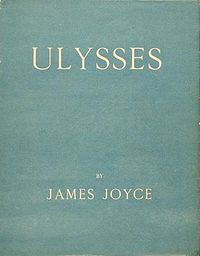
Review: ULYSSES by James Joyce


  • Original Publication Date: 1922
  • Genre: modernist fiction 
  • Topics: family, life, culture, philosophy, sex, process of thinking, parodies of different genres, Shakespeare, mythology, 
  • Review byBridget/Anachronist @ portable pieces of thoughts

Synopsis:

William Blake saw the universe in a grain of sand – he was a genius visionary. Joyce saw it in Dublin, Ireland, on June 16, 1904, a day distinguished by its utter normality – he was a genius writer.


Two characters, Stephen Dedalus and Leopold Bloom, go about their separate business, crossing paths with a gallery of indelible Dubliners. We watch them teach, eat, stroll the streets, argue, and (in Bloom's case) masturbate. And thanks to the book's stream-of-consciousness technique--which suggests no mere stream but an impossibly deep, swift-running river--we're privy to their thoughts, emotions, and memories. The result? Almost every variety of human experience is crammed into the accordian folds of a single day, which makes Ulysses not just an experimental work but the very last word in realism. In the past, Ulysses has been labeled dirty, blasphemous, and even unreadable and small wonder - the author takes both Celtic lyricism and vulgarity to splendid extremes. It is funny, sorrowful, and even (in a close-focus sort of way) suspenseful. One thing it is not: easy to read.

My impressions:

As the book itself is very long indeed, often called “the Mount Everest (or Chomolungma) of literature”, my review, surprise, surprise, will be uncommonly short. I’ll also try to restrain from using “stream of consciousness” technique although, I admit, the mere idea was very tempting. You get a nice pic instead:


So…yes, I read Ulysses - I mean I read and finished it. Honest injun! ;p Mind you, I did it not because I was forced but because I challenged myself. The experience left me slightly mad and dizzy. In a nutshell I think that if only Joyce weren't a genius he would be a terrific writer. My reading impressions are full of contradictions - the book was full of contradictions as well.

I loved it because it has so many deep literary and classical references: quotes in Latin, French, Greek, Italian, German, Hebrew, Gaellic; Bible quotes, mythology quotes, folk songs, Shakespeare and poems all mixed together. If you say you understand it all and know exactly what was quoted for what reason and from what source it means you are very well educated indeed, being – most probably - one of the English lit professors at Trinity, Oxford, Cambridge or elsewhere. I love long words - this book had plenty of them too. Some short ones as well :p.

I hated it because more often than not was boring as hell. I just couldn't care less about the characters and their navel-gazing, private parts-gazing, food-gazing, bathroom-visits-gazing and such. I just wanted them to get on with whatever they were doing and have Joyce interfere in their lives with his references, his poetry, and his overlong narrative considerably less.

I loved it also because the words, strung together in a stream-of-consciousness mellifluous, onomatopoeic way, read just beautifully, like no other narration I’ve read so far. I do believe that nobody and nothing compares to Joyce. On the other hand: most probably nobody would like to compare because, let’s face it, if you are not a genius such a style would render your book completely unreadable – not even by your most devoted lovers, friends and sycophants.

One thing is sure: if anybody claims they’ve read Ulysses quickly and painlessly, say in 2-3 days or even over a week, without serious skimming and/or cheating they are lying liars who lie. That's why I hated it:  it was a book which I could read no longer than 10-20 pages, 50 pages max, a day. Then, taking a leaf from Mr Bloom’s book who could read Aristotle and The Awful Disclosures of Maria Monk at the same time, I had to clean my palate with several pages of any pulp fiction, romance or erotica novel, something easy and cheesy; I used even m-m BDSM which is really not my thing (anyway The Administration series by Manna Francis helped a lot – just so you know).

Final verdict:
To read or not to read? That is the question...I would say: read it, especially as you can download it from the Project Gutenberg for free, but only if you feel you must or you really want to. It took Joyce seven years to write about one day of life of some plain Dubliners; my reading was, fortunately, quicker but still I struggled with that book over two weeks. It is a position perfect for literary masochists; still it is possible to enjoy it in a way but never like any other ‘normal’ novel. After finishing it you’ll never be afraid of any other book, fiction or non-fiction – not really. Can you fear a cat after taming a tiger?

Now four short, beautiful quotes to whet your appetite. Only four and really short, all of them. I promise.

“Love loves to love love.” (And a rose is a rose is a rose is a rose...ah, bully for Joyce for pouring such sentimentality into his masterpiece of high-brow literature. Did you know there’s essentially a romance novella written in the middle of this book? Would you guess it? Apart from that there is a scene with as many as four prostitutes – go figure.)


Think you're escaping and run into yourself. Longest way round is the shortest way home.” (What a pity I hadn’t known that before, my legs wouldn't have hurt so badly ;p Well-spotted, Mr. J.)


“Shakespeare is the happy hunting ground of all minds that have lost their balance.” (I wholeheartedly agree. Not that Joyce is much different - hello pot, meet kettle ;p.)


“We can’t change the country. Let us change the subject.” (It only proves that every politician or would-be politician should read Ulysses as well. Some great, ready-to-use lines are waiting.)


If Marilyn Monroe could read it, you can read it too!

Download Ulysses by James Joyce (if you are brave enough that is) at Project Gutenberg|Librivox|
Enhanced by Zemanta

Sunday, April 20, 2014

Happy Mystery Day!

c auguste dupin

Fun fact: Today, April 20th, is the 173rd anniversary of the publication of the first detective story, The Murders in the Rue Morgue by Edgar Allan Poe! Poe's detective, C. Auguste Dupin, inspired Arthur Conan Doyle's Sherlock Holmes.

To celebrate the birth of the mystery novel, curl up with Poe's Dupin stories: The Murders in the Rue MorgueThe Mystery of Marie Rogêt, and The Purloined Letter.

You can also check out my review of the Dupin series, or find out more about the first mysteries.

Friday, April 18, 2014

Review: FAR FROM THE MADDING CROWD by Thomas Hardy


Original Publication Date: 1874
Genre: English, British, rural, classic
Topics: farm life 19th century


Review by : Liz Inskip-Paulk (www.ravingreader.wordpress.com)


Really enjoyed this Hardy title, and found that as the book progressed, it became harder and harder to put down and go and do “real life” things. I ended up doing a marathon read last night and was really immersed into Wessex and the lives of the villagers that Hardy had conjured up.
What I was most interested in this read was the difference in vocabulary and references that Hardy uses in his writing. It’s been a while since I have needed to do a “New Words to Me” blog post, but reading Hardy helped me to add a lot of new words to that list, along with loads of references to biblical and Greek/Roman myths.
So – why is it that more recent/modern writers tend to stick to the familiar vocabulary and images when other older ones didn’t? Yes, some modern writers do play a lot of with language (John Banville comes to mind), but generally speaking, there is not the range of vocabulary in more modern publications. (Perhaps it’s just the ones that I’ve been reading?)
Is it because the older (read: Victorian) writers wore their learning lightly and made these literary references assuming that the reader would know them? Or were these older writers being elitist and showing off their education to their readers? Would the average reader at the time of Hardy know his references to Ixion’s punishment and when “the sailors invoked the lost Hylas on the Mysian shore”? Or were his readers just as puzzled as I was (and hitting the books to find out more)?
Another curious point is the link between the main female character -- Bathsheba Everdene -- and the more current heroic character of Katniss Everdeen in “The Hunger Games”. I had wondered if there was a connection between the two, and in further research, it seems that HG author Suzanne Collins did name Katniss as a homage to the Bathsheba character – both have strong independent characters that don’t always go down well in the society in which they live, both have similar romantic issues (Katniss/Peter (I think), and Bathsheba/Gabriel)… I wonder how many teen readers know that as the reference? Probably not, I would think, which is a shame as Hardy is a great read.
Speaking of literary influences, now I am curious to re-read Posy Simmonds’ graphic novel Tamara Drew which heavily references Far From the Madding Crowd. When I first read the Simmonds’ work, I hadn’t read this particular Hardy title so probably ended up missing a ton of references. I’m interested now to go back and re-read the graphic novel and see the parallels between them.
I’m now thinking of finding the 1967 movie adaptation of Far… as that seems to have the best reviews. (Although I am curious to see David Nicholl’s 2013 BBC adaptation as well. Perhaps I can catch some of that when I visit UK later this fall.)
It’s a shame that more people don’t read more Hardy – I think they think of him as writer of tragedy and sadness, but if you read his Wessex books, they are pretty light-hearted and funny at times. I’d almost classify Hardy as a rural more down-to-earth Jane Austen in some ways, but people tend to get stuck on the disastrous story of Tess and get scared off. They’re missing out.

Download Far From the Madding Crowd by Thomas Hardy at Project Gutenberg|Librivox|