Wednesday, January 22, 2014

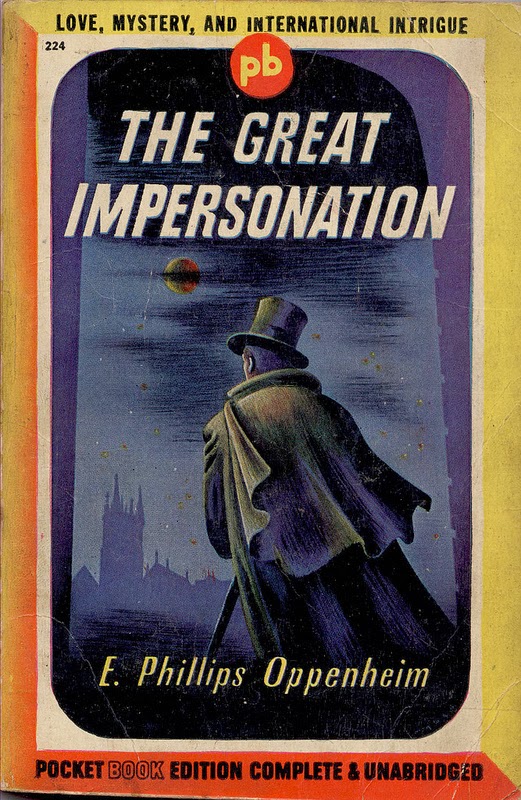
Review: THE GREAT IMPERSONATION by E. Phillips Oppenheim

book cover Original Publication Date: 1920

Genre: Mystery

Topics: Espionage, Germanic horde, WWI, love, civilization vs savagery


Review by heidenkind:

Sir Everard Dominey, living in self-exile in Africa, wakes up after a night of drinking too much whiskey to find himself the guest of Leopold von Ragastein, his doppelganger. The two have many similarities beside their appearance: they both have a natural gift for languages, and Ragastein is also in exile after killing his mistress' husband in a duel. The only major difference between them is that Ragastein is German and therefore EVIL. After spending the night prying into the life of Everard Dominey, Ragastein and his friend, Dr. Schmidt, send Dominey out into the African desert with no water and nothing but extremely salty food, never to be heard from again. Then, taking on the identity of his double, Ragastein goes to England, where he, impersonating Everard Dominey, is in the perfect position to be the greatest and most insidious German spy of all time. But will he have the heart to do what the Kaiser asks of him? And is Everard Dominey really dead?

I decided to read The Great Impersonation after I "overheard" Melody from Redeeming Qualities and Evangeline from Edwardian Promenade talking about it on Twitter. I'm so glad I did! The Great Impersonation is an absolutely great story, good enough for me to overlook the constant references to Rosamund Dominey, Everard's homicidally insane wife, as "childlike" (yes, his wife is insane and homicidal, YET CHILDLIKE. You're hooked now, aren't you?).

As soon as "Dominey" returns to England, the reader is sure two things are going to happen: Leopold's going to fall in love with Dominey's wife, and the real Everard Dominey is going to show up and spoil everything. Of course, this should be something the reader wants to happen, since Leopold is GERMAN and therefore EVIL. But in actuality, Leopold is kind of upstanding and honorable, and—now that he's in England—demonstrates some divided loyalties between England and Germany. It's almost enough to make one think The Great Impersonation might be the only book in all of 20th century English literature where there's a good German character. Almost.

I also liked how The Great Impersonation is a cross between several genres. Yes, you have the whole spy/WWI plot; but it could also arguably be classified as a gothic mystery, what with the ominous Dominey homestead (filled with secret passages, hauntings, superstitious locals, and an adjacent cursed forest, OF COURSE) and the disappearance of Roger Unthank; as well as a coming of age tale.

Basically, if you're looking for an entertaining, fast-paced novel with mystery, romance, and twists, you can't go wrong with The Great Impersonation. I'll definitely be reading more of E. Phillips Oppenheim's work in the future!


Download The Great Impersonation by E. Phillips Oppenheim at Project Gutenberg|Librivox

Thursday, January 9, 2014

Review: THE MYSTERY OF THE HASTY ARROW by Anna Katharine Green

book cover Original Publication Date: 1917

Genre: Mystery

Topics: Love, tragedy, betrayal, ambition


Review by heidenkind:


In the middle of a museum gallery, a young woman lies dead, an arrow shot straight through her chest. An older woman claiming no connection with the victim is found hovering over the body, muttering incoherently. Was it murder or a tragic accident? And who was the young woman? The aged detective, Mr. Ebenezer Gryce, is on the case to find out.

Anyone who reads this blog regularly knows I like to make fun of Anna Katharine Green, but The Mystery of the Hasty Arrow is actually a pretty decent book. The mystery is super-twisty and the story has the scope of a Greek tragedy.

Naturally the woman hovering over the girl's body is the initial suspect, but Gryce doesn't think she committed the murder. After locking down the museum and questioning all the visitors, Gryce discovers one of the men who witnessed the murder actually knew the victim, kinda sorta. You see, he fell in love with her at first sight and then chased her all the way across the Atlantic on a steamer ship from Europe to New York, never introducing himself, just always watching. STALKER MUCH? Gryce thinks Mr. Travis is a pretty weird dude, but still doesn't like him for the murder. Fortunately Travis has some useful information: the name of the girl (Angeline Willetts) and the fact that she was traveling with a French woman. Gryce and his team search all the New York hotels, only to discover that Angeline Willetts' traveling companion up and walked right of their hotel shortly before the murder took place. Dun dun dun!

And that's just the start of the novel.

Don't get me wrong, The Mystery of the Hasty Arrow has a few major problems. It's way too long—a quarter of it is all about the chase to find the French woman, and the denouement is inSANEly long—but overall I really enjoyed it. One of the things that always bugs me about Green's books is that everything is as it appears. The grieving yet ditzy widow is actually just a grieving airhead, the dangerous vagabond is actually a dangerous vagabond, etc. That's not the case in this book, though! No one is as they first appear, and the conclusion to the story definitely surprised me and went in a direction I never expected. I mean, yes, there are still some WTF scenes and everything is superfluously dramatic, but in the case of this particular story it didn't seem as weird as it has in some of Green's other works.

Basically, if you've been thinking about trying one of Anna Katharine Green's novels, I'd recommend The Mystery of the Hasty Arrow. It's definitely the best Green mystery I've come across so far.


Download The Mystery of the Hasty Arrow by Anna Katharine Green at Project Gutenberg|Librivox|GirleBooks

Thursday, November 21, 2013

Review: THE STRANGE CASE OF DR. JEKYLL AND MR. HYDE by Robert Louis Stevenson

book cover Original Publication Date: 1886

Genre: mystery, horror

Topics: madness, good vs evil, society


Review by heidenkind:

Mr. Utterson, a London lawyer, is concerned that his friend, Dr. Jekyll, has developed a relationship with an unsavory character named Mr. Hyde, especially as Hyde has been connected with several incidents of violence and assault. Eventually Jekyll assures Utterson he's cut off all ties with Hyde, but the mystery of Hyde's connection to Jekyll persists, especially after Jekyll disappears.

A few weeks ago, I got it into my head that I was going to read The Strange Case of Dr. Jekyll and Mr. Hyde. This is a book I'd had no interest in reading before; and, considering I DNF'd Treasure Island earlier this year, I didn't have super-high hopes for it. I was pleasantly proved incorrect—I loved Jekyll and Hyde, and this novel will definitely land on my short list of favorite reads of the year.

Robert Louis Stevenson had me from the very beginning of the story with his comparison of Utterson—a completely conventional, moderate, and reasonable man—to that of his friend and distant relative, Mr. Enfield, a "well-known man about town":

It was a nut to crack for many, what these two could see in each other, or what subject they could find in common.

In this way Stevenson immediately sets us up for a story about the multiple sides of men's characters—for, if Utterson was completely mild-mannered and Enfield completely dissolute, how would they manage to enjoy one another's company so much? Clearly there's a little of Utterson in Enfield and vice versa.

Fittingly, it is through Enfield that the character of Hyde is introduced, seen in a disreputable part of town knocking over a little girl. Utterson also knows Hyde, or knows of him, because Hyde is mentioned in the will of his friend, Dr. Jekyll. Like Utterson, Jekyll is an upstanding gentleman whose friends are "all intelligent, reputable men and all judges of good wine." So what would Jekyll have to do with a reprobate like Hyde? Utterson wonders.

Obviously we all know the answer to that question, even if we haven't read the book. But the real issue driving the story is WHY—what would drive Jekyll to even conceive of a way to isolate a part of his personality and then switch from one to the other?

Jekyll and Hyde was not what I was expecting based on the adaptations I've seen. It's more of a detective story than a horror story, and neither Jekyll nor Hyde are as good or evil as they've been portrayed. Is Hyde really evil, or is he just uncivilized? He knocked over the girl by accident, and he did offer recompense to her family. It seems like Hyde's demonic nature is more perception than reality; as soon as people see him, they detest him. According to Enfield,

I had taken a loathing to my gentleman at first sight. So had the child's family, which was only natural. But the doctor's case was what struck me. He was the usual cut-and-dry apothecary, of no particular age and colour, with a strong Edinburgh accent, and about as emotional as a bagpipe. Well, sir, he was like the rest of us; every time he looked at my prisoner, I saw that Sawbones turn sick and white with the desire to kill him.

How else is a person supposed to react when people treat them like that?

Jekyll wasn't the mild-mannered shy physician I anticipated, either: he's a gentleman bachelor NOW, but it's stated that in his youth he was "wild," and there's a certain "slyness" about his face.

It's for these reasons that I don't see The Strange Case of Dr. Jekyll and Mr. Hyde as being a tale of good versus evil—instead, it's a cautionary tale about conformity. Jekyll wants to be normal and to fit in with those men who are respectable and intelligent, so he tries to remove the part of himself they would shun if they knew about it. Whether it's addiction, the id, or a demon, Hyde represents whatever society rejects. In Jekyll's attempt to conform to society's definition of a gentleman doctor, he in turn rejects the part of himself that society finds distasteful, and in the process he destroys himself.

The Strange Case of Dr. Jekyll and Mr. Hyde is one of those deceptively simple novels, like Animal Farm, that's a good story and also makes you think. It's accessible to people of all ages and backgrounds and can be read simply as a great story, an indictment of Victorian society as a whole, or anywhere in between. Definitely a book I think is a must-read.


Download The Strange Case of Dr. Jekyll and Mr. Hyde by Robert Louis Stevenson at Project Gutenberg|Librivox|Internet Archive

Monday, November 11, 2013

Happy Birthday, Anna Katherine Green

Today is—or would be, if she was still alive—Anna Katharine Green's birthday. Green was the first woman to publish a mystery novel (The Leavenworth Case in 1878), and her books tend to be really weird. I don't know why I keep reading them, but I find them bizarrely fascinating. Like watching a Japanese game show: you have a general sense of what's going on, but you can also tell there are things getting lost in the translation. Except in Green's case, the translation is one of time rather than language.

By coincidence, I'm taking a class on historical fiction through Coursera right now called Plagues, Witches, and War: The Worlds of Historical Fiction, and Anna Katharine Green is one of the major authors featured. Apparently she was not just the first woman to publish a mystery novel, but was also the first person to write a historical mystery! Mind: blown.

The book in question is titled The Forsaken Inn; and yes, it's already on my Kindle. I thought it would be fun to include the instructor, Bruce Holsinger's, lectures on it here (I really hope the videos work):


Green was a realist? HOLY SHIT YOU GUYS, her books make so much sense now (I'm kidding, they still don't make sense). As a side note, Holsinger's obvious enjoyment of Green's very Victorian writing style is kind of adorkable.


One of the most interesting things I'm learning from this class is how much information can be found in the title pages of old books. They're like the metadata files of books in paper!

Anyway, happy birthday to Green, a very interesting and innovative author in her time period. Nice to see her getting some more attention!


Friday, November 1, 2013

Review: PYGMALION by George Bernard Shaw


Original Publication Date: 1912 -- Genre:  Play, drama -- Topics: Coming of age, bildgunsroman Review by : Liz Inskip-Paulk (www.ravingreader.wordpress.com)
 
Although having been vaguely familiar with this story, I’d never actually sat down and read the actual play or researched its background, so decided to do that this week. I’m quite new to reading plays and it’s rather a different experience than reading a novel, but it’s enjoyable all the same. This one, based on Greek myth, is a familiar story structure based on taking someone (sort of Noble Savage/Frankenstein idea) and then transforming them into a higher class of creature (a la Cinderella tale).  And as a sign of the times and the national culture, this play’s characters are extremely class-ridden. (There’s also a trace of the ongoing science versus art debate as well.)

In this case, the characters of Dr. Higgins and Colonel Pickering, two self-taught scholars in linguistics, pull flower seller Eliza Doolittle off the streets and teach her how to become a Duchess. There are, of course, unforeseen events that occur and it’s actually much more serious that the adaptation “My Fair Lady” would have you believe. There’s definitely an element of Higgins/Pickering (both men) being Superior Gods of a type, and Eliza (the female character) being molded/taught and in the position of a child or less being.

 (It’s also argued that Pinocchio is an adaptation of this Greek myth as well, and the narrative was well known before this play and now afterwards, Magnum PI and Star Trek: Voyager, for instance, both have versions, and then there are numerous Hollywood versions including Pretty Woman and with an interesting twist backwards, the Stepford Wives.)

According to Greek myth (and Ovid, although I haven’t read Ovid), Pygmalion was a sculptor who fell in love with a statue he carved. (The statue’s name was Galatea, FYI, and quite frequently the two names are paired together. (Doesn’t come up too often in my social circles though.)  The story finishes with a happy ending in most versions (as there was a popular demand for that), but Shaw plainly didn’t want that to happen (even though it did in some of the more commercial stage productions – which he hated.) In 1916, four years after the play had first been staged, Shaw was cross enough to add an afternote to the play in which he explains why he thought the ending had to be the way he wrote it. (It’s not a predictable ending, for the most part. The narrative is also quite feminist for the times, although that decision is supported by Shaw’s background and philosophy.)

 “I sold flowers. I didn’t sell myself. Now you’ve made a lady of me, I’m not fit to sell anything else.”

Shaw was an Irish playwright and worked to establish the London School of Economics (although it’s not clear to me what the connection would be between these two areas.) His mum was a professional singer, one of his sisters was a professional singer, so there was stage in his bones and childhood experiences.  He was an ardent socialist (clear in this play) and, curiously enough, is the only person who has ever been awarded both the Nobel Prize in Literature (1925) and an Oscar (1935) for his work on Pygmalion. Having no want for public honor, Shaw wanted to refuse the Nobel but accepted it at his wife’s bequest. The financial prize was personally rejected and he asked that it be used to finance translation of a Swedish playwright’s work.

Interesting note: Shaw joined the British Interplanetary Society, a group focused on space travel and exploration, when he was 91. I love that he was always learning something new throughout his life.


Download Pygmalion by George Bernard Shaw at Project Gutenberg|Librivox|

Monday, October 21, 2013

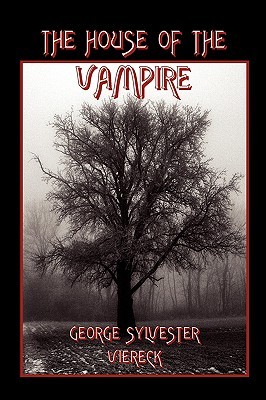
Review: THE HOUSE OF THE VAMPIRE by George Sylvester Viereck

book cover Original Publication Date: 1907

Genre: horror

Topics: vampires, love, art


Review by heidenkind:

Ernest is a young writer with great ambition, so he's thrilled when the famous author, Reginald Clarke, offers him a room in his house while Ernest works on the next Great American Novel. Weirdly, though, Ernest can never focus on his own work; and in the meanwhile Reginald Clarke's most recent writings seem to be taken directly from Ernest's ideas, even though he never told anyone about them. Will Ernest's girlfriend and bestie be able to rescue him from Reginald Clarke's clutches before he loses his talent and writing ability forever?

When Chris reviewed The House of the Vampire here last year, I immediately knew I wanted to read it. A psychic vampire who steals people's ideas? Sounds like a few professors I've known (haha, I kid—but the relationship between Clarke and Ernest does have a very mentorship-gone-wrong feeling to it that sometimes happens in academia).

Despite Chris's review, though, The House of the Vampire wasn't exactly what I was expecting. I was thinking Reginald Clarke's house would be chock full of young artists participating in a bacchanal free-for-all, but instead Reginald Clarke—he's always referred to by both his first and last names—very monogamously focuses on destroying one artist's life at a time.

There was also less homosexual innuendo than I expected, considering this book is touted at the "first gay vampire book" (aside from, you know, Carmilla). Ernest and his bestie have a rather close relationship, but both he and Reginald Clarke are obviously interested in women; and honestly, in comparison to the Victorian vampire novels I've read, the sexual innuendo in The House of the Vampire bordered on nonexistent. Reginald Clarke's psychic vampirism is a metaphor, of course, just not for sex. Instead, it represents unchecked power. Rather than being modeled off of traditional vampires, Reginald Clarke is more along the lines of Nietzsche's Übermensch, which  Rüdiger Safranski said, "...represents a higher biological type reached through artificial selection and at the same time is also an ideal for anyone who is creative and strong enough to master the whole spectrum of human potential, good and 'evil', to become an 'artist-tyrant'." (Wikipedia) That's a pretty close description of Reginald Clarke, and I would say that it's clear George Sylvester Viereck was not a proponent of Nietzsche's philosophy IF I didn't also know he was a full-on Nazi. Interesting dichotomy of belief there.

I was also pleasantly surprised—even shocked—at the depth of insight Viereck brought to Ethel, one of Reginald Clarke's former victims and Ernest's muse. She's The House of the Vampire's single major female character, so it's not like the book passes the Bechdel Test or anything; but Viereck does treat her as a 100% human, fully-realized character who drives the actions of the main characters in the second half of the book. She's intelligent, independent, and sympathetic. She might be the best female character written by a man I've ever come across.

Overall The House of the Vampire was a very interesting, entertaining, slightly creepy read. It's more about art and ideas than vampires, but I'm cool with that. Definitely worth checking out.


Download The House of the Vampire by George Sylvester Viereck at Project Gutenberg|Librivox

Thursday, August 29, 2013

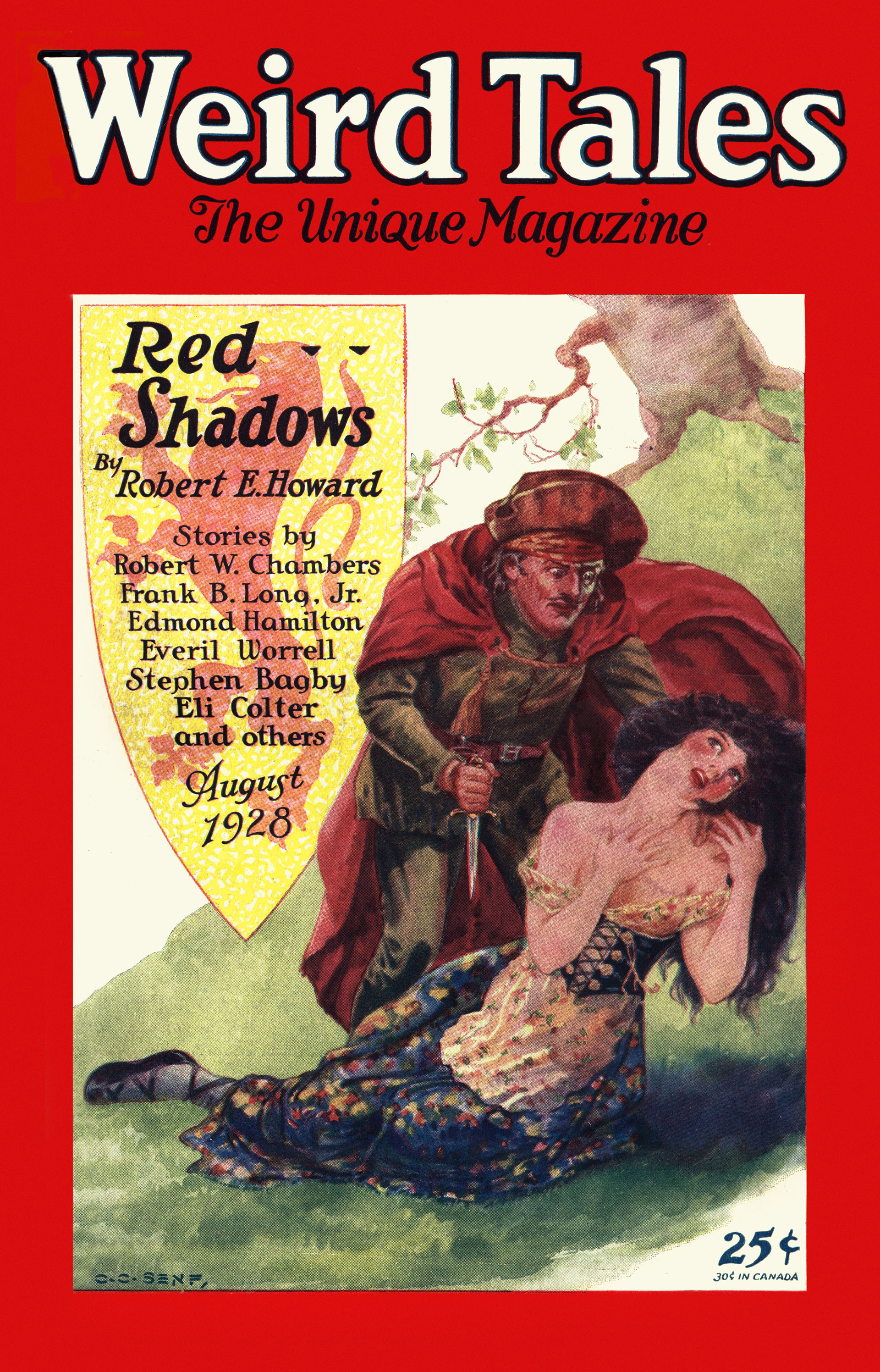
Review: RED SHADOWS by Robert E. Howard

book cover Original Publication Date: 1928

Genre: adventure

Topics: revenge, swashbuckling


Review by heidenkind:

Solomon Kane, an English adventurer with a wicked blade, is wandering aimlessly around France when he randomly stumbles across a girl. She's been robbed and attacked and left to die. As her life fades away, Kane decides to seek vengeance! against leader of the brigands who killed her, Le Loup.

Red Shadows isn't a Conan story, which is slightly disappointing. But it is a swashbuckling tale with swordfights, gigantic Baroque hats, and over-the-top dialog. ("Fires of Hades! A girl!") So it's still really fun.

The writing style is more abrupt than Robert E. Howard's Conan novels: each chapter feels like a vignette and then we're abruptly moved to a completely different place and time. I kind of think Solomon also has less personality than Conan; or at least, his motivations are less clear. Conan's motivation is self-interest, which isn't particularly complex, but Kane is a like a vengeance machine. Like that's all he does, for no benefit to himself that I could see. In fact, it seems to bum him out. Maybe some of his backstory is revealed in the later stories, but for Red Shadows there wasn't a lot of character development going on. Maybe if the only female character hadn't died in chapter one I'd be happier with this novella.

you killed my father prepare to die


Still, overall it was a good story. Kane travels to Africa in his obsessive quest to take down Le Loup, which is totally random, and there are literally pages where all Howard talks about are his characters' eyes as they have the longest stare-down in history. I love it. And I definitely wouldn't object to reading more Solomon Kane stories, because who doesn't love a highly skilled swordsman whose mission is vengeance, right?


Download Red Shadows by Robert E. Howard at Project Gutenberg Australia|Librivox