Wednesday, May 29, 2013

Review: THE THREE MUSKETEERS by Alexandre Dumas

book cover Original Publication Date: 1844

Genre: adventure

Topics: love, coming of age


Review by heidenkind:

Less awesome alternative title: D'Artagnan, the Early Years

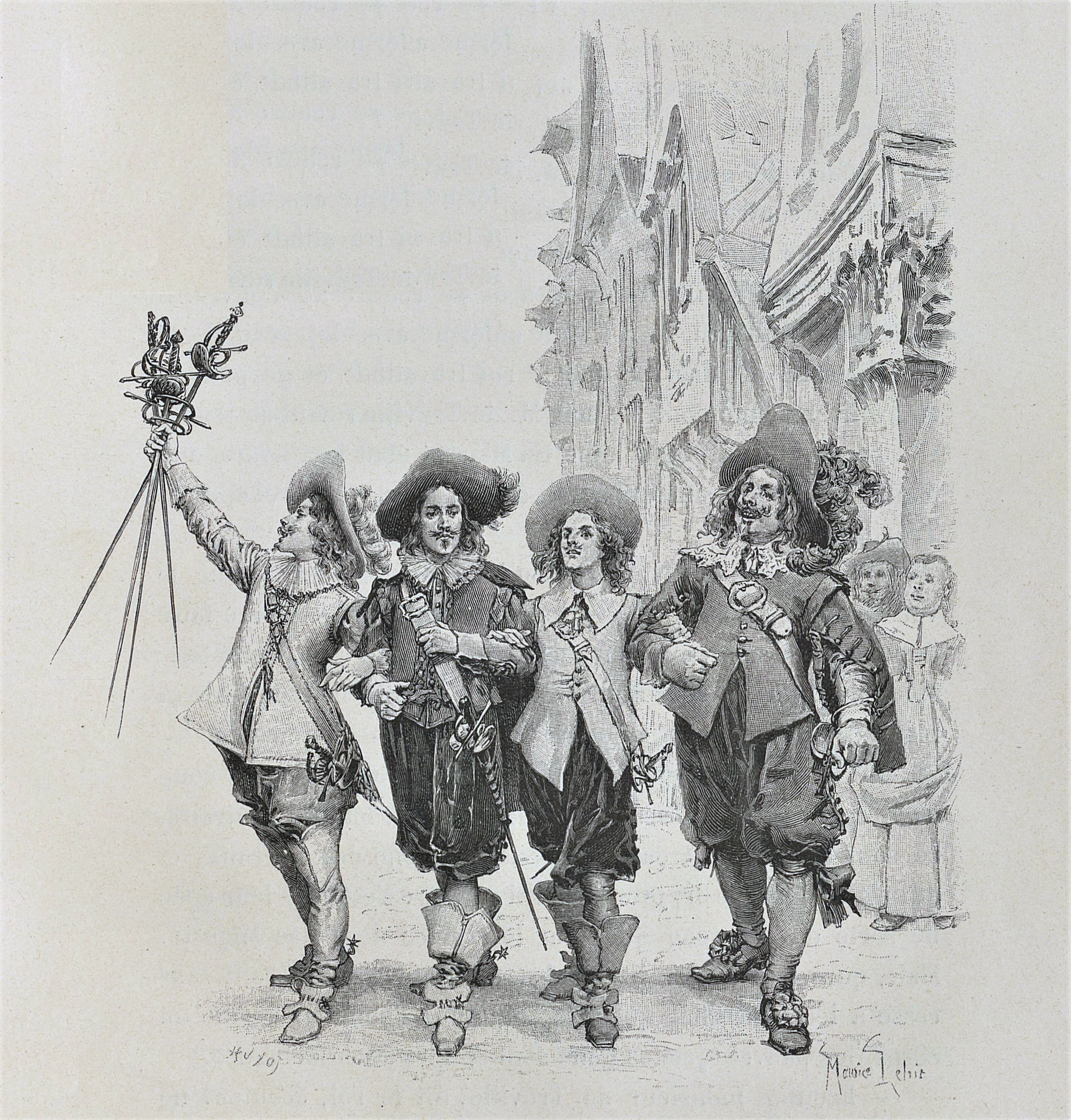
A young man from Gascony sets out for Paris with big dreams, namely to join the king's personal guards, the Musketeers. He finds he can't join the Musketeers, but he does befriend three of them: Athos, Porthos, and Aramis. D'Artagnan has one weakness, which is that he falls in love constantly with incredibly unsuitable women, and this winds up getting him and his friends into trouble of the most royal kind.

It took me about six weeks to make my way through this massive book—on audio—but honestly, it didn't FEEL like six weeks. Dumas does go off on one or two tangents, but for the most part the story is so tightly told that it felt like the book was flying by even though it was long. And honestly, if it had went on forever and ever, I WOULDN'T HAVE CARED! I would have happily listened to/read this novel unto eternity, because I loved these characters so much.

D'Artagnan is the main character of the novel (obviously), and I loved how he developed over the course of the story. At first he's very unsure and eager to prove himself, and therefore extremely defensive. He's willing to challenge anyone to a duel for any slight, real or imagined. But after he makes friends with the Musketeers, it quickly become clear he's the brains of the operation. He's super-smart and even wiley, but his heart's in the right place. Most of the time.

Athos is d'Artagnan's bestie. Everyone love Athos because of his Dark Past. I won't say any more about it for fear of spoilers, but he's an awesome character. The scene where he eats and drinks an inn keeper out of house and home while defending himself against all comers is PRICELESS, I tells ye.

Porthos is a playa playa and Aramis never really says anything, so.

I can see why English people love this book, because the only main English character, the Duke of Buckingham, is a total freaking badass and I would totally hit that.

Lady de Winter--ZOMG. LOVE HER LOVE HER LOVE HER LOVE HER. She's the best villainess I've encountered since Lady Audley. She's smart, and resourceful, and I really can't blame her for being pissed at Athos and d'Artagnan and the men folk in general, but she's also SO EVIL! But I love her!

I can't believe it took me this long to read The Three Musketeers just because I was intimidated by the length. Shame on me! It's not the length of the book but the story it tells, and this one tells a rollicking, swashbuckingly, non-stop story from beginning to end. I highly recommend you read it.


Download The Three Musketeers by Alexandre Dumas at Project Gutenberg|Librivox

Monday, May 27, 2013

Review: XINGU by Edith Wharton

Original Publication Date: 1916

Genre: short story, satire

Topics: closed society, women, book clubs

Review by : Patty @ A Tale of Three Cities


When one is under a sick spell, one should stick to simple, short and entertaining stories:  on such an occasion I turned to Xingu, by E. Wharton to ease my pain.  It delivered:  a cynical but very, very entertaining little story, perfect for my predicament...

What is Xingu?  well, we get to learn that at the very end of the story and this serves only to highlight the main point:  the superficiality of "good society"... Because the story is about a book club, where only the "chosen" ones get to belong to, where only the "wise" get to showcase their books and where those who belong to neither cast get to show their wealth.  It rang some bells with me, as I belong to two book clubs - and while there is nothing remotely similar to Xingu, I could recognise some instances I may have encountered myself (I'll leave it to this...)

The ladies of the book club are eagerly waiting the arrival of a famous author, to discuss her latest book.  We are given the characteristics (i.e. the vulnerable attributes) of everyone in the  group and we get an insight into their habits:  we get to know Mrs. Plinth, the distinguished member, in particular.  Looking down on everyone, she is the epitome of the "nerd-type" party of a literary group, a person who sees as their ultimate goal to make a name for a well-educated, industrious and valuable member (or a book club or society in general).   She declares:

"Amusement is hardly what I look for in my choice of books"

No, of course not.  One has to toil, or at least to make others thinks so.  Because when in another instance a question is posed, our dear Mrs. Plinth is revealed to utterly dislike

"...  being asked her opinion of a book.  Books were written to read; if one read them what more could be expected?  To be questioned in detail regarding the contents of a volume seemed to her as great an outrage as being searched for smuggled laces at the Custom House"

Now, I have met such people, I have to admit.  And I have seen this struggle to pretend to being something more.   Something greater.  Something higher.  And it just won't work.  There will always be a black sheep (hello, Mrs. Roby), who will basically form part of this group by accident.  But she will never strive to prove her worth against her fellow members. She is content with what she is and does, and will not hesitate to show how well she knows the others by playing a nice little farce.  A farce so well executed, she will even fool the distinguished guest.  The guest who will recognise Mrs. Roby's genius and will leave the whole group to further engage in a discussion with her.  Double the trouble then:  the group agree it's time they let Mrs. Roby go.  They shan't be made to look like fools by someone who is not deemed suitable to "participate in the mental gymnastics of the club".

And so, order is back:  everyone in the group will have their distinct role to play, and there will be no more disruptions by "outsiders".  Yes, it's all coming back to me, I knew I recognised this story...


Download Xingu by Edith Wharton at Project Gutenberg|Librivox|

Tuesday, May 21, 2013

Review: THE GREAT GATSBY - F. Scott Fitzgerald

Original Publication Date: 1925                                             Genre: American, classic                                                            Topics: Jazz Age, between the wars


Review by : Liz Inskip-Paulk (www.ravingreader.wordpress.com)


With all the recent hoopla about the recently released movie adaptation of “The Great Gatsby” and with the recommendation of a trusted fellow reader, I decided to pick up a copy of the book and see how it read.  The last time I had poked my head into it was during the rush and crush of grad school, and as that was such a rushed read, I don’t think I got a real appreciation of it. So read it again this week (and then immediately read it one more time to enjoy the writing and imagery at a much more leisurely pace).

Wow. What a difference a few years makes. This more recent reading was a completely different experience for me and I realized that I had not the same appreciation before due to the speed of grad school reading requirements or because I am much more experienced in the world of books now. (Perhaps it’s both.)

This is one of the few books that I immediately picked up and read again once I had finished it. I wanted to read it a second time to notice all the recurring imagery that Fitzgerald had put in there, and also, having read a brief biography of Fitzgerald and Zelda (both troubled in their own ways), it’s clearly much more autobiographical than I had realized before.

I’m not going to go over the plot – there are other resources for that and besides, I’d like people to read the original text to get their own ideas. This is fabulously written and seems to perfectly capture the rich idle ennui of the wealthy young in the Jazz Age (a phrase, incidentally, that Fitzgerald is credited with originating). The characters in this story drink to get drunk, they chat with people they don’t know about things they don’t care about, and all this in an atmosphere of excess – money, time, drink…

Fitzgerald and wife Zelda spent some time as expats in Paris at the same time as Hemingway and those guys, and although Fitzgerald and Hemingway were good friends, Hemingway rather sneered at Fitzgerald’s “selling out” and writing commercial stories to pay the bills. (Oh, how superior you must be, Ernie.) They both had alcohol problems and marital challenges, and obviously influenced each other in how they wrote – very spare sentences (despite the excessive and overloaded world Fitzgerald portrays).

Gatsby’s world seems to have been bought on every level – one evening, the “premature moon, produced like the supper, no doubt, out of a caterer’s basket…” Everything can be bought, everything can be sold.

Written in 1925, it predated the Depression years and reflects the over-consumption and deep feeling of detachment and isolation felt by some people at that time. Fitzgerald’s characters have a sense of despair unspoken and Gatsby is frequently portrayed removed from all his guests by him not drinking, by the shallow chatter, and by the fact that most of his guests don’t even know the host.

Fitzgerald writes that Gatsby not only dispenses generous hospitality to people, but also “dispensed starlight to casual moths”.  Light plays a huge role in this book – just think of the green light at the end of the dock – as does color (especially colors linked with the sun: yellow, gold, orange… Once you see this, you tend to recognize it more than otherwise. At least, I did.) 

It’s a love story (of so many things) on some levels, but it’s not one that the typical person would want to replicate – it’s unrequited (or is it?), it’s complicated, it’s delayed by five years and a marriage to the wrong person (Daisy to Tom). And throughout the story, I would argue that there’s a light veiled theme of same-sex attraction between various combinations of characters (mainly male).  Gatsby wants to go back to the past when he first met Daisy five years ago, although it’s not possible (and not healthy) to do so. And the “five years” pattern repeats itself quite a few times: Gatsby and his rich friend Dan Cody were together on the nautical adventure for five years, it’s been five years since Gatsby has last seen Daisy, and he’s been living on West Egg for five years… Fitzgerald is not known for his “sticking to the facts” (was “not scrupulous about real details” is how scholar Dr. Matthew Bruccoli* put it) and “was incapable of factual meticulousness” (i.e. he says that Nick Carraway was from the Mid-West: San Francisco! – but details schmetails.) So – was the five-year period there for a reason?

“Can’t repeat the past?... Why of course you can!” (Jay Gatsby)


This is really one of the best books that I have read this year, and I can’t believe that I didn’t really appreciate (or even like) this book on earlier readings. If this was a title forced on you in your younger educational days, I urge you to take another look at it. With the experience of years, it can be a completely different experience to read it again and I have loved reading it this time around.

Now I’m not sure about going to the movie – I can’t believe that it would do justice to such a rich storyline and characters. Highly recommended.

·         I am sure this guy has never received any guff about his last name. Nope. Never.

Download The Great Gatsby by F. Scott Fitzgerald at Project Gutenberg.

Thursday, May 16, 2013

Review: BURIED ALIVE: A TALE OF THESE DAYS – Arnold Bennett


Original Publication Date:1908                                     
Genre: classic, satire                                                                         Topics: mistaken identity, farce, art


Review by: Liz Inskip-Paulk (www.ravingreader.wordpress.com)


It's  been a long while since I have leisurely browsed the library shelves, and so I happened to wander over to the B section just to see what was there on offer. I came across a few copies of Arnold Bennett's writing, and since I really enjoyed "The Wives' Tale" a while back, I saw this one and checked it out. It was an  older book edition, it had yellowing pages and the font was perfect so if it ended up being a good story to boot, then it was win-win-win :-).
 
Bennett was a prolific writer and wrote everything from novels to self-help so there is a lot to choose from (on-line). The pickings at our library were slim, but not everyone is quite the fan of writers such as Bennett and I get that. I was not familiar with this title, but felt comfortable checking it out after reading the jacket, and so I settled down one rare rainy Saturday last weekend for a good read. It was pretty much a “perfect read for a perfect time” type of situation which ended up being…perfect! Ha.

Written as satire, Buried Alive is a shortish novel that focuses on Priam Farll, a world famous painter who is very shy and happiest out of the limelight. When Henry Leek, the painter’s valet, dies unexpectedly, Priam seizes the opportunity to change identities with his unknown (and now dead) assistant and retreat to a much valued quiet life. At first, it was just an impulsive lark to do so, but as time continues and events start to get more complicated, the story picks up speed.

World-famous as painter Priam Farll is, his face is not well known due to his reclusive life (although this lifestyle was becoming hard to maintain as more and more people wanted to meet him and his social requirements picked up). As he becomes more famous, more was expected of him, and so when Henry Leek, the butler dies in bed one day, it’s a decision of a moment for Priam to assume his identity (and his quieter life) – and thus Priam’s life changes for ever.

This is a quick read and a light-hearted novel focusing on the old standby of mistaken identity, dead bodies and turnkey moments in someone’s life. And yet, trite as that may sound, this was also a great read – it’s not a demanding narrative, but if you’re just looking for a solidly good read that’s hard to put down, then you’ll be happy with Buried Alive. It’s not deep; it’s not provocative; it’s not packed with lots of big words, but it is an enjoyable way to spend some time.


Download Buried Alive by Arnold Bennett at Project Gutenberg|

Monday, May 13, 2013

Review: THE THIRTY-NINE STEPS, by J. Buchan


Original Publication Date: 1915


Genre: adventure, suspense

Topics: war, espionage, duty, man on the run


Review by : Patty @ A Tale of Three Cities


John Buchan is a well-known Scottish author who wrote The Thirty-nine Steps while recuperating from an illness.  The title of the book came from a flight of 39 steps found in this nursing home...


It is considered one of the first "shockers" - combining personal and political drama -, but I actually watched Hitchcock's film adaptation by the same name first:  though not one of his best and memorable, it was adventurous enough to let 1.5 hours pass by.   As I came across the book, though, I wanted to see whether the plot there would be "flat" compared to the film, or whether it would be just as thrilling?

The novel describes the "man on the run", which would later become something of a standard in films noirs. We always identify with him and follow his adventures, and rejoice in his redemption in the end...

I said I liked Hitchcock's version, but next to the actual book, it simply pales in comparison:  the book starts with a general overview of the political climate at the time - Europe is on the verge of war and various political alliances form and threaten others.  It was very interesting to see (this is 1915) how well aware Buchan was of the little intrigues that were formed and how the would contribute to the deterioration of society, and I could even detect some early comments against the Jews that I could well imagine continued, increased and contributed to another war as well...

But this is just the setting of the story.  Already from the beginning the plot does not resemble at all the film, and I find I like the book more:  we get to know a little about Hannay first and become aware of his weaknesses and we understand better all that will ensue.  The initial meeting with the victim that will trigger the rest of the plot is in the building where Hannay lives (it's a neighbour), and not in a theatre with a total stranger.  All is more believable in the book, and more focused on the details that will explain the steps to follow.

I continue reading and I start getting upset with Hitchcock.  He has managed to distort the plot in every possible manner.  And while I understand that in a black & white film one cannot see much of nature, Buchan's novel is full of beautiful descriptions of the Scottish landscape that provide the background elements for the chase, the capture, the escape and all other action scenes with Hanney.

This is a story of a bored man (well-off, naturally and recently back from Rhodesia) who seizes the opportunity to do something for his country and thus come to realise the greatest interest one can have:  the good of society in general.  The United Kingdom's military secrets are in danger of being communicated to the enemies and that can have disastrous consequences with regard to its role and position in an eventual war.   Given the time this novel is written, this was a well-received message for those directly involved with the war:  we need to go beyond our petty, individual interests and see how and where we can help for the general good. 

Of course, throughout all of his adventures, Hannay always emerges the winner:  I would not have expected anything else, and although I did miss some negative spots in the story, I understand the need for such a hero. He never questions his involvement, he actually does more than his fair share, and in the end it will be him to confront the conspirators.  The UK thus enters the 1st World War, with its military secrets intact and Hannay will enlist as a captain.

Despite dealing with war issues (not my favourity subject), I really enjoyed this book - especially after watching the movie adaptation and appreciating Buchan's penmanship.  But also because of the humanity that can be found in all of us (Hannay encounters some beautiful people along the way), and the lack of the necessary love interest that had to be present in the movie - the novel wins!


Download The Thirty-nine Steps by J. Buchan at Project Gutenberg|Librivox|

Thursday, May 2, 2013

Review: A DOLL'S HOUSE - Henrik Ibsen

 
Original Publication Date: 1879. Genre: Play. Topics: Women's rights, gender roles, Scandinavia, Victorian


Review by : Liz Inskip-Paulk (http://ravingreader.wordpress.com/)


Since we went to see some local community theater here in town the other day, I thought it might be fun to read another play (especially since my last reading of a play on-line was rather strange.) So – I dug up “The Doll’s House” by Norwegian Henrik Ibsen and published in the later nineteenth century.

I hadn’t really realized (or perhaps noticed), but reading a play forces the reader to add most of the details of what is happening in your head. There is solid dialogue to go on, naturally, but the background details – the rooms, the house, the characteristics of each person in the narrative – are vague so it’s rather like reading a blank slate. When I think about it, I suppose that same argument would hold for reading a novel, but it still seems that reading a play is a different and more imaginative experience.
And I don’t say this in a judging way at all – there are great plays as well as great books – but just a different experience to go through. Perhaps I hadn’t really paid attention to this as I don’t have a great deal of reading of plays as background. It was just interesting to note.
Back to the play itself: It’s the story of a middle class family and the wife who has a large unwieldy secret that she needs to keep secret from her controlling husband. (He was one of the more annoying characters that I have come across in a long time. Sorry, Torvald husband guy. You were.) As the play progresses and the audience/reader learns more about the reasons and motivation behind this big secret, Ibsen keeps you guessing what will happen until the Third Act when the beans are spilled. It’s a well written critique of women’s roles in the Victorian time in Norway and elsewhere, and this is really what the play is famous for, I believe. Ibsen’s lead female character, Nora, realizes that the only way that she will ever blossom and become who she wishes to be is to leave. Her awful husband, Torvald, is so controlling (and will always be) that she can not see an end – an epiphany that only arrives at the same time as the secret is revealed. (Trying not to give the game away here.)

I think this would be one of the earliest feminist plays, although Ibsen himself argued that he was not really writing about women’s suffrage (on various levels) when he penned this work, but more that he was writing a “description of humanity” and the importance of learning about the world and yourself freely. It’s obvious that this is a message that strikes with many people as this is one of the most performed plays in history. It’s a quiet play – no loud drama etc. – but it packs a punch in its understated way. I’d love to see this performed somewhere live.

After the slight disaster of my reading of Chekhov’s play (see here), this was a really good read and it was a surprise to me to read about women’s rights in this context. The wife compares her marriage as the husband treating her like a very silly doll, only concerned with looking pretty and raising her children (also ”silly” people in the eyes of moron husband). So she feels that she lives in a “Doll’s House” and thus the title of the work. Her only hope is to leave and to learn things for herself.
This was much better than I had thought it was going to be so I recommend it. (And definitely go to see the play if it’s available as I think would be really good to see.)

Download A Doll's House by Henrik Ibsen at Project Gutenberg|Librivox|

Monday, April 29, 2013

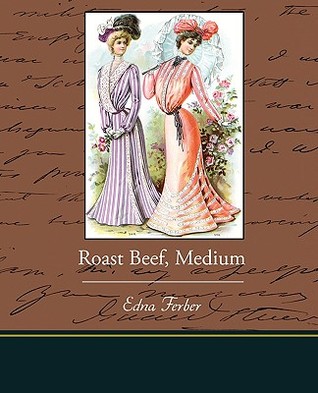
Review: ROAST BEEF, MEDIUM by Edna Ferber

Original Publication Date: 1913

Genre: fiction, adventure

Topics: women, feminist, single mother, independence


Review by : Patty @ A Tale of Three Cities


Roast Beef, Medium by Edna Ferber is simply a great read:  the compelling adventures of an independent woman, out to earn the respect she deserves, single-handedly winning over her male colleagues, while raising  her son on her own.  Simple, little story?  Absolutely not - this is 1913...

While this book could well make the case for being a feminist one, I did not feel this:  there is still a fine line between emerging feminist thoughts and nostalgia for the traditional roles in society expressed by Emma McChesney, our heroine.  I would just say it's a novel way ahead of its time:  Her "adventures" could well have taken place in modern times, which made me wonder:  if these descriptions apply today and the problems are still in existence today, what was the situation back in 1913?  How could Emma, any Emma, survive, when even today women can still fail facing such challenges?

I liked that the book is split in chapters focusing on a type of adventure.  I believe it gets us to know all facets of Emma's life, from the purely professional to the purely personal and all in between.
Emma has been now working for 10 years as a salesperson (to be politically correct) at a firm selling petticoats.  She married young, divorced not too long afterwards and has been left on her own ever since to struggle for herself and her son, Jock.

We follow her as she makes her way across the country (in those days, there was no wireless communication, so everything was carried out on a person-to-person basis...).  Emma has done it all, seen it all - that's why she sticks with a roast beef, medium:  once you have witnessed all of life's ups and downs, you get to appreciate life's staples, the standard values that, though unexciting, will serve you very well and provide a much-needed cushion from the world's troubles.  

"it's all very well to trifle with the little side-dishes at first, but there comes a time when you've got to quit fooling with the minced chicken, and the imitation lamb chops of this world, and settle down to plain, everyday, roast beef, medium. That other stuff may tickle your palate for a while, but sooner or later it will turn on you, and ruin your moral digestion"

The simile is spot-on and I really appreciated the simplicity with which Ferber can make her point.  How many times have I declined the flavour of the month in whichever domain, because I know I can rely to the tried-and-tested values that will remain true for the future?

Emma has to deal with her male competitors, who do not expect her to last long (funny, given she outwits them all...).  She has a "mentor" in her boss, who is the first to see through her and realise the potential she has.  From then, everyone else is an obstacle Emma can surely tackle, over and over again:

"now, a man would -""But I'm not a man", interrupted Emma McChesney. "I'm only doing a man's work and earning a man's salary and demanding to be treated with as much consideration as you'd show a man"

And yes, we're still in 1913, however much this could be said in 2013 as well (the realisation that the novel is 100 years old just hit me - not much progress in this respect, eh?)

There is a favourable disposition vis-a-vis Emma.  However much she's shown to struggle through life's adventures, she always manages to save the day and her composure:  
Long practice had made her perfect in the art.
Her only weakness is her son, but this is a tough love - she's not scared to let him know what the truth is:

Your mother is a working woman, Jock.  You don't like that idea, do yo?  But you don't mind spending the money that the working woman provides you with, do you?

And, of course, among everything else, there is always a suspicion of a love interest... Be it her fellow salespersons who want to just have a good time during their visits to all these remote towns, to her new boss, who could have honest intentions (the ending is not revealed, so the jury's out on this!).  But, Ferber is very good at keeping our interest alive throughout the pages:  she know she has a lonely heroine and she knows we want her to find someone, and at every chance she gets, she just loves to play with this idea:

"Great, ain't it?" said a voice in the darkness. (Nay, reader.  A woman's voice)

Emma will rise up the corporate ladder and ensure the company's future by innovative products - a relatively believable ending, not too exciting but remarkable nevertheless.  This book was a very nice discovery, truly recommended for an insight into the makings of independent women...


Download Roast Beef, medium by Edna Ferber at Project Gutenberg|Librivox|Girlebooks