Sunday, January 18, 2015

Review: THE GHOST, A MODERN FANTASY by Arnold Bennett

book cover the ghost a modern fantasy Original Publication Date: 1907

Genre: Gothic

Topics: Love, opera, coming of age, ghosts


Review by heidenkind:

Newly minted doctor of medicine, Carl Foster, visits a long-lost cousin who just happens to be friends with the owner of an opera house. While Carl and his cousin and his cousin's wife are enjoying an opera starring two of the greatest opera singers in the world–Signor Alresca and Rosetta Rosa–the primo uomo, Alresca, suffers a mysterious accident on stage and Carl is called on to care for him. As Alresca recovers, it becomes apparent that his malady is tied somehow to Rosa. Will Carl be able to save Alresca–and himself, now that he's fallen in love with Rosa?

The Ghost is another random Librivox find. It's a bit like Phantom of the Opera Lite: it's not as fun and delicious with the drama, but it's in the same wheelhouse. As a pure entertainment read, it was enjoyable, although the ending with the "ghost" part was seriously anticlimactic.

Our narrator, Carl, is a tough character not to like. When the story starts he's not very confident and, as we're reminded frequently, very young. The latter's an important point because it's the excuse for every stupid thing he does during the course of the novel. He's not TSTL, but after awhile one does start to notice a pattern with these things. Even so, he's smart enough and not judgmental or egotistical. Plus, he doesn't go into freak out mode when confronted with the strange and unusual–a useful skill to have in this book.

Then there's the glamorous world of the opera, which Arnold Bennett uses to infuse the story with a sense of mystery and danger. Opera also provides a great excuse for Carl to travel all over Europe, from Bruges to Paris to London to Italy. I think the traveling around and opera scenes were my favorite part of the book.

As for the female characters, I found them well-drawn with their own motivations. Not that The Ghost would pass the Bechdel Test or anything, but there is more than one female character. Huzzah! Naturally the star of the show (both literally and figuratively) is Rosa, who OF COURSE is a gorgeous, misunderstood prima donna with a captivating voice. I actually didn't find her that annoying, but the woman is obviously Bad News. Trouble follows her around like the worst cold in the history of mankind. First Alresca tumbles off the stage, then there's his long-running illness, train accidents, boat accidents, poisonings, etc. Danger, danger Will Robinson.

I also thought Rosa falling in love with Carl was a little too convenient–I mean, I get why Carl, an opera fanboi, would fall for a beautiful opera singer with the voice of an angel, but what's the appeal for her? She's used to hanging out with international men of mystery, which Carl is definitely not. Their relationship was the most obvious deus ex machina in the book.

Aside from that, though, I was really enjoying The Ghost until the last couple of chapters, when the eponymous ghost finally came to the forefront of the story instead of just lurking in the background menacingly. I wanted–and expected–something super creepy and scary. I didn't get it. The ghost, its so-called powers, and the manner in which it was got rid of were really lame and predictable. The conversation at the very end between Carl and Rosa was just odd.

That being said, for the most part I did like The Ghost. I'm glad I read it, even though I'll probably never reread it. Definitely a book for people who enjoy pulpy, vaguely gothic, old-timey novels with a bit of romance.


Download The Ghost, A Modern Fantasy by Arnold Bennett at Project Gutenberg|Librivox

Friday, January 16, 2015

Review: The Diary of a Nobody - Weedon Grossmith and George Grossmith


Original Publication Date: 1888 Genre: Victorian, fiction, humorous Topics: Suburbia, middle-class, London

Review by: Liz Inskip-Paulk (www.ravingreader.workpress.com


"Why should I not publish my diary? I have often seen reminiscences of people I have never even heard of, and I fail to see—because I do not happen to be a 'Somebody'—why my diary should not be interesting."

Although this was a reread, it was a reread from A Long Time Ago and so it ended up being more or less a New Read in the end. And this was fine, as I loved this book. I know it was written in the late Victorian era, but it was so funny that I burst out laughing at times which led to some strange looks when I was on the elliptical at the gym. I couldn’t help myself though, and TBH, it was that funny to me that I can neither confirm nor deny that snorting out loud did occur in public.


The Laurels - where the Pooter family reside.
This is a fictional diary of a lower middle-class man living on the outskirts of London, married with a grown-up son and a wife who loves him despite his flaws. (He doesn’t acknowledge these flaws though…) Charles Pooter is the diarist, and he lives a modest existence as a city clerk in an office where he’s been working for the past 20 years without much professional recognition, and he begins journaling as he secretly thinks that someone somewhere will publish his diary for its literary worth. He’s a nice guy, basically, but has some insufferable snobbish airs which stem only from his own personal social insecurity and not from malice.
Adult son William (and then later called Lupin) is rather a gadabout creature who drinks, gambles and makes somewhat brash decisions, but who receives the general adoration from his parents (which becomes somewhat tempered after Lupin movies in to his childhood home due to losing his job). Wife Carrie is portrayed as a sweet Victorian wife, but readers can see (through Mr. Pooter’s diary descriptions) that perhaps she is not quite as quiet and adoring of her husband as he writes. It’s all very farcical, but done in such a way that it’s fresh and still very very funny in parts.

Mr. Pooter’s diary chronicles about 15 months of his life and details his thinking about his life in London as a clerk and the sometimes hilarious social misfortunes that occur to him, typical things that happen to anyone but which, when they happen to Mr. Pooter, can completely shape his day and how he sees it. It’s a little bit like reading Basil Fawlty’s diary (if you remember that TV series). He does his best, but things consistently go wrong for him. Despite this, his family still loves him all the same.
George (right) and Weedon Grossmith
Written by brothers and stage performers, Weedon and George Grossmith, this book was first published as a series of excerpts in Punch, and was popular precisely it skewered most of the typical routines of its audience and the increasing social expectations of a booming lower-middle and middle class. However, it wasn’t an instant hit, but its popularity grew over time and since it was first published, this title has never been out of print. It’s also been the influence of other fictional diaries that have since been published: Diary of Adrian Mole series (by Sue Townsend), Bridget Jones’ Diary series (by Helen Fielding) and in other media forms, there’s a clear influence of Mr. Pooter’s ilk on TV shows such as Fawlty Towers. Interestingly enough, Hugh Bonneville (who plays Lord Grantham in Downton Abbey) was given rave reviews for his time as Mr. Pooter in a 2007 BBC dramatization on BBC Four. I wonder if that’s available on-line somewhere… I’ll check in the future.

Download The Diary of a Nobody by Weedon Grossmith and George Grossmith at Project Gutenberg|Librivox|

Sunday, December 28, 2014

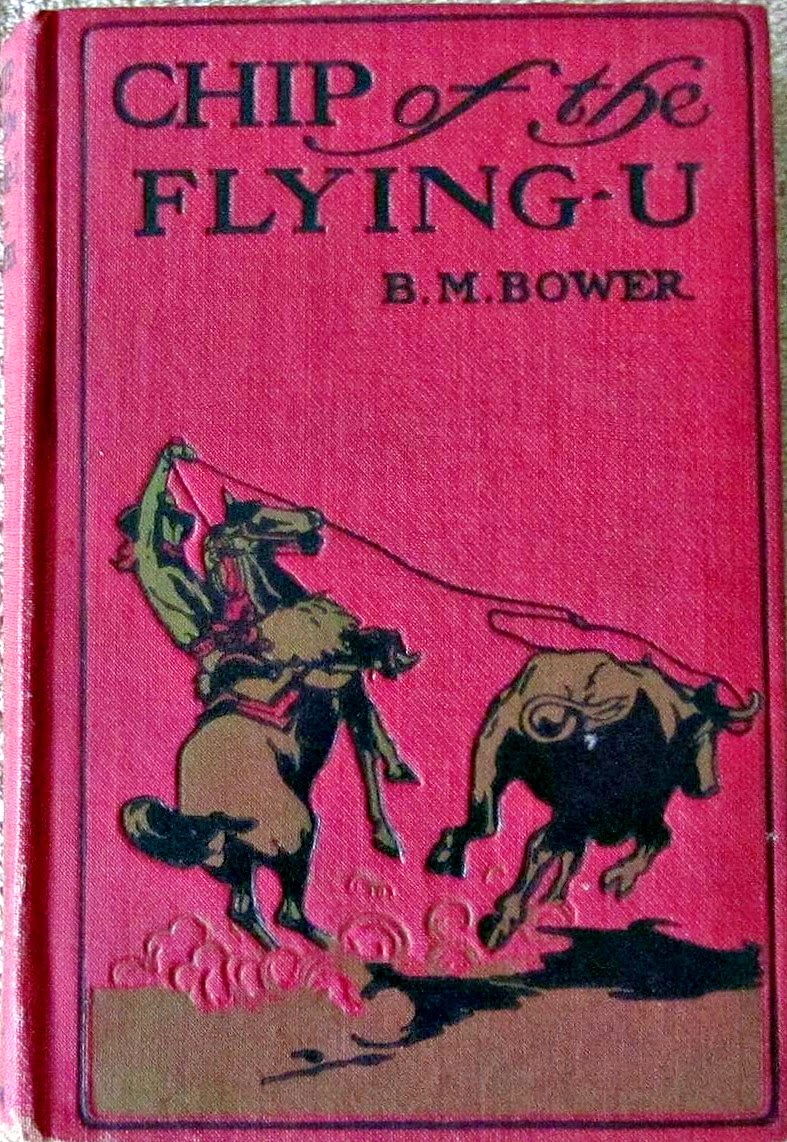
Review: CHIP OF THE FLYING U by BM Bower

book cover Original Publication Date: 1906

Genre: western

Topics: Love, belonging, nature, art


Review by heidenkind:

When Della Whittemore moves to her brother's Montana ranch, The Flying U, Chip and the rest of the hands aren't expecting much. Chip specifically predicts she'll either be a prissy “sweet young thing”, an annoying cowgirl, or an old maid who wants to drag him to church. But Della immediately surprises him and earns the respect of Chip and the other ranch hands with her quick wit and easy-going nature. Now all that's left is for Chip to man up and admit his feelings for her.

I tend to avoid westerns. I read one Louis L'Amour when I was a kid, and the only thing I remember about it is that it was distinctly unmemorable. There are hardly ever any women in westerns, either, and when they are in them they demonstrate an alarming tendency to be kidnapped by Indians. It's just not my thing. But when I asked for romance novel rec's in Melody's Public Domain Google Group, Chip of the Flying U came highly recommended and I decided to give it the barest briefest hint of a try, just in case it didn't suck. Well, it absolutely didn't–Chip of the Flying U grabbed me in the first chapter. It was so much fun that I slowed down reading it when I got near the end, to drag the story out as long as possible.

First of all, BM Bower is a really good writer. She's very much with the show-and-not-tell. For example, by the end of the first chapter we know The Flying U ranch hands have a deep appreciation of irony. Shorty's not short and Happy Jack is morose–something's that inferred through dialog, not exposition.

And speaking of the ranch hands, the real strength of Chip of the Flying U are the quirky western characters, like JG Whittemore's housekeeper, the Countess, who constantly speaks in aphorisms; the pretentious Dunk; and of course the "Little Doctor" herself, Della.

But my favorite character is Chip! He's so well-drawn and layered: a combination of smart, snarky, defensive, and sensitive that's absolutely irresistible. But most of all I loved the fact that he's clearly based off the famous painter, "the cowboy genius" Charles M. Russell. Let's do a quick comparison, shall we?


  • Chip has no formal art training and has always enjoyed sketching. Ditto Charlie Russell.
  • Chip's paintings are based on his life as a ranch hand in Montana. Charlie Russell's paintings were based on his life as a cowboy in Montana.
  • The first painting by Chip that captures public acclaim is titled "The Last Stand," which shows, "A poor, half-starved range cow with her calf which the round-up had overlooked in the fall, stood at bay against a steep cut [snow]bank. Before them squatted five great, gaunt wolves intent upon fresh beef for their supper." The first work by Charlie Russell that captured public attention was "Waiting for a Chinook," which shows an emaciated cow in the snow surrounded by hungry wolves. In both cases, the painting was of something the artist saw himself.
  • Chip's nickname before he came to The Flying U was Kid. Russell's nickname when he was a cowboy was Kid Russell.
  • Chip signs his work with a "brand," or glyph, and his name. Russell famously signed his work with a buffalo head brand and either his initials or his name.
  • Finally, it's Della who pushes Chip to show others his work and sell his paintings because she believes in his talent. Likewise, it was Russell's wife, Nancy, who pushed Russell to charge high prices for his work and managed his career. "[S]uccess came tapping at the [Russells’] door or, rather, Nancy dragged success in, hog-tied and branded," the Russells' nephew once said.


So that was fun! But even without those references, Chip of the Flying U was a really good read. It can be classified as a romance–and the relationship arc between Chip and Della is really well-done–but it's more of a coming of age story for both the main characters. Della grows into her role as a doctor and Chip discovers his true talent. In between, there are round-ups, western dances, ranch hijinks, and a horse named Silver is saved.

I definitely recommend Chip of the Flying U if you're in the mood for a fast, entertaining, and well-written read.


Download Chip of the Flying U by BM Bower at Project Gutenberg|Librivox

Friday, December 12, 2014

Review: The Ladies' Paradise - Emile Zola


Original Publication Date: 1883 Genre: Nineteenth Century Literature Topics: Human behavior, love, shopping (!)


Review by : Liz Inskip-Paulk (www.ravingreader.wordpress.com)


As we’ve been enjoying the PBS Masterpiece series on Sundays featuring “The Paradise”, I picked up Zola’s book upon which this series was based. (To be honest, when I first started reading the original version, it became pretty confusing as there are some significant differences between the book and the TV version [naturellement], but with the names kept the same… I got it sorted out after a bit, but at first, it was really perplexing.) In the end, I decided that the TV series based was based only slightly on the original – there were loads of differences from one to the other, but both are good in different ways.)

This book is a long multi-volume series that Zola wrote about a family (and its offshoots) as it goes through generations in France in the mid-nineteenth century. (However, this volume works well as a good stand-alone story as I hadn’t read any of the original set prior to this.) The plot revolves around a large department store in Paris, and was based on the real Bon Marche store, one of the first department stores in real life at that time. (Previously, most stores only specialized in one thing: umbrellas, bread, tailoring, milliner, butcher etc.) When the Industrial Revolution arrived, it led to factories mass-producing cheaper goods which also contributed to the downfall of these very small shops.

As the book progresses, The Ladies’ Paradise as (the department store is named) is growing with Mouret, the young manager at its helm. Alongside him are his employees, his suppliers, and of course his customers, all of whom intersect and around whom the story evolves. Mouret is deeply ambitious and wants to grow his business as to be as big and successful as he possibly can, often putting business before other considerations (including his love life). In fact, business to Mouret is seen through a parallel lens as others viewed religion:

His creation was producing a new religion; churches…were being deserted by those of wavering faith, were being replaced by his bazaar…”

Mouret often espouses his goal of using his business to reach the end result of “owning Woman” through his strategy of selling almost every product possible that “Woman” would want. This huge selection of wares attracts all classes of women from around Paris and afar, and via the old theory of Supply and Demand, Mouret takes their money whilst still leaving them wanting for more. Perhaps not the newest idea nowadays, but back then, it was legendary and new and this was the first time that the city had seen all these things available for sale under one roof.

Along with Mouret’s desire to be a very successful businessman, his other desire is for women and in particular, one specific woman – Denise Baudu. But can his money and business acumen convince her to love him back?....

Zola was a writer (and the self-proclaimed leader) of the Naturalist school of thought which was all about writing very clearly and realistically about social problems facing people who lived in the city: poverty, slums, filth, sickness… Zola really saw his writing as a focus to bring attention to problems that the typical reader would rather not look at – a verbal written documentary of a kind, you might say.

Despite this serious tone, the plot rattles along with the speed of the train and with the machinations of a soap opera and, if I’m honest, there are places which are terribly overwritten at times. Despite this, the writing seems to work as it could be argued to reflect the gilded extravagance of the shop and the idea of over-the-top luxury it sells as needs to its customers. The description of the store as it grows over time are gloriously detailed (reminded me of Dickens’ writing at times), and, when combined with the drama of the store stuff and that of the local neighborhood inhabitants, makes a very rich story indeed.

So, in case you haven’t picked this up so far, I really enjoyed this read. As mentioned before, this volume is part of a huge long series, but as I’m not a series kinda person for most of the time, that’s not for me. However, I would pick up another stand-alone volume by Zola at some point in the future.

One note: there was a character in this volume called Madame DesFarges which I found *slightly* confusing as the Mme. Desfarges that I kept seeing in my head was the rebellious she from Dicken’s Tale of Two Cities (1859). Zola’s was written in 1883 so he must have been aware of this character.

1789 – French Revolution with storming of the Bastille

1789 – Queen Marie Antoinette gets guillotine

1803 – France sold Louisiana to USA

1804 – Napoleon comes to power

1815 – Battle of Waterloo (marks the start of almost 50 years of peace throughout Europe as there had been loads of wars all over the place up until this point)

1815      Napoleon sent to exile; King Louis XVII comes to power.

1831 -    First clearly defined worker uprising of Industrial Revolution

1848 – French revolution against monarchy à Louis Napoleon Bonaparte starts as President of French Republic

1851 – Louis Napoleon Bonaparte becomes dictator

1863-56 – Crimean War (France and Britain against Russa)

1870 – Franco-Prussian War (start of ongoing war with Russia for ages). Paris captured by Prussian forces à Napoleon outed and goes into exile. Much general unrest due to Republicanism vs. Monarchism parties.

1871 – Riots in Paris streets over resentment against right-wing government à new President (Adolphe Tiers).

1883 – This was when The Ladies Paradise was published. Zola was politically liberal which led him to be against the tough right-wing government.


Download The Ladies' Paradise by Emile Zola at Project Gutenberg/Unavailable at Librivox.

Friday, November 14, 2014

Review: The Death of Ivan Ilyich - Leo Tolstoy (1886)


Original Publication Date: 1886
Genre: Fiction, classic, nineteenth century, Russia
Topics: Dying, death, family, doctor, Russia, medicine, illness
Review by: Liz Inskip-Paulk (www.ravingreader.wordpress.com)


I dug this title up as it was mentioned in my recent read of Atul Gawande’s On Mortality book, and I’m all about following down the rabbit holes of different books and topics sometimes. Although somewhat intimidated by Russian authors (although not sure why), I picked this up with trepidation and then relaxed. It was going to be a good read.
Gawande’s reference to this Tolstoy novella meant that I knew that the plot was about a man dying, but the actual details were vague for me (which I was happy about). I opened the book one morning and then finished it that evening and it was a great read. The plot itself is pretty simple: a man works hard in his career, get married with kids, falls off a ladder and gets slightly hurt, and then ends up dead. (And I’m not giving the game away here. This is what the story is famous for, after all.) However, it’s a lot more than that as Tolstoy (via his lead Ivan Ilyich Golovin) ruminates on the process of dying and how it may affect one’s thinking.
Ivan Ilyich feels that he has done all the “right” things in his life: he has worked hard on his career rising in the legal ranks of the municipal court, he has married well, and has a good family. So why is he so uncomfortable dying in this way? And that’s what most of this work is about – how the dying process evolves for both this particular participant and the family around him/her. It’s really quite fascinating especially after that recent read of Gawande’s book (which also focuses on death and dying). Sounds desperately morbid (doesn’t it?) but it’s not. This dying thing happens to everyone, and as with almost anything else, the more you know the better. (At least that is how I’m approaching things).
Using the POV of Ivan Ilyich himself, the story follows his thinking process as his life winds down. His pain in the side (originally triggered by an accidental fall at home) worsens, and as it progressively gets more and more painful, he visits a few doctors trying to get his diagnosis. However, the doctors are unable to agree and give him a final diagnosis (let alone a cure) and so Ivan struggles on, unable to talk about his concerns about dying with no one, not even the medical professionals let alone with his family.
And I find this to be so relevant with attitudes towards death today. In my experience, I've noticed that when one has a difficult illness, people usually don’t mind acknowledging it at first when everything is mostly normal, but as time progresses and one’s prognosis worsens, many people would prefer to talk around it than actually address it face on (a la elephant in the living room). This is how Ivan Ilyich’s family and friends handled the situation, and so the reader learns about the frustrations, struggles and the sheer loneliness of the person who’s doing the dying. I really don’t think that this is an untrue situation for a lot of people, but I wish it wasn’t that way.
Gawande mentioned that this novella was taught in med school in a class about death and dying, but I’m not sure how common that is across the nation. (Anyone know?) However, common or not, I think this is an excellent novella about a very common natural human process which is frequently denied or skirted around as people are uncomfortable with it (for whatever reason).
A provocative read about a pretty ordinary guy who is going through a totally natural process. Although the subject may be dark, this is extremely well written, not maudlin at all, and is a good demonstration of something that happens but most people would prefer not to talk about. It was an excellent read when paired with reading the Gawande book. Recommended.
 
 
Download The Death of Ivan Ilyich by Leo Tolstoy at Project Gutenberg Consortia Center|Librivox|

Wednesday, November 5, 2014

Review: THE BLACK MOTH by Georgette Heyer

book cover Original Publication Date: 1921

Genre: Historical, adventure

Topics: Love, honor, betrayal, #eighteenthcenturyaristocratproblems


Review by heidenkind:


Several years ago, Jack Carstares took the blame when his brother, Richard, cheated at cards. Now Richard manages the family estates and Jack, exiled in shame from society, roams the roads of England as the most bespoke and gentlemanly highwayman in the land. What earthly force could possibly make Jack leave behind his life of adventure, admit his brother was the actual cheater, and return to the fold? Love of course!

The Black Moth was Georgette Heyer's first novel, and is the only one of her books in the public domain. It's also the first Heyer novel I've managed to read (I tried one or two, but I have to admit my heart wasn't in it and I returned them to the library unfinished), and I was shocked at how much I enjoyed it. I was expecting it to be a rather dull romance novel, but it's not—it's an adventure that is SUPER DRAMATIC.

Heyer wrote The Black Moth to entertain her brother during a long illness, and if his taste in books was anything like mine is, she definitely succeeded. The Black Moth has EVERYTHING: kidnapping, highwaymen, cheating, a villain you love to hate because he's the only character with a sense of humor, secret earls, a shrieking harpy of a wife, heiresses, star-crossed lovers, duels, sword fights, fashion, a put-upon manservant/sidekick, love affairs... I could go on. Is it crazy over-the-top? YES. Does it go too far at times? YES. Do I think it's Heyer's best work? I certainly hope not. BUT—did I enjoy the hell out of it? YUP.

My favorite character by far was Tracy Belmanoir, the eponymous "black moth" and brother-in-law to Richard Carstares. It was Tracy who discovered Richard cheating at cards, and he's been using that knowledge to coerce Richard into all sorts of things ever since. It's also Tracy who drives the action through much of the book. He's a boss! He gets all the best lines and mopey Richard hates him so much it's hard not to be fond of the guy.

The way women are presented in The Black Moth is also pretty refreshing. You've got Lavinia, Richard's wife, who's a nitwit and constantly talks in exclamation marks. It's! Very! Annoying! But you also have several women characters who are powerful and smart and get things done, like Lady O'Hara, who's very sexually aggressive and awesome. Diana Beauleigh is the damsel in distress, but she's also willing to press the issue of Jack's affections. Her aunt, Elizabeth, is a super-smart older lady who could give Miss Marple a run for her money.

Is The Black Moth a perfect book? Hells no. But if you can enjoy it for what it is—a fun, silly historical romp—you'll get a kick out of it.


Download The Black Moth by Georgette Heyer at Project Gutenberg|Librivox|University of Pennsylvania Library

Wednesday, October 29, 2014

Beyond Good and Evil by Friedrich Nietzsche

Original Publication Date: 1886
 Genre: Nonfiction, Philosophy
 Topics: Philosophy, Religion, Morality
Review by : Becca Lostinbooks
Download Beyond Good and Evil by Friedrich Nietzsche at Project Gutenberg|Librivox|

“To recognise untruth as a condition of life; that is certainly to impugn the traditional ideas of value in a dangerous manner, and a philosophy which ventures to do so, has thereby alone placed itself beyond good and evil.”

In this work, Nietzsche lays the foundation for thought that the Christian notion of good and evil is based on a simplified yet hidden slave morality.  Nietzsche, instead, claims that the philosophy of “will to power” (I got tired of this phrase by the end of 158 pages, let me tell you) is all the morality that an individual needs.

Nietzsche talks of good and evil not as opposites, but basically as on a spectrum that all people lay somewhere on and often drift along at different times in their lives because of various experiences.  He also argues that religion is not the basis for morality, an argument that is still being fought today.   The concept of “will to power” is a complex one, but can be simplified as the main driving force in humans, whatever that force may be, because “a living thing seeks above all to discharge its own strength – life itself is will to power.”
He argues who are we to suppose that there is an essential opposition of “true and false”, or good and evil?  “There is no such thing as moral phenomena, but only a moral interpretation of phenomena.”  I found myself at turns confused, disagreeing, and nodding along in agreement while reading this.  One thing Nietzsche does is make you think and consider and you will be a deeper person for having read him.

Nietzsche is not easy to read.  I had to take my time, read along with the Librivox recording, and then re-read it again.  I took notes as I read and after finishing the book, I took some time off before going back and re-reading my notes.  It has taken me a long time to even figure out how to write a review of Nietzsche’s philosophy.  The task is as daunting as you would expect.  I recommend just giving him a try because as daunting as Nietzsche is, I feel better for having taken up the challenge.