Showing posts with label unintended consequences. Show all posts

Thursday, May 10, 2012

Short Story Review: The Black Cat by Edgar Allan Poe

book cover
Original Publication Date: 1843

Genre: horror

Topics: madness, unintended consequences, guilt


Review:

The Black Cat is probably Edgar Allan Poe's most famous short story. I know it was one of the two Poe stories that was in my English textbook in middle school (and the fact that I remember it should tell you a lot about what an impression it made upon me as a kid). Basically it's about a guy who's a mean drunk and winds up killing a faithful pet, his cat. He later suspects the cat has come back to life to haunt him and this leads him to make some rather poor decisions.

After re-listening to this on Librivox (read by the boss Ralph Snelson) as an adult, I have to say I didn't really enjoy reading it. It's way cynical, and also a little predictable (I have read it before, but still). It's very well-written, of course, but it's not the type of story you come away from with the thrill of being scared silly--more like the sense that it's time to take a good long look in the mirror. Still, you should read it if you haven't.

And now it's time to play What Is the Cat a Metaphor For?! Here are my ideas:
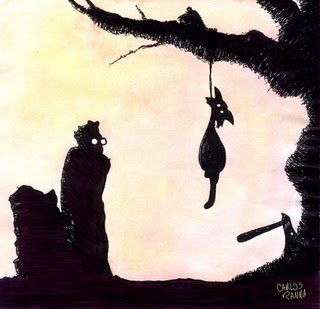
black cat hanging
Theory #1: Slavery

When the narrator hangs the cat, he says

Who has not, a hundred times, found himself committing a vile or a silly action, for no other reason than because he knows he should not? Have we not a perpetual inclination, in the teeth of our best judgment, to violate that which is Law , merely because we understand it to be such? This spirit of perverseness, I say, came to my final overthrow. It was this unfathomable longing of the soul to vex itself - to offer violence to its own nature - to do wrong for the wrong's sake only - that urged me to continue and finally to consummate the injury I had inflicted upon the unoffending brute. One morning, in cool blood, I slipped a noose about its neck and hung it to the limb of a tree; - hung it with the tears streaming from my eyes, and with the bitterest remorse at my heart; - hung it because I knew that it had loved me, and because I felt it had given me no reason of offence; - hung it because I knew that in so doing I was committing a sin - a deadly sin that would so jeopardize my immortal soul as to place it - if such a thing wore possible - even beyond the reach of the infinite mercy of the Most Merciful and Most Terrible God. (excerpt from Literature Network)
The hanging of the cat resembles a lynching in that it's an act of revenge, but not against any wrongdoing on the part of the cat--rather, the cat represents what the narrator should and could have a partnership and friendship with, yet he can't because every time he sees it, he's reminded of what a terrible person he's become, by his own hand. So he lashes out. Even after the cat is dead, the narrator still fears that it will bring a reckoning he knows he deserves.

the black cat by aubrey beardsley
Aubrey Beardsley's illustration of the Black Cat
Theory #2: The Wife

It's probably more likely that the cat is a metaphor for the narrator's wife. She's the one who gets the cat for him, and early on the cat is likened to a witch by the wife herself ("I'm not a witch, I'm your wife!"), which seems to plant the seeds of his later attitude toward the cat. The wife shares his love of animals, and when the narrator starts drinking, he admits to beating both her and their pets. And of course there's the fact that in his attempts to kill the cat--again--the narrator actually ends up killing his wife.


Have you read The Black Cat?

Wednesday, May 2, 2012

Short Story Review: Midnight on Beauchamp Row by Anna Katharine Green

book cover
Original Publication Date: 1895

Genre: "Horror." Kinda.

Topics: trust, marriage, unintended consequences


Review:

Letty Chivers is a young bride vaguely dissatisfied with her life, whose husband has some sort of job that requires him to carry large amounts of money around. Whenever the money's in the house, Letty gets nervous, but Ned never leaves her alone with it. Then one night he comes home and says he HAS to do something for work and won't be home until after midnight. In the meantime, he needs to leave the money with her.

Letty wants to go to her friends' house to wait for him, but Ned won't let her because he doesn't like her friends. So, with a "Tata, Little Woman!" Ned rides off into the night. It is then that Letty faces the true horror of her imagination: an uninvited guest.

Most of the time I would stop my summary there, but you guys HAVE to know what happens at the end of Midnight on Beauchamp Row. If you don't want to be spoiled, go here, read the story, then come back. I'll wait.

Are you back? Did you ever leave? It's okay, I'll catch you up.

Lettie's uninvited guest is a vagrant, whom she is SURE wants to steal her husband's money. So, to keep him from getting it, she throws it outside. Fiscal responsibility, folks! Then she feeds him dinner because that's only polite. All the while, though, she's thinking, "Why didn't I poison him? I could have grabbed some arsenic in the kitchen!" At some point she remembers there's a gun in the house and plans to shoot him, but it turns out Ned took the gun when he left. Meanwhile, the crude vagrant who offends all her delicate feminine sensibilities offers to do the dishes, which is pretty damn decent of him.

While he's doing the dishes, ANOTHER vagrant bursts into the house! Except this one is black, so he's extra-dangerous. Vagrant #2 is all, "Where's the money?" and goes straight to the cabinet where Letty put it, except naturally it's not there anymore. Then vagrant #1 comes in from the kitchen and whacks vagrant #2 upside the head. Vagrant #2 goes splat and vagrant #1 observes that he's dead--he knows, since he's killed men before. But it's all good, cuz he was saving Letty from the colored person.

They're going to dump the body outside, but Letty wants to make sure he's dead first (so she can whack him again if he isn't?). It's then that she notices vagrant #2 is not actually black--instead, it's her husband in black face!

David Tennant what


I'm sorry, but... WHAT?! Of all the things I hoped would happen during the course of this story--Letty plotting to steal the money from her hubby and running away, her and the vagrant falling in love and running off together, etc.--her husband stealing the money from her while in black face was noooowhere on the list. Zomg, race should not be the big reveal/plot twist. No no no no no.

Of course, Letty's not terribly upset by this (although more upset than when it was just a homeless person), because she wasn't that happy with her marriage to begin with. She doesn't know why, but I do: her husband's a controlling dick who treats her like she's ten years old. In the brief period of time he's on the page, he calls her "little" twice. AND he leaves her home alone at night all the time. No wonder she's so nice to vagrants, eh? It's the only action she gets in that house!

This is a pretty odd story. Not just the actual events that happen during the course of the tale, but the tone itself is odd. For one, the way Letty is treated is very The Doll's House-ish. Is Anna Katharine Green making a negative comment on how patronizing and controlling Ned is? I don't know. At most points in the story, it seems like this is taken as acceptable, normal behavior. But then he dies, and no one feels bad about it because he's a jerk, so that means... it's bad. Right? And Letty isn't fulfilled in the marriage, so I think Green is saying, "Yo, we have needs and desires, too, boys." But that message isn't terribly clear.

Also, the events of the story have a very comedy-of-errors feeling to them, but the tone of the writing is weirdly dire, so it all comes off as a little stilted. Then the ending is put forward so matter-of-factly and you're like, "Denouement, plz!" I'm still rooting for Letty and vagrant #1 to get married and have fourteen children.

Anna Katharine Green is the first woman to write a mystery novel, which I haven't read. But judging by this short story, I would definitely be interested in seeing what that's all about--because if it's anything like this story, it's some serious wtf.

Monday, April 23, 2012

Short Story Review: The Monkey's Paw by WW Jacob

book cover
Original Publication Date: 1902

Genre: horror

Topics: wishes, unintended consequences


Review:

Another audiobook from Ralph Snelson, aka the bossest reader on Librivox and the person I'm currently stalking.

Do I really need to tell you what a story called The Monkey's Paw is about? The Whites are a happy if boring family, until one day when a friend of Mr. White's, a Sergeant-Major, shows up out of blue and is like, "Hey, look at this monkey's paw I got in India! It's supposed to grant three wishes, but it's really dangerous. You guys don't even know." Then he tries to throw it away, except naturally the Whites pick it up because they want to try it out. The Sergeant's like, "Your funeral!" and leaves. Wow, what a great friend.

Is this going to end badly? You know it.

you damn dirty ape

The Monkey's Paw is probably a little predictable and cheesy by now, especially considering how many adaptations there have been of it, but I personally think it's worth reading. It's a very well-told story, where people destroy their own lives through the innocent things they wish for. Plus there's incipient zombieism!

I found this short story to be pretty creepy, mainly because I would have totally wished on that monkey's paw. Seriously, if someone hands you something and tells you it grants wishes, how can you NOT test that out? But it's like Karl from An Idiot Abroad says: "Never wish for anything. You'll just end up being disappointed."

Also, monkeys are scary.


Find The Monkey's Paw at Librivox|Gaslight

Thursday, March 22, 2012

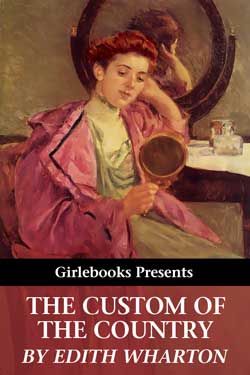
Review: The Custom of the Country by Edith Wharton

Photobucket
Original Publication Date: 1913

Genre: Fiction

Topics: women, marriage, society, social status, social climbing, old money, noveau riche, old New York


Review: I don't know why The Custom of the Country isn't a more popular Edith Wharton novel. Oh wait, I do: Undine Spragg. I could see why Undine might turn off readers. She makes Scarlett O'Hara look like Mother Theresa. I love a good b..., um, witchy character and she is that through and through.

The story starts with Undine Spragg dragging her socially awkward parents around New York. Undine's father is a very wealthy man after a series of successful financial deals in their hometown of Apex. Undine is determined to climb the social ladder of New York. She uses her beauty to entice a member of one of the Old Families of New York, Ralph Marvell, into marrying her. She's on top.

The trouble with Undine is that she is never satisfied. Once she gets what she wants, she no longer wants it. Life with Ralph isn't what she thought it would be. He has his own ideas about family and propriety. On top of that, Ralph is poor by Undine's standards. To keep up with Undine's ridiculous overspending, Ralph works like a dog, yet combined with a generous allowance from her father, it's not enough. Undine manages to convince Ralph that she must go to Paris, alone, and like an idiot, he lets her. While in Europe, Undine lives the high life and sends the bills home. Then she starts getting ideas and sets her sights on European aristocracy.

Undine is the type of person that could fall into poo and come out smelling like a rose. She has the most incredible luck. In fact, she is the complete opposite of another Wharton character Lily Bart from The House of Mirth. Just when I thought it was all over for her, something would just fall into her lap! It's almost admirable how she can size up a situation and figure out how it can benefit her. She has a lot of her father in her and if she had been a man, she'd easily be a millionaire. However, Undine is a cold-hearted, selfish, shallow person. She has no feelings for anyone but herself. She doesn't care what pain her actions cause other people, from her parents to her husband to her son. She leaves a trail of bodies in her wake. Though I believe that if someone told Undine this, she'd be genuinely surprised.

The Custom of the Country is a story for the 21st century as well as the 20th. Anyone who has seen an episode of My Super Sweet 16 has seen a Undine in the making. She's never been told no by her parents and won't take no for an answer from anyone else. Everything she wants or owns has to be better than what anyone else has. She's a victim of her upbringing. At times, I felt that if Undine had been expected to be more than an accessory to a man she would have been a better person. A character named Charles Bowen, who considers himself an amateur sociologist, makes this observation to a friend:
"I want to get a general view of the whole problem of American marriages."
Mrs. Fairford dropped into her arm-chair with a sigh. “If that’s what you want you must make haste! Most of them don’t last long enough to be classified.”
"I grant you it takes an active mind. But the weak point is so frequently the same that after a time one knows where to look for it.” 
“What do you call the weak point?”

He paused. “The fact that the average American looks down on his wife.”

Mrs. Fairford was up with a spring. “If that’s where paradox lands you!”

Bowen mildly stood his ground. “Well–doesn’t he prove it? How much does he let her share in the real business of life? How much does he rely on her judgment and help in the conduct of serious affairs? Take Ralph for instance–you say his wife’s extravagance forces him to work too hard; but that’s not what’s wrong. It’s normal for a man to work hard for a woman–what’s abnormal is his not caring to tell her anything about it.”

“To tell Undine? She’d be bored to death if he did!”

“Just so; she’d even feel aggrieved. But why? Because it’s against the custom of the country. And whose fault is that? The man’s again–I don’t mean Ralph I mean the genus he belongs to: homo sapiens, Americanus. Why haven’t we taught our women to take an interest in our work? Simply because we don’t take enough interest in THEM.”

Charles has a point but Undine has no interest in Ralph's affairs. She's interested in her own. Undine treats her marriages like business deals; it's not personal. The men are useful until they outlive their purpose, then they are discarded and she's onto the next one. In a way you can't blame her, it's the only career she can have.

The Custom of the Country is a feminist novel in a way but it's also a satirical look at wealth: the rising nouveau riche of America and the fading old families of New York and Europe. They are all subject to their own follies.

I could go on more but I'll stop there. This is now my favorite Edith Wharton novel. It's entertaining and even shocking.

Highly recommended

I read this free edition of The Custom of the Country from girlebooks.

This review was originally published on Chrisbookarama.