Showing posts with label sailing. Show all posts

Monday, May 7, 2012

Review: THE AFTER HOUSE by Mary Roberts Rinehart

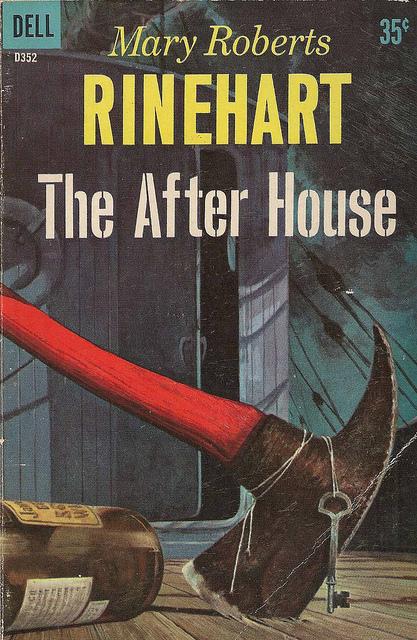
book cover
Original Publication Date: 1914

Genre: mystery

Topics: sailing, Germanic horde


Review:

Ralph Leslie came down with typhoid only a day after graduating from college. Still weak from illness and with only seven dollars to his name, Leslie's friend sets him up with a summer job on a yacht. There's the forecastle, where the crew (including Leslie) sleep; and the after house, which is where the owner of the yacht and his friends have their rooms. Things seem calm on the surface, but tensions are clearly brewing in the after house, due mainly to the owner's endless drinking.

Then one night, three people on board are murdered, chopped to death by a silent, axe-wielding murderer. Trapped on a small vessel and weeks outside of port, everyone wonders who they can trust and who will be next.

Things I learned from The After House:
  1. Don't trust Germans. They have long names that are difficult to pronounce, are argumentative, and spend too much time philosophizing. I know what you're thinking: Tasha, shouldn't you have already known not to trust Germans from watching EVERY MOVIE EVER MADE? And you're right, I actually did know that, but sometimes I forget because 90% of the people I'm related to are, in fact, German. But still. Argumentative, really?!
  2. There's a reason why people are buried at sea.
  3. Don't be stupid like the hero of this book! At first I had high hopes for Leslie, but he makes one gaff after another, from ordering the blood washed away (evidence, hello! Didn't you go to med school?) to telling the women where exactly they can find the key to where the evidence is kept so they can throw it overboard.
  4. Bad things come to those who drink, especially if you drink whiskey.
Honestly, I have mixed feelings about The After House. For the first half I absolutely loved it. Mary Roberts Rinehart's writing was so sparse and perfect, and I was completely drawn into the story. Then the murders take place and they are SO. CREEPY. First everything is fine, if a little tense; and then all of a sudden there are dead people all over the freaking place in little pieces! Not only that, but no one sees or hears anything, even though they're right next door. It's like Lizzie Borden came back from the dead and is all, "I'm on a boat! *chop chop chop*"

In the second half, though, the pacing started to go off, and inconsistencies in the story began jumping out at me. I expected Leslie to solve the murders on board the ship as they made their way back to port, which would have kept the tension high and offered an elegant conclusion: roll into US waters, show the authorities the culprit, and disembark. Instead, Leslie does very little investigating and moons over a girl, who seems really sketchy. They pull into port with the murders still unsolved, and then everything we already know is retold in court. Basically the story lost all momentum at that point, and the conclusion was riDONculous.

It's still a pretty good book, though, because it's by Mary Roberts Rinehart. I have to wonder if Rinehart herself was a teetotaler; there's a definite presentation in the book about the evils of alcohol, what with the owner of the yacht going into delirium tremens and Leslie dumping all the alcohol overboard. Before that even happens, I was thinking the after house had to be a metaphor for something--either success or the American dream--and Leslie's face is pressed against the glass throughout the entire book. Leslie himself never imbibes, and Rinehart definitely contrasts his behavior with that of the thirstier characters.

The women in this novel are also really interesting. When the murders take place, to me they seemed like the obvious suspects (well, there were some other obvious suspects, but they were TOO obviously obvious, if you know what I mean). The ladies had the opportunity, and come on--people are hacked to death with an axe feet from where they're sleeping and they don't hear anything? Way suspicious. But the men folk never consider one of the women might be the killer, even though they order everyone around, defend themselves with guns and knives, accuse random people of the murders for the sole purpose of throwing suspicion on them, and attempt to destroy evidence. These ladies keep it real, yo. It was extremely frustrating that the thought one of them might be a homicidal maniac never even crossed Leslie's mind.

The After House isn't as good as The Man In Lower Ten (review here), and I probably wouldn't recommend starting with it if you haven't read Rinehart before; but it was pretty damn creepy, and had a deliciously claustrophobic atmosphere, so I think it's worth reading for that.


Read The After House at Project Gutenberg
You might want to know: there are some racial slurs in this book.

Thursday, February 23, 2012

Review: THE RIDDLE OF THE SANDS by Erskine Childers

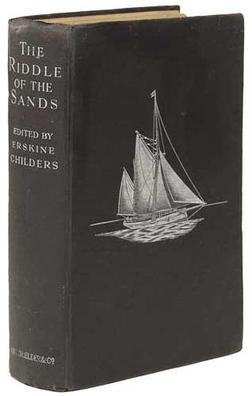
book cover
Original Publication Date: 1903

Genre: spy, thriller, adventure

Topics: sailing, espionage, Germanic horde


Review:

Carruthers is a bourgeois suit with a desultory job in London with the Foreign Office. He's feeling sorry for himself because he can't enjoy a house party with his friends, when he receives a telegram from a long-forgotten college acquaintance, Davies, inviting Carruthers to join him on his yacht. Carruthers' immediate reaction is that yachting in the Baltic at the end of September sounds like a HORRIBLE idea and he would rather choke; but a few days later, he finds himself on vacation and headed off to meet Davies, towing along a completely random collection of oddly specific items that Davies requested.

When he first arrives, Carruthers' instinct that this trip was a terrible idea seems confirmed. But he soon chills out, only to find Davies invited him to go sailing for a reason: he believes a German spy attempted to kill him in the Frisian Islands, and he needs a partner to help him figure out what the man wanted to hide.

If you picked up this book based purely on the title, you'd probably expect Riddle of the Sands to be some sort of adventure novel or archaeological mystery set in Egypt. You'd be wrong! The "sands" referred to in the title are actually a collection of sandbanks near the Frisian Islands, which are relatively uncharted and difficult to navigate. On board a tiny boat in the middle of a bunch of barren sand banks doesn't sound like the most interesting setting in the world, but the sense of isolation and difficulty Carruthers and Davies face really heightens the tension of the story. It works!

There is a lot of sailing jargon in this novel, which can be a bit difficult for those of us who don't know a jib from a forecastle (*raises hand*), but that's easily overcome because the characters are so awesome. Carruthers, our narrator and protagonist, doesn't know a thing about sailing (even though the author, Erskine Childers, clearly does), and he's so funny it's hard not to enjoy him. He's extremely fussy and a little spoiled, but underneath all his posturing and complaining he's good-hearted. If Karl from An Idiot Abroad was a Victorian gentleman, he'd be pretty similar to Carruthers.

Davies, meanwhile, is a weird combination of a bloke and a fanatic. He really only cares about one thing: sailing. Everything else tends to fall by wayside, and around people who aren't sea-worthy he's awkward, just because he has no idea what to talk about. But he's also basically a good guy, and not as dense as he first seems.

The main thing that I didn't like about Riddle of the Sands was that there were hardly any female characters. I'm a woman; I like to read books with women in them, what can I say. There was one lone female character in this story: the daughter of the German spy. But she didn't do anything; her role in the story was mainly to quell any suspicions that might crop up over Davies' heterosexuality. Or lack thereof.

Aside from that, though, as a espionage thriller this novel is pretty top-notch. Childers knew what he was talking about and put a lot of thought into what role an area like the Frisian Islands might serve in a military conflict between Germany and England, and it shows. Unlike many thrillers, Riddle of the Sands doesn't feel fantastical at all, and I'm not surprised it inspired generations of novelists as well as real-world policy enacted by politicians and military peeps.

I first head about this novel on Evangeline Holland's and Melody B's list of Downton Abbey-era fiction at Edwardian Promenade. I highly recommend you check it out!