Showing posts with label guest review. Show all posts

Sunday, March 17, 2013

Review: THE AGE OF INNOCENCE by Edith Wharton

book cover Original Publication Date: 1920

Genre: general fiction

Topics: love, society, tragedy


Guest review by Ash (http://bookletsgo.wordpress.com/):

Blogging about certain books can be a challenge at times and I believe this is one of those times. Deemed as one of the best classics in English Literature, The Age of Innocence throws light on the late 1800′s upper-class society in America..particularly the New York society. I came across this book through a lot of sources but one that particularly struck me was a review by Danielle.

The novel opens with an Opera theater where all of the New York’s elite are watching a play. Newland Archer, the hero of this story is looking out for his fiance May Welland when he spots her seated beside her infamous cousin, Countess Ellen Olenski. Rumors are astrife that the Countess is in NY recouping from a disastrous marriage to a Polish Count. Even so, the New York society condemns her decision and shows it quite boldly. At first, Archer takes it upon himself to show his support to May and her family for sheltering the countess but he finds himself in love with Ellen Olenski who also finds herself returning the affections. And then May who is all the while docile and quiet, decides to prepone the wedding, and Archer finds himself married to May Welland. This doesn’t put a dent on Archer's affections until May makes a decision that changes the course of the story. Describing this plot any more wouldn’t do any justice for its a very difficult to blog on this particular title.

Archer is torn choosing between what society approves vs. what his heart desires. Although his first impression of May is that she meets the Society’s standards and his in every way, he gradually realizes that May and many women like her were groomed to be perfect, ignorant of any independent thoughts or opinions. Ellen is a complex character who seems to be a misfit both in NY and in Europe. She struggles the most trying to fit in with the NY society which scorns her every decision pushing her to the brink of moving back to Europe. For me, May was perhaps the most complex of all characters...She is first introduced as a docile well-bred lady and as a reader, you'll be taken in by it all. Watch out though, for she does have some tricks up her sleeve.

Edith Wharton comes from an upper-class family herself and so her insights into New York old society’s rules and customs are well highlighted in every chapter. Whereas Europe has more liberal code of behavior and independence in thought, NY society condemns any semblance of independent thought or action. So long as a man conducts his affairs in secret and silence, he is exempted from the scorn and rejection by the society whereas a woman is literally shunned. This is another point that is brought out by Ms. Wharton. And then there are the usual theatrics associated with the society when people meet at an Opera or a Ball or a dinner. The novel has many other characters painted to life who add spice to the otherwise quiet plot but its best to explore them through the book then through a blog. For those who don’t want to read the book, I recommend the film featuring Winona Ryder and Michelle Pfeiffer.


Download The Age of Innocence by Edith Wharton at Project Gutenberg|Librivox|GirleBooks

Tuesday, March 12, 2013

Guest Post: BLACK BEAUTY by Anna Sewell

book cover Original Publication Date: 1877

Genre: "autobiography"

Topics: animals, children, the golden rule


Review by Liz Inskip-Paulk (http://ravingreader.wordpress.com/):

A book of four distinct parts, this was Sewell’s first and only novel and was written in the final years of her life. Various sources report that more than 50 million copies have sold worldwide, but despite that and despite the fact that I was/am a huge animal-lover, I wasn’t that into horsey books and hadn’t ever read this one.

And this is a very horse-y book with a heavy message of treating horses (and thus, by extension, all animals) well. In return, they will treat you well. Absolutely nothing wrong or dated about that message.

So – this is the story of Black Beauty, a horse who is relating his life and adventures in very short chapters. It’s written rather simply with basic sentence structure and although it’s Victorian in age and spirit, I think young and fairly confident readers would do fine with it today. (It’s also good to keep in mind that Sewell did not write this as a “children’s book”, but more of a tool to bring attention to animal mistreatment.)

I quite enjoyed this read and was pulled into the story, although I do imagine that should I have read this when I was a child, I would have been haunted by the description of the death of Ginger, one of Black Beauty’s horse friends. I also would have felt awful reading how badly horses and other animals were treated by cab drivers in industrial London and by farmers who only work to the bottom line, and it would have been quite likely for tears to have been involved for this particular reader at some point.

Not a fabulous read, but not a bad one, by any means. I always enjoy a good animal-based book, and this had a happy ending which was a relief. (I was unfamiliar with the narrative arc of the story and so wasn’t sure whether to expect a fatal ending or not. Thank goodness it all ends up ok for Black Beauty, although I hope I didn’t give you a spoiler about that if you haven’t read it.) However, fair warning in that there are some hard-to-bear descriptions of animal cruelty earlier in the story.

So – pretty good and if I was a horse-mad child, I would have been interested in reading this during my childhood. I went through my Pullein-Thompson horse book stage and also read lots about fell ponies and mine ponies, but just not this one.

Warning to sensitive animal-lover readers: be aware – if you’re sensitive about animal treatment, this will not be an easy read, but it is historically accurate. Thank goodness times have changed for the most part.


Download Black Beauty by Anna Sewell at Project Gutenberg|GirleBooks|Librivox

Monday, March 4, 2013

Guest Post: SEVENTEEN by Booth Tarkington

book cover Original Publication Date: 1914

Genre: satire

Topics: love, teenagers, small towns


Review by Liz Inskip-Paulk (http://ravingreader.wordpress.com/):

Having seen Booth Tarkington’s name mentioned in various places over the interwebs, I thought I would delve into his work and see what it was like. Somehow in the Lucky Dip of choosing, I ended up with this volume (written in serial form in 1914), and it was a fun little jaunt into earlier times and the mind of a young man who is deeply in puppy love with a visiting girl up the street.

With an omniscient PoV to enable the reader to see all, Tarkington has done a good job of satirizing the importance of one’s First True Love when you’re young, and all the complicated situations that are fraught with disaster as one tries to navigate that. Your parents are awful. Your little sister is a continual embarrassment. Your friends are rivals and the world is out to humiliate you at every turn. Oh, how we probably all remember these days regardless of which gender we are…

William S. Baxter is almost 18 and lives with his parents in a small town in Iowa. He has a young sister who is uninhibited with regard to his “secret” crush and joyfully young in her approach to the world and to her elder brother. William is a typical teenager, it seems, for he regards the world around him guardedly and is very over-reactive to life and its trials. (How important things seemed back then when you’re in the midst of teenaged emotions!)

Tarkington has a good eye for teenaged angst, especially the more-innocent angst of the early 20th century: the glance that a girl (and the one you love) was loaded with meaning, your friends were everything to you, and your parents were just impediments to your social stature (although well meaning at the same time).

So William is in love with visiting Miss Pratt who has a small white dog that she carries everywhere and who speaks in baby talk all the time. Miss Pratt is also very pretty and fully aware of the social powers that she carries with the local pack of teenaged boys who cluster around her all the time. This pack of young men consists of William and his friends and the existence of Miss Pratt throws their small world into confusion: they are both rival and friend to each other…

Although this volume does not really have any deep meaning to it, it’s a fun and light-hearted satire of Young Love in Small town America during a more innocent time. (And – it must be said – it was also a lot funnier than I had anticipated.) It also reminded me of other “Prairie writers” such as Willa Cather, Sinclair Lewis et al. although not sure if they overlap time-wise and they are a trifle more serious, and his humor reminded me of Mark Twain’s Huckleberry Finn and Tom Sawyer (although they were published much earlier).

Tarkington, however, was a writer of his times which means that there are some frequent cringe-inducing descriptions and dialogue of African-American help especially the Baxter family’s handyman called Genesis. It’s not surprising to read when one views in a historical context, but it still creates a jarring read to come across this so smoothly integrated into an otherwise really good book.

Outside that, I enjoyed the read. Tarkington had a great sense of humor that came through in his portrayal of Willie and his tormented love life that summer. Tarkington ended up being quite a prolific writer and was named by Publisher’s Weekly as “the most significant contemporary American author” in 1921. Additionally, he was awarded the Pulitzer Prize two times, once in 1919 for The Magnificent Ambersons and once in 1922 for Alice Adams, neither of which I have read but I think I own the earlier book. I’ll need to check the bookshelves….


Download Seventeen by Booth Tarkington at Project Gutenberg|Librivox

Sunday, February 24, 2013

Guest Post: THE AMERICAN WOMAN'S HOME by Catharine E. Beecher and Harriet Beecher Stowe

book cover
Subtitle: Being a Guide to the Formation and Maintenance of Economical, Healthful, Beautiful and Christian Homes and dedicated to the women of America in who hands rest the real destinies of the Republic*

Original Publication Date: 1869

Genre: non-fiction

Topics: cooking, housekeeping, health


Review by Liz Inskip-Paulk (http://ravingreader.wordpress.com/):

The wise woman seeks a home…, she will aim to secure a house so planned that it will provide in the best manner for health, industry, and economy, those cardinal requisites of domestic enjoyment and success.

Meet the original Martha Stewarts…

This was a mid-Victorian American best seller of domestic advice and was a successful collaboration between two sisters, Catharine E. Beecher and Harriet Beecher Stowe (younger sister of the two). Their mother died when Catharine was 16 and Harriet was five, and Catharine took over the running of the house then. She became a teacher during her 20’s and was engaged to be married but her fiancĂ© died at sea before that could happen. Instead, she started a school for girls which included a more rigorous “male” education than usual. Catharine was instrumental in promoting schools out west in the US pioneer territories.

Interestingly, Catharine did not believe that women should have the vote, but then so did a lot of other people at that point in time. (The National Woman Suffrage Association was founded in 1869, and Wyoming was the very first state to give women the vote, so it was an ongoing political battle at that point.)

Younger sister Harriet was a mover and a shaker in the abolitionist world (especially for the writing of Uncle Tom’s Cabin), and the U. S. Civil War had only just finished a few years ago before this was published, and would be fresh in the cultural memory. Also, the Emancipation Proclamation and 13th Amendment were recent historical events as well.

Harriet was the seventh of 13 children (including six brothers who all became ministers), and was lucky enough to be educated in the school that her older sister founded (see above). She married a preacher/theologist and moved to northern Florida where she started one of the first integrated schools in the country. Both Harriet and her hubby were involved in the Underground Railroad at times.

This particular book is very detailed on many levels with the aim of elevating “housekeeping” to a domestic science, and admittedly, there is a lot of science talked about here – serious science as well on a variety of topics ranging from heat conduction/convection, how we breathe, how furnaces and stoves work, how cells form in the human body, the different chemical elements in the human body (wrt nutrition etc.). It’s really interesting to see how the sisters matched domesticity with hard scientific fact here, and it’s clear how hard they had both worked to make this a serious reference book for women in the domestic sphere (and out) – perhaps trying to elevate the humble art of making a home?

Loaded with such intricate details to help inexperienced wives or housekeepers with few servants (if any), this is a pretty comprehensive handbook. Details are included to help readers make their own furniture or house down to the type of nails and what should match with what… how wide the shelves should be in the kitchen… The kitchen sink was designed to be very shallow compared with today’s sinks (three inches deep was recommended with three feet wide)… Plumbing was important (as it still is today) and “must be well done or much annoyance will ensue”…

The physical health of the family, especially for a family far removed from urban resources, was vital, and this volume does not shy from the technicalities of the human body functions. It goes into some depth about human breathing and heart and the importance of fresh air (especially in crowded houses in winter) – The authors state that “they are informed by medical writers that defective ventilation is one great cause of diseased joints, as well as of diseases of the eyes, ears, and skin…”

It’s important for women to know how to care for the health of her family: To a woman of age and experience, these duties often involve a measure of trial and difficulty at times deemed almost insupportable; how hard, then, must they press on the heart of the young and inexperienced!

Watch out for too much learning as “the thinking portion of the brain may be so overworked as to drain the nervous fluid for other portions which become debilitated by the loss… the overworked portion may be diseased or paralyzed by the excess…” Victorians would also believe that education negatively affected a woman’s uterus and fertility so watch out for that…

This also holds for staying busy by being active: “the heavenly pleasure secured by virtuous industry and benevolence, while it satisfies at the time, awakens fresh desires for the continuance of so ennobling a good”… Getting up early is a very important trait (as seen in the aristocracy in England, it seems) and it’s important the young America avoids this “aristocratic folly”… (It’s also, for reasons unknown, portrayed as more patriotic to get up early in this land of ours.)

Having a beautiful home “contributes much to the education of the entire household in refinement, intellectual development, and moral sensibility”… It even offers lists of art to buy and maintains that having a beautiful house is also important for the ongoing education of the children of the establishment: The educating influence of these works of art can hardly be over-estimated. Surrounded by such suggestions of the beautiful, and such reminders of history and art, children are constantly trained to correctness of tote and refinement of thought, and stimulated…

Such sly-witted opinions are put in subtly every now and then: (with reference to the practice of growing ferns in the house to add color) - “we have been into rooms which…have been made to have an air so poetical and attractive that they seemed more like a nymph’s case than any thing in the real world…” (Watch out for greenhouse ferns as they are expensive and “often great cheats … and die on your hands in the most reckless and shameless manner…”

As for the quality of food, as the authors state, “the American table, taken as a whole, is inferior to that of England or France”… chortle. Yorkshire pudding for all! (French people and their cooking (their niceties and French whim-whams!) are described (for unknown reasons) as “seemingly thoughtless people” – what brought that comment about? Rather different perspective than Julia Childs, methinks… But no recipes were included which was curious. Perhaps the authors didn’t want to venture into that “women’s” territory with this project.

And I liked this bit: “Yet in England,… their perfect cooking is as absolute a certainty as the rising of the sun…”

American cookery books get a bit bashed here: “Half of the recipes in our cook-books are mere murder to such constitutions and stomachs as we grow here…” so it’s perfectly OK to swipe tips from other countries (notably France and UK, it seems). Curiously enough, the authors are very conscious of being American and try extra hard to show that America (young as the country was) still had its own merits. They are quite concerned about being “as good as” other countries (notably in Europe).

Back to the kitchen…. Beware of using pepper, mustard and spices – they “quicken the labors of the internal organs” … “a person who thus keeps the body working under an unnatural excitement [using such spices], *live faster* than Nature designed, and the constitution is worn out just so much the sooner…” At the same time, beware of cold foods (such as ice cream) as the stomach needs to have a certain degree of warmth or it “ceases to act….” And if you’re going to eat whale oil, add sawdust to give it heft.

Despite its age, the book offers some very valid advice though, still applicable today: The fewer mixtures there are in cooking, the more healthful is the food likely to be… the idea of growing local (of course since transport was difficult), and eating for appetite and due to exercise etc. as opposed to just sitting down at the table and gobbling everything there is. Lots of fruit and veggies etc. but watch out for the evil potato as it belongs to a “family suspected of very dangerous traits…” (i.e. deadly nightshade et al.)

As for serving cold bread, the authors report: “the unknown horrors of dyspepsia from bad bread are a topic over which we willingly draw a veil…”

Healthy drinking choices were also covered, including the hazards of using stimulants (alcohol, opium mixtures, tobacco, tea and coffee). This habit often goes to “such an extreme that the passion is perfectly uncontrollable, and mind and body perish under this baleful habit…” (Chapter 10.) Tea is not left out either: Drinking hot tea can lead to loss of teeth (as a study from Mexico demonstrated – drinking tea at almost boiling point was the chief cause of the “almost entire want of teeth in that country..and it cannot be much doubted that much evil is done in this way by hot drinks”…

However, a later chapter reports really positively on drinking tea with the following: “The first article of … faith is, that the water must not merely be hot, not merely have boiled a few moments since, but be actually boiling at the moment it touches the tea. Hence, though servants in England are vastly better trained than with us, this delicate mystery is seldom left to their hands. Tea-making belongs to the drawing-room, and high-born ladies preside at "the bubbling and loud hissing urn," and see that all due rites and solemnities are properly performed—that the cups are hot, and that the infused tea waits the exact time before the libations commence.”

Fashion - according to the authors, wearing tight corsets may lead to dreadful ulcers and cancers… In fact, the authors conclude that “the horrible torments inflicted by savage Indians or cruel inquisitors on their victims or the protracted agonies that result from [using confining corsets etc.] sometime the former would be a merciful exchange… and tender parents are unconsciously leading their lovely and hapless daughters to this awful doom…”

I do think that quite a lot of people would benefit from reading chapter Fifteen (about manners). What’s interesting is that both the Beechers argue that people in America are too repressive in their expression of feelings, and they need to loosen up a bit, but I think that that’s been overcome by people now. J

The Beechers also make rather a radical point for the time: that husbands need to honor the wishes and happiness of wives as of equal value of his own – I’m not sure how popular that sentiment would have been with the Average Guy back then.

Related to being polite to people is also a whole chapter on keeping your temper when you’re a housekeeper – “There is nothing which has a more abiding influence on the happiness of a family than the preservation of equable and cheerful temper and tones in the housekeeper.” So you remember that as you’re cooking dinner for ten on an unpredictable stove in a far outpost on the Pioneer Trail in a dust storm….

And on the handbook goes – principles and advice about almost everything from giving to charity, saving time, taking care of infants and the “aged”, what to do if someone gets struck by lightning, lighting a fire, propagating plants, how to build and maintain an “earth closet and its excrementitious matter”… (That’s not a typo there…)

I think this book must have been HUGE to hold and read (or published in multi-volumes) as it has so much info in it. This was a fascinating journey into the housekeeping world of the nineteenth century of Victorian America, and if you are remotely curious about how earlier generations of women maintained their houses, this is for you. Great to dip in and out of….


* “dedicated to the women of America in who hands rest the real destinies of the Republic” – this reference is very striking as it seriously undermines the current thinking of that time (i.e. that women could not be smart/powerful/involved in politics). By phrasing this “in whose hands rest…”, the Beechers smartly make a point without sounding too “aggressive” for the people who were threatened by increased female involvement in society. Nice tricky touch by the sisters there.


Download The American Woman's Home by Catharine E. Beecher and Harriet Beecher Stowe at Project Gutenberg|The Historic American Cookbook Project

Thursday, February 21, 2013

Guest Review: OF STUDIES by Francis Bacon

book cover Original Publication Date: 1597

Genre: non-fiction, essay

Topics: learning


Review by Liz Inskip-Paulk (http://ravingreader.wordpress.com/):

One in a long series of very short essays (is there a name for a short essay like “novella” for novel?) Francis Bacon was a politician during the sixteenth century in England, and although he himself was not above scandal, he did have some good points about being a good person/leading a good life in his numerous essays.

This particular short essay discusses studies and learning: who should do it, how they should do it, and what they should do with the end results. It’s all very down-to-earth and pragmatic about it, and there is a lot which I agree with and that just makes sense. It’s not the easiest essay to read, but it is packed with points with which I just nodded my head and said “yup” to. I’m not sure why he wrote this huge series of short essays – they were initially packaged into a series of ten and published in 1597, but then revised about ten years later.

He was also a strong writer, and although doesn’t seem to have a big fan of paragraphs (!), he did make good use of parallel sentence construction to emphasize a point (see below). I had seem some of these sayings referred to before reading this, but didn’t know it was Bacon who was the author. He seems to have been enamored of reading as much as I am…

  • STUDIES serve for delight, for ornament, and for ability. Their chief use for delight is in privateness and retiring; for ornament, is in discourse; and for ability, is in the judgment and disposition of business.
  • To spend too much time in studies is sloth; to use them too much for ornament, is affectation; to make judgment wholly by their rules, is the humor of a scholar.
  • Some books are to be tasted, others to be swallowed, and some few to be chewed and digested; that is, some books are to be read only in parts; others to be read, but not curiously; and some few to be read wholly, and with diligence and attention.
  • Reading maketh a full man; conference a ready man; and writing an exact man.

Just a delight to read (and I don’t say that very often about sixteenth century writing!)


Download "Of Studies" by Francis Bacon at Project Gutenberg|

Wednesday, February 13, 2013

Guest Review: CAMILLE or LA DAME AUX CAMELIAS by Alexandre Dumas fils

book cover Original Publication Date: 1848

Genre: tragedy

Topics: love, society, bourgeoisie


Review by Ash G. (http://bookletsgo.wordpress.com/):

Camille was first published in 1848 and later converted to plays which have gained popularity over the novel. The novel’s well-written introduction proves to be a valuable guide and sets context on the contents and timeline of this novel. The author Alexander Dumas fils makes references to the tale of Manon Lescaut and Chevalier Des Greiux highlighting the contrasts between the characters and lifestyles of the 2 courtesans as well as their lovers.

Narrated by an unknown person, the novel begins with the death of Marguerite and the auctioning of her personal possessions by her creditors. It is followed by the arrival of Armand Duval in Paris, and the narrator goes on to describe Duval’s efforts to exhume and re-bury Marguerite all of which adds a macabre twist to the story. Afterwards the chapters are narrated by Armand as he divulges his past to the unknown narrator and the story goes thus -

Marguerite is a well known courtesan in Paris and is, both admired and feared by men and women alike. Dumas attributes this to Marguerite’s strong yet sensitive spirit which akin to the delicacy of the Camellias creates an alluring persona. And Armand like many others before him falls hopelessly in love with Marguerite.

Dumas depicts Marguarite in a favorable light comparing her persona and presence to the light and delicate nature of the camellias yet she is shown to possess a strong spirit that is pure…untainted by her profession. And just as the camellias wither in a day, so is Marguerite’s death depicted…a result of her enduring suffering from tuberculosis. And in a bid to pacify the astonished audience and to leave no doubt of his disapproval of a Courtesan’s life, Dumas smartly attributes Marguerite’s suffering to God’s will…the final judgement perhaps. The novel when taken without this allegory is a beauty in itself but takes on a heavy note once you start to ponder. The only exception to Armand’s character is that unlike the others before him, he proves his unwavering love by admitting his shortcomings freely and tracing Marguarite’s last moments until the very end.

Camille is also notable for its brilliantly detailed depiction of the parisian life and the world of courtesans during the 19th century in France. The book by itself is quite descriptive but it may also help to read it with the aid of a guide. Camille is definitely well worth the read and an addition to the personal collection!


Further reading:


Download Camille by Alexandre Dumas fils from Librivox or Project Gutenberg FRENCH|ENGLISH

Sunday, February 3, 2013

Guest Review: THE CHERRY ORCHARD by Anton Chekhov

book cover Original Publication Date: 1904

Genre: play

Topics: society, class


Review by Liz Inskip-Paulk (http://ravingreader.wordpress.com/):

Having absolutely no familiarity with Chekhov (except for his namesake Chekov in Star Trek), I was curious to read some of his work. I am not that familiar with reading plays – I love to attend good ones locally, but I have found that reading a play and watching a play can be two very different experiences.

So – trawled around the ‘net for a while and decided on “The Cherry Orchard” as my first foray into his work. Having finished it, I am not quite sure what has made this work so famous. It seemed pretty ordinary to me (although I do expect to get harpooned by avid fans when I say this). What is the big deal about this?

The play is set in Russia (naturally, as Chekhov was Russian), and focuses on a family of the aristocracy and the return of the matriarch after having lived overseas for quite some time. Essentially, the family estate (which includes a large and famous cherry orchard) is faced with foreclosure due to unpaid debts and they have to decide what to do with this: do they sell the orchard and their grounds to another family? Do they sell it to a real estate developer (equivalent) and see it sectioned off into holiday cottages and the orchard dug up?

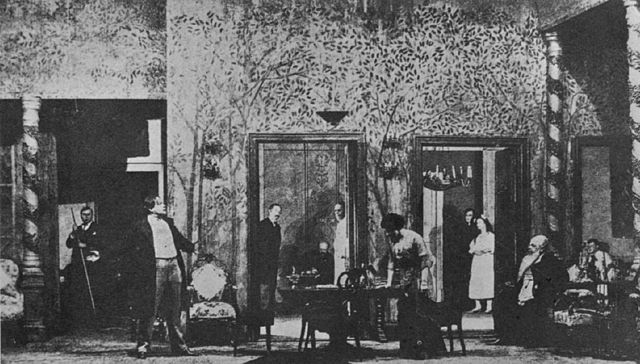
cherry orchard scene
Scene from first production of The Cherry Orchard at Moscow Art Theater.


So, as a reader, it would seem appropriate to expect some kind of settlement by the end of the play, but this is not to be. I am very open to Po-Mo endings, Po-Mo anything really, but this particular version just struck me as pointless – absolutely nothing happens. There are endless conversations about what various people think should happen, but after all that build-up, there is nada. As mentioned before, I am not a reader who necessarily needs a story to have the ending all wrapped up and in a pretty bow, but at least make it have a point in some way. (Unless I am missing something?)

There are some obvious themes throughout the story -- the changing roles of class in Russian society, the theme of identity (and changing identity) -- which were interesting when you link them back to what was happening to Chekhov personally: his family ended up in poverty and having to sell their own house to cover costs, Chekhov himself refurbished a house later in his life (complete with orchard and pond) upon which he lavished care and in the words of his brother, “look[ed] after… as though they were his children,” the play has a physician and Chekhov was a physician etc…

Chekhov died of TB just after this play came out, and one apocryphal anecdote has it that his body was transported to Moscow in a refrigerated railway care for fresh oysters…

In further researching this, it was noted in numerous sources that most producers are not sure how to show the play – is it a tragedy? Is it a comedy? And I think that here is the crux of the whole problem – because the play does not commit itself to one or the other, I wonder that it becomes less than either.

As mentioned in the introduction, I am not a Chekhov expert by any means, not am I an experienced dramatist or reader of plays, so it might well be that I am missing something vital here in my interpretation of The Cherry Orchard. Can anyone enlighten me?


Download The Cherry Orchard by Anton Chekhov at Project Gutenberg|Librivox

Sunday, December 30, 2012

Guest Review: UNDER THE GREENWOOD TREE by Thomas Hardy

book cover


Original Publication Date: 1872


Genre: social novel


Topics: pastoral life, love, society


Review by Liz Inskip-Paulk (http://ravingreader.wordpress.com/):


Dick wondered how it was that when people were married they could be so blind to romance; and was quite certain that if he ever took to wife that dear impossible Fancy, he and she would never be so dreadfully practical and undemonstrative of the Passion as his father and mother were. The most extraordinary thing was that all the fathers and mothers he knew were just as undemonstrative as his own.
This is a book of gentle humor and loving description of country life in an English small village – quite idyllic and a big comparison with his later much bleaker published works. This reminded me of E. F.  Benson, Miss Read, and Angela Thirkell, except written from a Victorian mindset and using the vocabulary of the day.

It also covers a few more serious issues - gender roles, the changing times of agriculture – but it has plenty of levity and wit in its gorgeous descriptions of countryside and the people who inhabit the village. The female protagonist is a headstrong and educated village school teacher who, of course, is who a lot of the village men (and women) talk about. She’s not a shrinking violet, by any means, and the end of the book could be seen as moralistic or shocking, depending on your viewpoint.

…wives be such a provoking class o’ society, because though they be never right, they be never more than half wrong.

The book starts off with a section introducing the reader to the members of the Mellstock Quire (or Choir) and I would have been perfectly happy if the whole book had revolved around these fairly funny guys. It was still a good read when Hardy takes the narrative off into other worlds, but honestly, it would have worked just fine to stick with these early characters.  (They reminded me of the old BBC comedy, “Last of the Summer Wine”…)

Divided into sections to represent the changing seasons (plus a conclusion), this was a fast read with quite a few snappy one-liners in it (not what you’d expect from an author with such a gloomy reputation) and there is plenty of satire and irony scattered throughout the story.  However, despite this humor, there are loads of pastoral paradise descriptions as well – it was a beautiful reading experience and just sucked me in. I could really see some of what he was describing in my head.

…hanging of bacon, which were cloaked with long shreds of soot, floating on the draught like the tattered banners on the walls of ancient aisles…

So – there’s the twisting winding love story, the interloping of an unwanted new organist which upsets the balance of things, and a new vicar who wants to “modernize” things. There’s a funny group of old grumpy men and a country wedding, and lovely descriptions in between. I don’t think this is a particularly deep and meaningful book, but as a good read, it checks all the markers for me. I am now rather curious to read his later work to see the contrast between this rather happy story and his other more tragic takes on life.

There’s also a 2006 TV production of Under the Greenwood Tree which I’d like to track down at some point.

  • Written in 1872 when Hardy was 32 – grew up in a small village in Dorset with a stonemason father and a reading mother. Mostly taught himself from the books he found in Dorchester, the nearby town, and was an apprentice to an architect when he turned 16. Specialised in restoring old houses and churches and after living in London for a few years, returned to Dorchester to be a professional restorer of church there.
  • First novel he wrote was rejected and then he burned the manuscript, but then Under Greenwood got published (under an anon name at first). Also serialized (similar to Dickens et al.)
  • Work reflects his idea of rural life in his fictional county of Wessex, although got bleaker as time progressed
  • Also quite forward thinking with regard to role of Victorian women and the novels Tess of D’Urbervilles and Jude the Obscure were eviscerated in the press enough to stop Hardy writing novels and concentrate on poetry
  • Died in 1928, and it seems (according to legend) that his heart was to be buried in Stinsford, his birthplace. All went according to plan until a cat belonging to the Hardy’s sister snatched the heart from the kitchen (where it was being temporarily kept) and disappeared into the woods with it. Yikes.


Sunday, December 23, 2012

Guest Review: A CHRISTMAS CAROL by Charles Dickens

book cover
Original Publication Date: 1843

Genre: holiday

Topics: kindness, love, redemption


Review by Liz Inskip-Paulk:


First published on Dec. 17 1843 which was the early Victorian era. Prince Albert (who had quite recently married Queen Victoria in 1841) bought custom of Christmas trees to UK, and it was fashionable to have one, and so story is a mix of several traditions out and new reflected in this novella.

The First Christmas card is believed to have been sent in 1843, carol singing also became more popular and this novella is divided into “staves” as opposed to chapters (“staves” being also a verse or stanza or a poem or song thus the link with Christmas music). This volume was instrumental in bringing the secular celebratory aspects of Christmas to the fore for Victorians: the plentiful rich food, family gatherings, and the other festive bits of the season.

The novella came out of Dickens’ concern for the working poor children linked with his own experience of having to leave school at age of 12 and working in a blacking (boot polish) factory where he obviously didn’t fit in, class-wise, and where the other workers called him the “young gentleman”. He was strongly concerned with child poverty for the remainder of his life.

Several sources argue that the dichotomy of Scrooge could be linked to be the polarized feelings that Dickens felt for his father – he both loved him and hated him. (Bit of a psychological stretch for me, but you know lit crit.) The cycle of Scrooge developing from mean and hateful to a sweet and loving man could also reflect the changing of the seasons throughout the year, and how nature grows and changes. (Again, this might be a bit of ridiculous stretch in some ways.) And then I suppose one could argue that the redemptive aspect of the story could reflect the over-arching theme of the Nativity story in Christianity.

Christmas Carol took six weeks to write and due to the poor sales of Dickens’ previous book, he decided to take a percentage of profits from the publisher instead of one lump sum hoping to earn more money. However, this was a risk that did not pan out for him financially, although it ended up being a best seller and a critical success in both the UK and the US. (This was actually in wide circulation by the end of the American Civil War. It’s been argued that the sense of regeneration for Scrooge reflected the hope for regeneration for the US after the battles it had just been fighting.)

Although it wasn’t a tremendous money-making success, the book did sell loads of copies, so it was a popular story. Thought to have an influence on both Capra’s movie “It’s a Wonderful Life” and Seuss’ “How the Grinch Stole Christmas” – but haven’t there always been stories of regeneration and redemption? Point to ponder, methinks.

Its narrative plot was also used as a template for the later Dickens’ Christmas books (which I haven’t read). I did see a strong push by a US manufacturer to convince unsuspecting US shoppers that having a cricket on the heart was a long-standing English holiday tradition. (Not that I know of. At least it wasn’t in our house, and I had not heard of it until a few years ago in the stores.)

By 1849, Dickens was busy with other projects and decided that the best way to maintain public interest in the story (and its message) was through public readings, and according to Wiki, he completed more than 120 readings before his death. Portions of this book were part of his funeral address apparently.

Of course, there are the numerous stage and media productions of this, the most painful of which to experience would surely have to be the BBC production of the story in mime.

:)

Thursday, December 6, 2012

Guest Review: THE ART OF TRAVEL by Francis Galton

book cover
Original Publication Date: 1854

Genre: non-fiction

Topics: travel, how-to, adventure


Review by Liz Inskip-Paulk:

Subtitle: Shifts and Contrivances Available in Wild Countries

A how-to manual of how to explore countries back in the Victorian days.  Incredibly detailed and was THE go-to book for beginning explorers at the time.

Who should explore?

Qualifications for a Traveller [sic].--If you have health, a great craving for adventure, at least a moderate fortune, and can set your heart on a definite object, which old travellers [sic] do not think impracticable, then--travel by all means. If, in addition to these qualifications, you have scientific taste and knowledge, I believe that no career, in time of peace, can offer to you more advantages than that of a traveller [sic]. If you have not independent means, you may still turn travelling to excellent account; for experience shows it often leads to promotion, nay, some men support themselves by travel. They explore pasture land in Australia, they hunt for ivory in Africa, they collect specimens of natural history for sale, or they wander as artists.
In addition, the explorer does not necessarily need to be powerful – “it is rather those who take the most interest in their work that succeed the best…”.  Additionally, he needs to have Good Temper (as “tedious journeys are apt to make companions irritable”) and as for the problem of Reluctant Servants: “leaders should make great allowance for the reluctant co-operation of servants; they have infinitely less interest in the success of the expedition than their leaders…”

“Neither sleepy nor deaf men are fit to travel quite alone.”  (You need to have good hearing and be alert.)

If natives want to bring their wives, it’s fine as well:  “a woman will endure a long journey nearly as well as a man, and certainly better than a horse or bullock”… “It is in the nature of women to be fond of carrying weights; you may see them in omnibuses and carriages, always preferring to hold their baskets or their babies on their knees, to setting them down on the seats by their sides.”

Equipment suggestions range from large (rafts and pontoons for 1-2 men) to small (sealing wax and pens for writing letters). (Triple H pencils are the best tool though – less smudging when damp.) Don’t forget to take a small table or two and a stool, and do remember your protractor and your iron. (Unwrinkled clothes are important in the bush.)  A hare’s foot comes in handy for cleaning lenses and you can easily make your writing ink if need be from burnt sticks and a bit of milk. (Milk is always handy when you’re exploring, I think. :)

Pay for help from the locals in beads, but don’t forget that “there is infinite fastidiousness shown by savages in selecting beads…” The following colors are the most popular ones: dull white, dark blue, and vermilion red, all of a small size.

Food stores need to include an ass, a small mule, a horse, an ox and a camel but note that it is “very inconvenient” to take more than six pack animals that whenever one gets loose, the progress of the overall exhibition is seriously slowed.  This volume also contained copious information of the “theory of tea-making” including using a make-shift teapot (of course, since it’s English).

Huge detail down to how to label your medicine tins – always label the bottom of the tins as the lids can get mixed up.  A handy emetic is a “charge of gunpowder in a tumblerful  of warm water of soapsuds…” Satisfy your thirst by drinking water with a teaspoon – just as effective as drinking glassfuls and will “disorder the digestion very considerably less”…  Mercury (mixed with chewed up old tea leaves and added with spit) can make a good lice repellent when worn in a bag of material as a necklace, but only lasts about one month until it needs to be renewed.  Blisters in new boots can be prevented by putting raw egg into the boot to soften the leather. Oh, and cats can’t stand high altitude and it can be fatal for them (according to one Dr. Tschudi).

Oh, and if someone ends up being half-drowned, don’t hang them upside-down by their feet for the water to come out of their mouths. That’s ineffective.

An artery cut might be able to be stopped if you pour boiling grease into it (ouch), but this is a “barbarous treatment, and its success is uncertain…”

With regard to transporting fragile research instruments, Galton recommends entrusting them to “some respectable old savage, whose infirmities compel him to walk steadily. He will be delighted at the prospect of picking up a living by such easy service…”
Everything is included: how to measure how far your expedition has traveled (whether by wagon or a cantering horse), the lunar measurements of the night sky, the best way to climb trees or go down a cliff (but remember – “it is nervous work going over the edge of a cliff for the first time”), what size and shape to make an axe blade…”

It seems that almost everything (if not everything) has been covered in this book.  Make your own snow glasses using a piece of soft wood with a slit cut into it (a la Esquimaux [sic]).  Holding a horse’s tail as they walk ahead of you can help you up steep hillsides.  Bite a cow’s tail to make him/her stand up from lying position. 

An explorer traveling and making notes noted this about asses:

The instincts of the mulish heart form an interesting study to the traveller [sic] in the mountains. I would (were the comparison not too ungallant) liken it to a woman's; for it is quite as uncertain in its sympathies, bestowing its affections when least expected, and, when bestowed, quite as constant, so long as the object is not taken away.
And don’t, for God’s sake, wear linen. (It is “by universal consent a dangerous dress wherever there is a chance of much perspiration, for it strikes cold upon the skin when wet. The terror of Swiss guides…and of Italians…is largely due to their wearing linen shirts.” If you need a pith helmet, you can buy them in London under the Opera Colonnade in Pall Mall, and a dressing gown never goes unused. (“It is a relief to put it on in the evening…”)

If you’re stuck out in the cold without shelter, it’s recommended that you creep within the warm and reeking carcass of a recently-dead horse (a la Bear Grylls, although this particular case is referenced to Napoleon’s troops).  Speaking of animals, Galton also tells you how to avoid on-rushing animals attacking you (except a buffalo who “regularly hunts man, and is therefore peculiarly dangerous”...) Instructions are also included for crocodile-shooting. (You never know…)

And if you’re traveling to a “rich but imperfectly civilized country”, one option for making certain that you always have a small capital to fall back on to bury jewels in your flesh (the left arm is recommended at the spot chosen for vaccinations). You make a gash, put the jewel(s) in and allow the flesh to grow over them as it would a bullet. (You could also put the jewels into a small silver tube which might be less irritable to your body as it heals.)  Good idea if you’re concerned about robbery.

So – I bet you get the idea. This is THE manual for exploring for Victorian explorers. With so many topics and such detail, I don’t think it was a small book but I bet if you weren’t the poor person carrying it, that would be ok.  A fascinating read.

Don’t forget your pith helmet when you leave the house today.


Download The Art of Travel by Francis Galton from Project Gutenberg|Librivox

Tuesday, November 27, 2012

Guest Review: THE ODD WOMEN by George Gissing

book cover
Original Publication Date: 1893

Genre: fiction

Topics: marriage, society, women


Review by Liz Inskip-Paulk:


Another provocative read from Victorian writer George Gissing, this one focused on the role of women in society and the push-and-pull of the early feminist movement. The title comes from a phrase that one of the female characters says in the middle of the book:

My work and thought are for the women who do not marry – the “odd women” I call them. They alone interest me.

(Speaking is Rhoda Nunn who runs a typewriting/business school for middle class women who don’t want to/can’t get married and will need to work.)

As is the trend in Victorian novels, there is a dichotomy set up in the structure of the book: the group (mostly women) who believe that women should have more choices for their lives than just getting married, and then characters (such as Mr. Widdowson – a real pain) who believe that women should do what’s expected of them (i.e. what men expect them to do), and this age-old battle is a constant thread throughout the plot.

Here is an example of Widdowson’s (misogynistic) PoV:

Women’s sphere is in the home, Monica (name of wife). Unfortunately, girls are often obliged to go out and earn their living, but this is unnatural, a necessity which advanced civilization will altogether abolish.

Basically, the plot concerns three groups of people: two women who are business partners in the women-focused business school (neither married), a family of sisters, and a few men who stray into the obits of these folks. A lot of the action revolves around the machinations and stratagies for the women to get married (or not married) to the right people (or not). It gets quite complicated in places, rather like a Venn diagram in terms of worlds colliding and overlapping with each other, but it’s realistic in that in the confining world of Victorian times, your friends and family did interact with each other a lot, primarily because that was who you met back then (due to convention, transport limitations, individual freedom etc.)

As mentioned, the story revolves around relationships and cultural expectations for gender: who should get married to whom, when… Monica, the youngest of the group of sisters in the novel, ends up choosing to marry an older widow (Mr. Widdowson of the quotation above) who ends up being a jealous and controlling husband for her. (Not a real shocker there, as he more or less stalked her during his “courtship” of her and eventually browbeat her into submission and marriage. Not a good start to a lifelong relationship, I’m afraid.)

There’s a rakish cousin involved “with a past”, and there’s scandals of the Victorian type, such as babies out of wedlock, “women of the street”, and substance abuse. Again, this novel is close to being a sensation novel, but just stays on the serious side of things most of the time. It’s well written, certainly, and representative of its time. After all the complex action that occurs throughout the novel, the ending was a bit of a disappointment, but those Victorians could be a bit heavy-handed with their moralism every now and then.

Gissing was a promising student in the late 1800’s, and won a prestigious scholarship to a forerunner of University of Manchester. However, he focused on more than just his studies (as people do), and ended up falling in love with an unsuitable orphan prostitute called Nell. He gave her money to keep her off the streets, and when his funds ran out, Gissing stole from his fellow students which didn’t go over well.

Gissing was expelled, and sentenced to a month’s hard labor in Belle Vue Gaol in Manchester in 1876.

He left for a year to move to the States, but was not successful so decamped back to England after a year or so. (This experience was influential in his novel, New Grub Street.)

Nell was still around, and they married a few years later. There’s a discussion about how true Gissing’s literary tales of his poverty are, but even if he himself didn’t actually live them, they seem to be accurate so perhaps it was through observation of others.

Eventually, Nell died of alcohol-related disease, and Gissing went on to marry another “unsuitable” working class woman who ended up in an asylum. (Not sure what role Gissing played in her being ill. He sounds like he was a lazy work-avoiding layabout to me.) And when the second wife was indisposed, there was a third woman who came into Gissing’s life and took care of the kids. (Gissing, it seems, was too busy being “scholastic” to help much with his family life.)

One interesting overlap is Gissing was friends with J. M. Barrie (he of Peter Pan fame) among others, and as Barrie himself had somewhat of a weird life, perhaps it enabled Gissing to see his lack of involvement as normal.

Despite my misgivings about Gissing as a responsible human being, he was a prolific writer and ended up published twenty-plus novels and short stories over his time.

Thursday, November 1, 2012

Guest Review: DEATH IN VENICE by Thomas Mann

book cover
Original Publication Date: 1912

Genre: novella

Topics: philosophy, obsession, logic versus passion


Review by Patty S.
:


I regard Thomas Mann as one of the more esteemed German writers of his era. He has provided enough material to mark his place in German literature, and his works are almost always taught at university. It was hight time, therefore, to read one of his better-known novelas, Death in Venice (I read it in the original, available through Project Gutenberg).

I knew of the plot of the book so I was ready to dive into a whirl of emotions. No - this is not how Mann writes. We follow the story of Gustav von Aschenbach, a middle-aged man who is at the height of recognition as an artist and basically on the verge of going downhill. He tries to find inspiration anywhere, and this has to be Venice. From the beginning, I could not sympathise with him. Because the story is told by an unknown third person, I find there is too much distance between myself and the main character. While I can read about his struggle, it felt like reading a report on some unknown soldier in a far-away land. How much more impressive it would have been had I been reading Gustav's own thoughts and fears and expectations! That was a point I was really astonished with and it triggered a bit of research into Mann's point of view: It turns out that the story of this book is based on Mann's own experience. This put everything into a new perspective: did Mann deliberately want to "tone down" the connection between Gustav and himself? Was he afraid that if he had the protagonist talk for himself, he might have revealed more than he was comfortable with? And why should he be uncomfortable?

This is the second point: I see the despair of an man who has gained recognition by nurture when he sees a naturally beautiful boy. To me, this goes beyond an older man trying to find the youth elixir in the young boy - it's more of the feeling of insecurity that keeps us from feeling safe. We will always run the risk of being "exposed" because we don't feel at ease in our skin. We've accomplished great things with the respective effort, but we feel that it's all fake. It is when we witness someone who embodies all the qualities we would have liked to see in ourselves, that we lose our grasp of reality. Gustav has all the qualities that other people admire, yet he's not happy. He's searching for inspiration, he can find none, and resorts to moving to and from places, just to escape this feeling of convention.

This is the third point: while I said I would have preferred Gustav to talk for himself, I appreciate the insinuations the reader provides as to social convention. The story unfolds at a time where society imposed a number of guidelines as to how one should live. We can a glimpse from the Polish family, where the girls are made to look like nuns, while the boy is free to do as he pleases. While growing up, of course, he will also succumb to the pressure of society and will probably end up like Gustav. Gustav, who has "profited" from society, but who now realises that he has made a pact that can no longer be sustained. He sees how pointless all this masquerade is, and he escapes - only in spirit - by obsessing about the young boy.

How I wish that escapes of this kind were the beginning of a new chapter in the lives of those who need it. But there, even Mann knows the outcome: harsh and definite, he shows that there is no escape - once we get into acting our lives, we will keep on acting until the end. A challenging book, great in interpretation, but it left me wondering how Gustav really felt - how Mann really felt ...


Find Death In Venice by Thomas Mann at Project Gutenberg (German)|Internet Archive (English)

Thursday, October 18, 2012

Guest Review: THE RETURN OF SHERLOCK HOLMES by Arthur Conan Doyle

book cover
Original Publication Date: 1903-04

Genre: mystery

Topics: detective, short stories


Review by Liz Paulk:

A collection of more Sherlock Holmes stories, although this anthology features the resurrection of Holmes after Doyle had tried to kill him off in his earlier book. Due to such a public outcry from the fans of Sherlock Holmes, Doyle was forced to bring him back to life and the first story handles that, although it’s not graceful in any way. (Kinda fumbles it, if you ask me, but there may have been reasons for that on Doyle’s side of things.)

Doyle had been writing Sherlock Holmes stories for a while, and although that character was amazingly well liked (and almost a celebrity in his own right), Doyle had got fed up with him and wanted to move on to other projects. However, when Holmes was “killed” in an earlier story, there was a huge public outcry and Doyle felt that he had to bring him back from the dead. This was easier to do than would be expected, as the story wherein Holmes dies is a bit wish-washy about the details of his death, and so it wasn’t that hard to provide details that would prove he was alive in other ways.

So Holmes arrives back in London to meet his friend and business partner Dr. Watson, and then the typical high jinks ensure. As always, a fun read with lots of clues and red herrings sprinkled throughout to make the cases each alluring to the reader to work out. I also noticed that Holmes is starting to get bit more openly grumpy in this book: he snaps at Watson, uses sarcasm and is generally a bit snarky. (You know, he reminded me of Doc Martin in the BBC TV series of the same name. And also House, MD, which of course takes us back to Holmes.)

This bad-tempered side of Holmes comes out more clearly and more defined in this anthology, and I am wondering if it’s because Doyle was grumpy about having to resurrect him when he had thought he was done with that character. (Doyle was an interesting person, in and of himself, but I’ll travel down that rabbit hole another day. In the meantime, here is the official website of the Sir Arthur Conan Doyle’s Literary Estate… http://www.sherlockholmesonline.org/).

An interesting parallel to this is that another book that I am currently reading (“The Devil and Sherlock Holmes” by David Grann) is non-fiction and one of its chapters details the curious tale of how one of the world’s foremost scholars of Sherlock Holmes died a suspicious death after he started to get involved in the large stash of Doyle’s personal papers which was supposed to go to the British Museum, but somehow (through family machinations) ended up on the auction block at Sothebys. (The papers – the important ones, at least – did get to the British Museum in the end, but it was a lengthy journey.) So – even after Doyle is long dead and his characters are historical icons, there is still mystery surrounding the whole topic.

I made a list of all the Sherlock Holmes works that Doyle produced, and thought it might be a fun project to work my way through them in a laid-back non anal-retentive way (if I can). Here is the list so far:

Sherlock Holmes Novels:
  • A Study in Scarlet (1887)
  • The Sign of Four (1890)
  • The Hound of the Baskervilles (1901-1902)
  • The Valley of Fear (1914-1915)
Collections of Sherlock Holmes short stories:
  • Adventures of SH (1981-1892)
  • Memoirs of SH (1892-1893) – SH killed off here
  • Return of SH (1903-1904) – SH resurrected here
  • Reminiscences of SH (including His Last Bow) (1908-1913 and 1917)
  • Case Book of SH (1921-1927)


You might also be interested in:


Download The Return of Sherlock Holmes by Arthur Conan Doyle at Project Gutenberg|Librivox

Thursday, September 6, 2012

Guest Review: PETER PAN by JM Barrie

book cover
Also known as Peter and Wendy and Peter Pan and Wendy.

Original Publication Date: 1911

Genre: fantasy

Topics: children, civilization versus savagery


Review by Liz Inskip-Paulk:

Happened upon the title of classic children’s lit, Peter Pan by J. M. Barrie (1904) and thought I would read and see how it was. Having grown up (along with thousands of others) on the Disney version, I was surprised by how dark and violent the original story really was. It’s still classified as children’s literature, but wow – it’s a bit rough around the edges.

Some of the new information for me that differed from the Disney version:
  • Captain Hook was “black”
  • The crocodile who bit off Cap’n Hook’s hand (and thus gave him the moniker) was a female and had eaten a clock. So long as Captain Hook could hear the ticking of the clock, he would know where this murderous crocodile was, but the minute it stopped ticking… “Ay…That’s the fear that haunts me…”
  • Peter was the cause of Captain Hook’s hook hand and it was he (Peter) who gave the bitten-off hand to the crocodile. (Not sure why it was bitten off in the first place though…)
  • Tinker Bell is actually really mean, jealous and spiteful – none of this little gentle flickering light fluttering around….
  • The “Pan” mentioned in the title refers (I think) to the Pan, the god of Nature etc., he who played the pipes and danced around. This god was a common image in lit for about the fifty years between late 1800’s and early 1900’s. In fact, one of the chapter titles in “The Wind in the Willows” is called something to do with Pan…
Assuming you know the basic story, I was really intrigued by all the details of the story and how the characters behaved. The group of Lost Boys who follow (and worship) Peter Pan have some serious psychological issues with regard to mothers (and thus Wendy), and the boys rely far too much on Peter’s direction when it is actually a case of “the blind leading the blind”… They are all a case of extremely arrested development, and can only remember snippets of their lives before Neverland, so using this spotty knowledge only gets them into more trouble.

There is a lot of violent murder on the island: at least a murder a day (done by the Lost Boys or the Indian tribe on the island, the pirates or maybe a mermaid or two), but the population doesn’t seem to shrink – ever. They never seem to run out of people to kill.

The fairies are over-indulgent and greedy, limping home after having an orgy (presumably with the definition of eating/drinking too much as opposed to otherwise, although who knows with this book?)… Mermaids, who had always before had a pretty benign reputation with me, were actually rude and bullies, especially for poor old Wendy. (Wendy regretted that she “had never had a civil word from one of them” the entire time she was on the island.)

And speaking of Wendy, I had no idea that the English phrase of “Wendy House” (referring to a child’s play house) was related to this (although it seems obvious in hindsight). The Lost Boys built a house around Wendy when she arrived and was unconscious, so it was a Wendy House. I even think the play school my siblings and I attended was called the Wendy House, but that might be wrong.

And the misery doesn’t even end when they Darling/human children return home to their parents. Mother agrees to let Wendy go back with Peter for one week a year to do his Spring Cleaning. (Yeah for parenting skills!)  And then, years later, when Peter comes back, un-aged as he is, he sweeps up Wendy’s kids and future kids “as long as children are gay and innocent and heartless”…  And apparently this is ok with everyone.

wendy darling
Hmm.

So – the author J. M. Barrie (Sir James Matthew Barrie, 1st Baronet). Who was the guy with this twisted imagination? (Or is it me looking with unreasonable 21st century eyes?)  He lived from 1860-1937 and was a playwright and author. He wrote Peter Pan, Or the Boy who Wouldn’t Grow Up in 1904, calling it a “fairy play” and although he had other work, this was the play that made him famous. (It also popularized the name Wendy as that was unusual before this play was published.)

Barrie’s childhood was not an easy one, being the ninth of ten children, and on the accidental death of his next oldest brother, Barrie tried to help his mother’s grief by wearing the dead brother’s clothing and whistling like he used. (Psychological problem #1.) Along with this came the idea of a boy who would never get old (a la Peter Pan) as the brother who died was only 14 when the accident occurred. (Psychological problem #2.)  This big dead brother’s influence would continue on for years, even affecting the career choice his parents wanted for Barrie. He wanted to be a writer, but his parents told him that his dead brother would have been a minister and so that’s what he should do as well. They eventually reached a compromise. (Psychological problem #3.)

Additionally, Barrie was exceptionally small in stature for his family reaching only about five feet tall at adulthood. This led to other problems for him. However, as an adult and writer, he moved in elite literary circles: Robert Louis Stephenson, George Bernard Shaw, Thomas Hardy, Jerome K. Jerome... he told stories to the young Princess Elizabeth and Princess Margaret. Barrie also made friends with Antarctica explorer Robert Falcon Scott, and Scott, when his expedition was falling apart, wrote one of his last letters to Barrie asking him to look after his wife and son if he could not get home…

Linked with friendship is the fact that in 1897, Barrie was in London’s Kensington Gardens when he came across five young boys, all brothers and called the Llewelyn Davies family. “Uncle Jim” (as Barrie became known to the family) was a frequent visitor to the boys’ home and would entertain them with stories during his visits, and it is thought that he based the story of Peter Pan on these young boys. The boys’ father died in 1907 and their mother in 1910, Barrie (in a somewhat bizarre manner) ended up being the boys’ guardian for the rest of their lives (though most of them wouldn’t live too long). It’s all rather strange and Wiki has the details here (as true as Wiki can be): http://en.wikipedia.org/wiki/J._M._Barrie

Before Barrie’s death, he gave the rights to the Peter Pan works to Great Ormond Street Hospital, the children’s hospital, which, if you saw the London Olympic Games opening ceremony the other day, was referenced frequently (sometimes as GOSH). This was the first hospital in the English-speaking world to provide in-patient beds for children and was supported by several royals, including Queen Victoria and Princess Diana (who acted as President for a while).

It seems that Barrie was basically a good guy, but any good psychologist would have had a field day with him. (But then who is to say who is normal and who is not? :)


Find Peter Pan by JM Barrie at Project Gutenberg|Librivox

Monday, July 2, 2012

Guest Review: HOWARDS END by EM Forster

book cover
Original Publication Date: 1910

Genre: society novel

Topics: gender, class, appearances


Guest review by Liz Inskip-Paulk:

So – I did have to take some deep breaths right from the start when I saw that the book title was “Howards End” (with no apostrophe), but once I had leapt that hurdle, it was ok. (Deep breaths are a wonderful thing for a Grammar Nerd. Ha.)

I have been dying to read some EM Forster books since a long time ago, at least ten years or so, but for some reason or another, I hadn’t picked one up. Then, the other day, saw it on a list of classics that another bookie person was reading and thought now was the time.

Basically, a story that revolves around the ongoing fate of Howards End, a country house whose ownership links three different families, it is also a book to be read on two levels. On one level, is the basic plot of wealthy High Society families in London during the Gilded Age (a la Wharton books) and all their machinations with regard to appropriate marriages and friends etc. And then on the other level, is Forster mucking about with turn-of-the-century symbolism of class roles, gender roles, and the overarching worry of this time in UK history: where is England going? Will it remain structured as two classes of rich people and poor people or will Socialism win the day? (This was before WWI had even occurred and wasn’t even a speck on the horizon at this point.) With England just finishing up the years of the Industrial Revolution (where business and money were Kings), it must have been rather a worrying time for the people at the top of the business heap. Would socialism come and take everything that they worked for and believed in?

The story focuses on three groups of people: the Wilcox family, a wealthy business-oriented family (who represent commerce); the Schlegel artistic and intellectual family (who represent the arts and thinking etc.), and then the Bast family who are at the bottom of the heap, money-wise and education-wise. The family who links the two extremes on this scale is the Schlegel daughters who, through a chance meeting on vacation on the Continent, happen to make the acquaintance of the wealthy Wilcox family. Actually, accident plays a big role in how the Schlegels meet the Basts as well…

So, as you can see, the book doesn’t just question gender roles and society in general, but is also philosophical in many ways, discussing the roles and importance of business/commerce and the arts – is one better than the other? A discussion, I think, that continues to this day and age if you think about funding in schools etc across the nation.

The book also throws Imperialism into the mix as well – what role did England have on colonizing the rest of the world? How would it continue? What would it mean?... Lots to think about, and it’s clear that there were strong winds of change at this time in the world – look at Wharton, James, Forster, Chopin (Kate)…

Haven’t actually told you much about the actual plot, but suffice to say, it’s about who will marry who, and when and where, and who will inherit what. I thought the plot was actually more of a vehicle or a framework for Forster to hang his deeper questions on – the future of England and its role in the world, the questioning of commerce vs. art, gender roles…

This was a good read. The story held together very well, and characters were believable and realistic. When I was reading the story itself, all these philosophical strands were there in the background, but the story itself came first. It wasn’t until afterward that I was struck with all the deep thoughts about the book itself so all this questioning about life is only in the background for the most part. (Forster occasionally makes forays and digression into philosophical questions, but it’s not too distracting.)

Forster wrote quite a few books, but after he published his last novel in 1924, he didn’t write another novel for the next 46 years. He lived in one of the halls at a college in Cambridge and apparently sat around doing not much for decades. (Unless someone knows differently?) I think he authored some literary crit. articles, but nothing major. He died in 1970 in the family house of his long-term partner.

Tuesday, May 8, 2012

Guest Review: A ROOM WITH A VIEW by E.M. Forster

room with a view cover
Original Publication Date: 1908

Genre: romance?

Topics: love, society, coming of age


Review by Patty from Tale of Three Cities:

Many times, the novels I've read as a teenager seem to lose their appeal when re-reading them as an adult. Others, on the contrary, gain even more allure and highlight new facets to their story.

A Room with a View by EM Forster is one such novel.  Having read it while a teenager (and watching the film about 15+ times...), I was still aware of the main characters and the overall plot, but I could not remember whether it was all that good.  

The first comment I can make on A Room with a View is definitely politically incorrect: I had the impression that I was reading a book written by a woman! I know this is ridiculous, there is no feminine or masculine way of writing, but I honestly found the writing style too focused on petty details, too romantic... too pink!!! (excuse the expression). It didn't make an impression as such, but that made me pay even more attention on the book...

Moving on, Forster presents an array of situations and happenings to showcase comparisons: the two main venues in the book are Italy and England: Italy, the land of freedom, of laughter, of endless meadows with violets, a pure beauty - in sharp contrast with stiff upper-lipped England, full of rules and regulations, with the Church imposing the norms of society, a beauty perhaps only on a first glance... I found the stereotyping very amusing, and mostly spot-on: I believe the intention here was not to shock the audience, but rather  to move across the "sensitive" subjects rather painlessly, while still making the social criticism. Very clever indeed...

Lucy and her warden Charlotte find themselves without rooms with a view in Italy. Such a dramatic event surely cannot be sustained of course, and a respectable complaint starts being heard in the Pensione.  Upon the offer by the Emersons to swap rooms with theirs that do actually have a view, we witness the hardship of  good manners, taking refuge with the vicar, and finally the obedience towards the decision taken by said priest - the fact that this coincides with the original desire of the ladies, need not bother us. First: things are not always what they seem. From the perspective of a woman who knows what her position in society is, but who nevertheless wants to accomplish (tiny) things, the procedure to follow is way too time-consuming and complicated: she has to make everyone think it was their own idea and decision, while she has been plotting the end result since the beginning... 
(the women's) mission was to inspire other to achievement rather than to achieve themselves.
Difficult times... (I really laughed when Charlotte wouldn't give the big room to Lucy because young Emerson had it - that worry for absolute protection is bound to have the opposite results).

This difference between the new generation and the established one is also a main theme in this book. Not only is Lucy rebellious in contrast with her warden Charlotte but also the two Emersons seem to differ immensely - they just don't understand one another. Only novelists are allowed to cross over to the other side, and hence we have the little devil in the story: Miss Lavish. She will inform Charlotte of all possible mischief that can befall Lucy (I believe this is how Charlotte catches Lucy in the meadow and spoils one of the best romantic scenes in literature...) but she is also the source of amusement for Cecil by writing a book on Italy that will inevitably bring George and Lucy together... (I'm starting getting the romance now...)

On to the next set of comparisons, the conservative versus the radical: the Cecils of this world, who will say to whoever will listen how radical they are, how beyond class they've become, only to prove that they keep the status quo and even worse - they are actually misanthropists:
of course, he despised the world as a whole; every thoughtful man should; it is almost a test of refinement.
Fortunately, there are also the Georges and Lucies in this world, who may stray in the beginning, when they're still trying to fit in the norms of society, only to realise that life's too short for "trying": there has to be a rebellion, and it has to be now. Not in the most articulate manner as in Lucy's breaking the engagement off, but all's well that ends well.

Although the novel is full of comparisons / antitheses, it prefers staying on the surface of the matter at the most crucial point - I was surprised when Lucy and Cecil call off their engagement, that the dialogue is plain and civil to the point of being dry - not much information is provided for the inner feelings (or lack thereof) of the two main characters. That was the only point where I felt I wanted more.

In general, I have to say the novel gave me a lot more food for thought. The characters are given much more shine and I got much more information on the main characters: I was surprised, for example, at the very unflattering light Charlotte is portrayed. I had as reference the film, where Charlotte, while a stiff old spinster, is actually a likable stiff old spinster. I did not get that feeling at all with the book. She is to be meaningless, living in a cheerless, loveless world,  
a world of precautions and barriers which may avert evil, but which do not seem to bring good...  
There is only one hint at her good soul at the very end of the book. Interesting to see the difference between writer and filmmaker...

Lucy and Cecil in Florence


For the visual interpretation of this novel, I re-watched the 1985 film by the same name, directed by James Ivory. I have to agree that the film does the novel more than justice - the points where the novel may lack in depth, are compensated by the actors' interpretation.