Showing posts with label adventure. Show all posts

Monday, February 23, 2015

Review: An English Woman-Sergeant In the Serbian Army by Flora Sandes

 englishwomansergeant_serbianarmy_1407

Original Publication Date: 1916

Genre: Memoir

Topics: Army life, World War I, Serbia, British nurses, soldiers, women soldiers, sisters doing it for themselves, smoking-drinking-shooting

Review by : Chrisbookarama

Have you ever stumbling across something by accident and then instantly became obsessed with it? That is me right now with Flora Sandes. Obsessed! I was just minding my own business, scrolling through the Librivox catalogue, when I came across An English Woman-Sergeant In the Serbian Army. Well, I thought, this sounds intriguing. I started listening and couldn’t believe my ears. Is this real life? Was Flora Sandes a real person? I had to find out for sure. Fool me once, Public Domain! And it was true! This really happened!

flora sandes

Flora begins her story with herself travelling back to Serbia after a brief vacation from the action during World War I. England was an ally to Serbia. Serbians needed all the help they could get. Flora volunteered to be a nurse with St John Ambulance. She quickly became a favorite with the men. She’d smoke, drink, and share a laugh with them, as well as hold their hands as they died.

Flora decided early on to stick with the Serbian Army even though she was British. The Serbians’ ideas about women in the combat were more enlightened than the Brits’. She travelled with the army while they retreated from the Austrian advance, taking care of the wounded and sick men. At some point Flora is asked to make a choice.

They said the journey through Albania would be very terrible, that nothing we had gone through so far was anything approaching it, and that they would send me down to Salonica if I liked.

Flora says Yes! to Albania, though they find the locals very hostile to their presence. They get fired upon a lot. But here Flora finally gets to be a real soldier and holds her own against the enemy.

I had only a revolver and no rifle of my own at that time, but one of my comrades was quite satisfied to lend me his and curl himself up and smoke.

It isn’t all shooting dudes all day long though. The Serbians were constantly on the move. Along the road Flora saw the corpses of horses that died of starvation or exhaustion. The men themselves weren’t doing so good, as the locals put up the prices of food when the soldiers arrive in their towns.

As for the men, they showed her great respect. She says she expected resistance, but never experienced it, even in her interactions with the British commanders. Her Serbian commander makes her a corporal, and eventually a sergeant, making her the only woman to officially serve in the Serbian Army during World War I.

flora and her men

An English Woman-Sergeant In the Serbian Army ends unexpectedly, but this is because Flora wrote it in 1916, while the war was still ongoing, to raise funds for the Serbian Army. Flora ain’t got time for writing memoirs. The writing is what you would expect from a woman like Flora: to the point, honest, unadorned. It’s also pretty short. In 1927, she wrote her autobiography, An Autobiography of a Woman Soldier. I will be reading that, I can tell you.

The only thing I didn’t like about this memoir was the patronizing introduction by a Serbian politician:

But she only took to a rifle when there was no more nursing to be done, as, owing to the Army retreating, the wounded could not be picked up and had to be left behind.

No, dude, she would have “took to a rifle” if that had been an option from the start.

Here are some facts about Flora:

  • She was 38 when World War I began, 40 when she wrote this memoir. (Yay!)
  • After the war, she married a Russian soldier 12 years younger than herself. (Get it, girl!)
  • They lived in Serbia until he died in 1941.
  • When World War II broke out, she joined the army again. She was 65. (A Boss!)
  • The Nazis imprisoned her. (Oh no they didn’t!)
  • She moved back to England and drove around in a motorized wheelchair until she died at age 80. (Only death could stop her.)

Project Gutenberg doesn’t have the text but The University of Toronto has a text version.

Download An English Woman-Sergeant In the Serbian Army by Flora Sandes at |Librivox|

Monday, February 9, 2015

Review: THE PASSENGER FROM CALAIS by Arthur Griffiths

the passenger from calais Original Publication Date: 1906
 
Genre: Adventure
 
Topics: Rule of law, honor among thieves, travel, trains, love, motherhood, women


Review by heidenkind:

Lieut.-Colonel Basil Annesley, traveling to Lake Como for some R&R, hops aboard the train from Calais only to find that the train is completely empty of any other passengers, except for one small party consisting of a lady, her maid, and a baby. When he overhears the lady confessing to a theft, he decides she's bad news and that he's going to have nothing to do with her. After she tells him off for being a judgmental douche canoe, however, the Colonel abruptly realizes two things: 1. he IS being a douche canoe; and 2. he's totally in love with this woman and will do anything to help her, despite the fact that he still doesn't know who she is, what she stole, or why. Will the larcenous party be able to evade the private investigators on the lady's trail, and will the Colonel's feelings for her survive the trip?

I was so pleasantly surprised by The Passenger from Calais! It's a game of cat-and-mouse stretching across Europe in an extended chase that reminded me of Around the World in 80 Days–only better, because it includes several awesome female characters. There are fights, run-ins with the law, a slippery villain, double- and triple-crosses, and identity switches. The story takes an unexpectedly feminist turn in the middle, and I thought the ending was pitch-perfect despite an all-too-convenient death.

Even though the Colonel seems a bit dense at the beginning of The Passenger from Calais (his abrupt one-eighty in regards to the mysterious lady was enough to give me whiplash), as the book goes on he proves himself to be a clever and worthy adversary to the people chasing the woman. The story isn't only told from his viewpoint, however: we also hear parts of the story from Falfani and Tiler, the detectives, as well as the lady herself. The switching of viewpoints was confusing sometimes, especially listening to the book on audio, but that's my only real criticism of The Passenger.

The rest of this review is going to be spoilerific, so if you want to read The Passenger from Calais and still be surprised by some of the twists and turns, you may want to avert your eyes.


As for the mysterious woman on the train–whose name is Lady Claire Standish–I absolutely loved her. She's intelligent, capable, steady, and 100% principled even though she *did* steal something. The something that she stole is where the book takes that unexpectedly feminist turn I mentioned.

See, Lady Claire's sister, Henriette, married the vicious Lord Blackadder (cue Blackadder gifs), and several years later was just as unfairly divorced by him, resulting in a huge scandal. Naturally Blackadder got custody of their child, and made it known that he would never allow Henriette to see the little munchkin again. So, while her sister hied off to the Continent, Claire and her maid took her nephew from the house of Blackadder and planned to reunite mother and child in Italy.

So not only is the plot generated by the actions of two women, it centers around a woman's right to have access to her children as well as chose her own husband and maintain her own autonomy (Henriette was forced to marry Blackadder by her guardians, and the divorce hinged on rumors of infidelity sparked by her daring to socialize with men other than her husband). Not only that, but Annesley immediately and genuinely recognizes the women's plight as a just cause.

Blackadder is just as horrible as you can imagine. At one point he pulls the, "Do you know who I AM?!" card with a French official, which I think we can all recognize as a stupid move. The French judge's reaction to it, however, made the scene totally worth it.

And then there's Henriette. When we first meet her it's through the eyes of Colonel Annesley, and she's definitely a Difficult Woman. Completely unlike her sister, she is not cool, calm, and logical in the face of adversity. She's histrionic, temperamental, emotional, and refuses to listen to reason. Colonel Annesley thinks she's a harridan, actually, and when he's telling the story you can understand why Blackadder might have wanted to divorce her.

Lady Henriette is also very suspicious of men in general–understandable, all things considered, but not something I encounter a lot in older novels. Henriette and Claire are painfully aware of the power imbalance between men and women, and Henriette takes care to point it out (in the most annoying way possible, of course):

"Oh, how like a man! Of course you must have your own way, and every one else must give in to you," she cried with aggravating emphasis, giving me no credit for trying to choose the wisest course.

Why should she give you credit, dude? She don't know you. Lady Henriette is sick of doing what the goddamn patriarchy tells her to do. SICK OF IT.

What's interesting is that when Claire's telling the story, Henriette is still difficult and unreasonable, but much more sympathetic. And by the end Henriette redeems herself by taking the initiative to find the people who testified against her in the divorce trial and convince them to confess to the authorities they were bribed by Blackadder, which means everyone can to return to England.

Basically, Claire and Henriette each possess certain attributes of a classic femme fatale (that's certainly what I thought Claire would be when The Passenger from Calais started), but they're not the femme fatales–they're the heroines! Annesley really just provides a supporting role to their adventure.


Despite a few little too-convenient blips now and again, I really enjoyed The Passenger from Calais. I can imagine this book as movie directed by Wes Anderson, à la The Grand Budapest Hotel, and I loved that movie. I'd definitely recommend this novel!


Download The Passenger from Calais by Arthur Griffiths at Project Gutenberg|Librivox

Wednesday, November 5, 2014

Review: THE BLACK MOTH by Georgette Heyer

book cover Original Publication Date: 1921

Genre: Historical, adventure

Topics: Love, honor, betrayal, #eighteenthcenturyaristocratproblems


Review by heidenkind:


Several years ago, Jack Carstares took the blame when his brother, Richard, cheated at cards. Now Richard manages the family estates and Jack, exiled in shame from society, roams the roads of England as the most bespoke and gentlemanly highwayman in the land. What earthly force could possibly make Jack leave behind his life of adventure, admit his brother was the actual cheater, and return to the fold? Love of course!

The Black Moth was Georgette Heyer's first novel, and is the only one of her books in the public domain. It's also the first Heyer novel I've managed to read (I tried one or two, but I have to admit my heart wasn't in it and I returned them to the library unfinished), and I was shocked at how much I enjoyed it. I was expecting it to be a rather dull romance novel, but it's not—it's an adventure that is SUPER DRAMATIC.

Heyer wrote The Black Moth to entertain her brother during a long illness, and if his taste in books was anything like mine is, she definitely succeeded. The Black Moth has EVERYTHING: kidnapping, highwaymen, cheating, a villain you love to hate because he's the only character with a sense of humor, secret earls, a shrieking harpy of a wife, heiresses, star-crossed lovers, duels, sword fights, fashion, a put-upon manservant/sidekick, love affairs... I could go on. Is it crazy over-the-top? YES. Does it go too far at times? YES. Do I think it's Heyer's best work? I certainly hope not. BUT—did I enjoy the hell out of it? YUP.

My favorite character by far was Tracy Belmanoir, the eponymous "black moth" and brother-in-law to Richard Carstares. It was Tracy who discovered Richard cheating at cards, and he's been using that knowledge to coerce Richard into all sorts of things ever since. It's also Tracy who drives the action through much of the book. He's a boss! He gets all the best lines and mopey Richard hates him so much it's hard not to be fond of the guy.

The way women are presented in The Black Moth is also pretty refreshing. You've got Lavinia, Richard's wife, who's a nitwit and constantly talks in exclamation marks. It's! Very! Annoying! But you also have several women characters who are powerful and smart and get things done, like Lady O'Hara, who's very sexually aggressive and awesome. Diana Beauleigh is the damsel in distress, but she's also willing to press the issue of Jack's affections. Her aunt, Elizabeth, is a super-smart older lady who could give Miss Marple a run for her money.

Is The Black Moth a perfect book? Hells no. But if you can enjoy it for what it is—a fun, silly historical romp—you'll get a kick out of it.


Download The Black Moth by Georgette Heyer at Project Gutenberg|Librivox|University of Pennsylvania Library

Wednesday, April 2, 2014

Review: THE PIRATES OF ERSATZ by Murray Leinster

book cover Original Publication Date: 1959

Genre: science fiction

Topics: Pirates, economics, civilization, technology, coming-of-age, adventure


Review by heidenkind:

ersatz (adjective): 1. (of a product) made or used as a substitute, typically an inferior one, for something else; 2. not real or genuine.

Bron Hoddan is not a pirate, but he comes from pirates. Instead of following in his family's footsteps, he's decided to try to make his fortune honestly, as an engineer on the most civilized planet in the galaxy, Walden. Unfortunately, the people of Walden aren't interested in his inventions, and when Bron tries to press the issue, they arrest him for creating death rays. WHOMP WHOMP. Fed up with Walden, Bron escapes with the help of the most awesome ambassador ever. But it's only when he meets a band of outcasts like himself that he has an opportunity to accomplish great things, grow rich, marry some delightful girl, and be a great man... somewhere.

I decided to listen to The Pirates of Ersatz because it's narrated by Elliot Miller, the same Librivox narrator who read The Poisoned Pen. Also: Pirates! Who doesn't love pirates? Those lovable scamps. Even though these aren't "real" pirates, they certainly do act like them most of the time. That being said, The Pirates of Ersatz is mainly an adventure novel and coming-of-age tale: Bron goes to a wild, uncivilized world called Zan and discovers his place in the world.

Some of the more interesting parts of the novel are where the characters posit theories about civilization and economics that, despite the fact that they're coming at me from a serialized science fiction novel, I kiiiiind of buy into? Like, even if they're not true, THEY SHOULD BE. Here are some of my favorites:

"Do you realize," [the ambassador] asked, "that the whole purpose of civilization is to take the surprises out of life, so one can be bored to death? ...Government, in the local or planetary sense of the word, is an organization for the suppression of adventure. Taxes are, in part, the insurance premiums one pays for protection against the unpredictable."

"I tell y', piracy's what keeps the galaxy's business thriving! Everybody knows business suffers when retail trade slacks down. It backs up the movement of inventories. They get too big. That backs up orders to the factories. They lay off men. And when men are laid off they don't have money to spend, so retail trade slacks off some more, and that backs up inventories some more, and that backs up orders to factories and makes unemployment and hurts retail trade again...
"But suppose somebody pirates a ship? The owners don't lose. It's insured. They order another ship built right away. Men get hired to build it and they're paid money to spend in retail trade and that moves inventories and industry picks up. More'n that, more people insure against piracy. Insurance companies hire more clerks and bookkeepers. They get more money for retail trade and to move inventories and keep factories going and get more people hired.... Y'see? It's piracy that keeps business in this galaxy goin'!"

Okay, twist my arm, I'll take up piracy. There are similar passages about technology and engineering, since Bron is an engineer. If you're thinking they slow down the story, you'd be right. But there's not a lot of them, and they do become relevant later on.

Aside from Murray Leinster's economic theorizing, there's a lot to like about The Pirates of Ersatz. Both of the characters quoted above—the Ambassador and Bron's grandfather—are awesome, as is Fani, the woman who's obviously sweet on Bron (obvious to everyone except him). And then there's Bron himself—he's like a sci-fi version of Robin Hood (have I mentioned I'm a sucker for Robin Hood stories?). He's definitely a reluctant hero, but he can think himself out of nearly any situation and he uses his powers to steal from the rich and give to the poor. And hey, it's all insured anyway, right? The scene where Bron and his pirates land on Walden to raid a suburb is priceless. You kind of have to read this book just for that.

The Pirates of Ersatz is a fast, fun read with ironic overtones (obviously—it's a book about pirates that aren't really pirates, what can one expect?). It certainly won't change your life, but if you're in the mood for an adventure along the lines of A Princess of Mars by Edgar Rice Burroughs, I highly recommend it.


Download The Pirates of Ersatz by Murray Leinster at Project Gutenberg|Librivox

Thursday, August 29, 2013

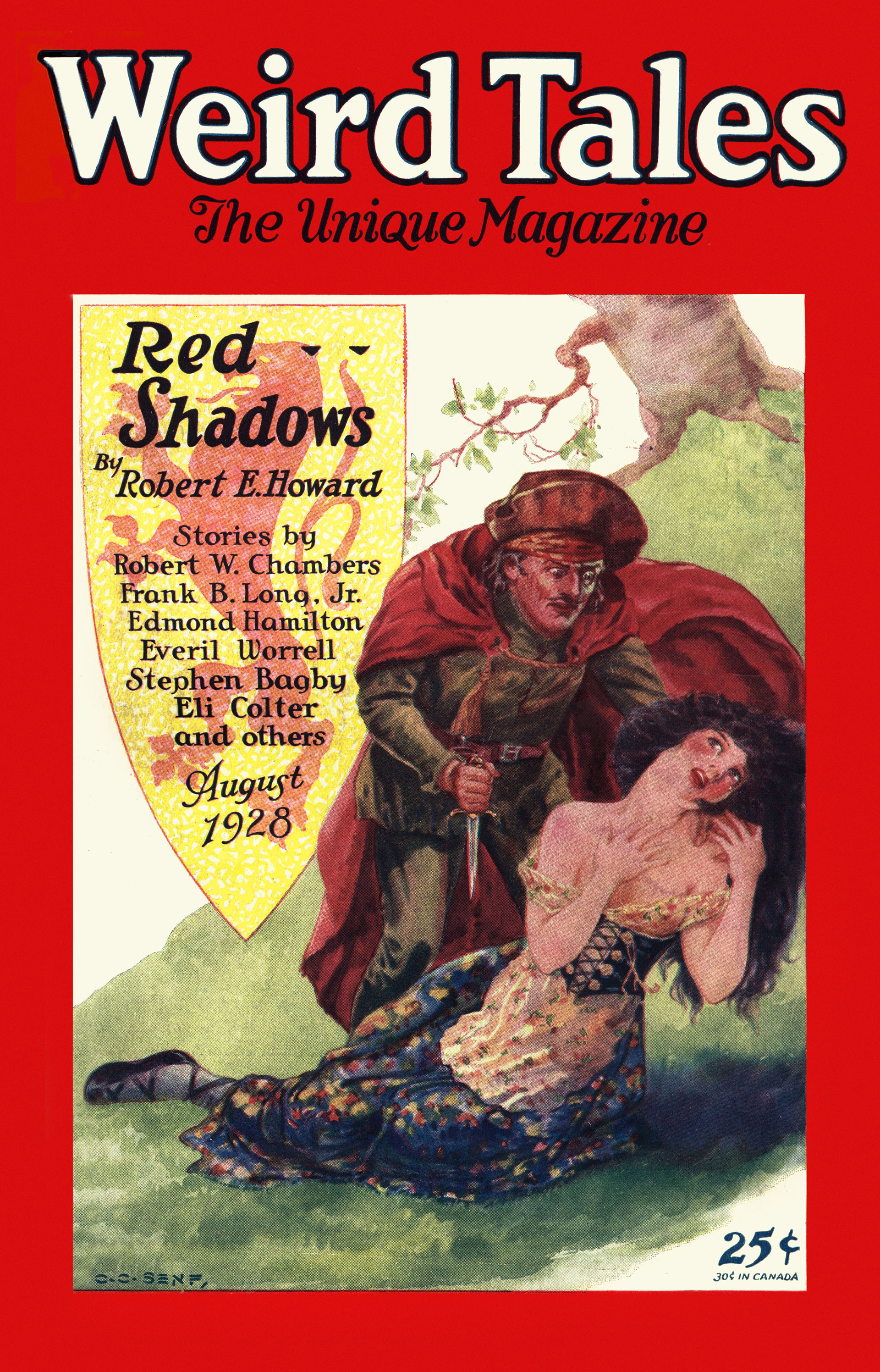
Review: RED SHADOWS by Robert E. Howard

book cover Original Publication Date: 1928

Genre: adventure

Topics: revenge, swashbuckling


Review by heidenkind:

Solomon Kane, an English adventurer with a wicked blade, is wandering aimlessly around France when he randomly stumbles across a girl. She's been robbed and attacked and left to die. As her life fades away, Kane decides to seek vengeance! against leader of the brigands who killed her, Le Loup.

Red Shadows isn't a Conan story, which is slightly disappointing. But it is a swashbuckling tale with swordfights, gigantic Baroque hats, and over-the-top dialog. ("Fires of Hades! A girl!") So it's still really fun.

The writing style is more abrupt than Robert E. Howard's Conan novels: each chapter feels like a vignette and then we're abruptly moved to a completely different place and time. I kind of think Solomon also has less personality than Conan; or at least, his motivations are less clear. Conan's motivation is self-interest, which isn't particularly complex, but Kane is a like a vengeance machine. Like that's all he does, for no benefit to himself that I could see. In fact, it seems to bum him out. Maybe some of his backstory is revealed in the later stories, but for Red Shadows there wasn't a lot of character development going on. Maybe if the only female character hadn't died in chapter one I'd be happier with this novella.

you killed my father prepare to die


Still, overall it was a good story. Kane travels to Africa in his obsessive quest to take down Le Loup, which is totally random, and there are literally pages where all Howard talks about are his characters' eyes as they have the longest stare-down in history. I love it. And I definitely wouldn't object to reading more Solomon Kane stories, because who doesn't love a highly skilled swordsman whose mission is vengeance, right?


Download Red Shadows by Robert E. Howard at Project Gutenberg Australia|Librivox

Monday, July 1, 2013

Review of THE SECRET ADVERSARY by Agatha Christie

book cover Original Publication Date: 1922

Genre: mystery, adventure
 
Topics: espionage, wwi, love, master criminal


Review by heidenkind:


Tommy and Tuppence are old friends who run into one another in post-WWI London and find themselves in the same boat: they're broke, unable to find work, and on the verge of being thrown out of their respective abodes. As they're musing over their impecunious fortunes, Tuppence has an idea: they should start their own business and be professional adventurers! Tommy agrees to put an ad in the paper just to humor her, but no sooner do they part ways than Tuppence receives a job offer from a very suspicious bloke. Beggars can't be choosers, however, so Tuppence agrees to accept a retainer, and in short order she and Tommy are sucked into a world of international intrigue, missing documents, spies, and master criminals. And that's just in the first few chapters!

This is only the third Agatha Christie novel I've read. The other two were Murder on the Orient Express, which was very good but didn't inspire me to read more Hercule Poirot books; and The Mysterious Affair at Styles, which was just okay. So I wasn't expecting to be wowed by The Secret Adversary.

BUT I TOTALLY WAS.

The Secret Adversary is a very different type of book from Christie's Hercule Poirot novels. For one, it's hilarious. Whenever Tommy and Tuppence get together there's snappy, clever dialog, and the story is delightfully ridiculous with plenty of opportunities for hijinks. The coincidences in this novel are just mind-boggling, but whatever. As long as Tommy and Tuppence continue having adventures, Christie can throw as many incredible happenstances into this book as she wants.

Speaking of Tommy and Tuppence... I LOVE THEM! I need my own Tommy and Tuppence to hang with, you guys. I AM SERIOUS. The other characters in the book are also really fun, from Julius P. Hersheimmer, the American billionaire, to Albert, the elevator operator who loves gangster movies.

As for the mystery, it worked surprisingly well considering the pool of suspects consists of basically two, possibly three, men. Christie does a great job of planting red herrings that had me thinking I knew who Mr. Brown—the criminal mastermind—was, but at the same time not being quite sure.

The Secret Adversary is in no way a realistic book. It is a proudly fluffy, sublimely ridiculous tale. In a lot of ways it reminded me of The Man Who Was Thursday (which I loved), only much less metaphysical: the cabal organization, run by a mysterious man who is everywhere yet whom no one has ever seen; a series of fun, entertaining adventures; and then everyone lives happily ever after. In a word, delightful.

I can't wait to read all of Tommy and Tuppence's other stories! If you haven't read anything by Christie before, The Secret Adversary is a great place to start.


Download The Secret Adversary by Agatha Christie at Project Gutenberg

Wednesday, June 26, 2013

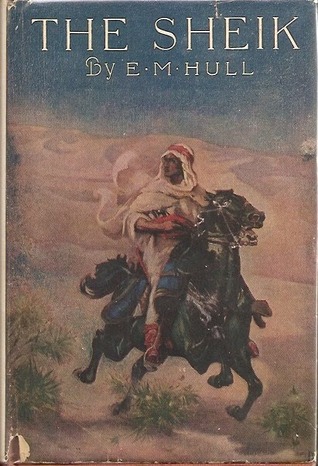
THE SHEIK by EM Hull - Discussion

book cover Original Publication Date: 1919

Genre: romance, adventure

Topics: sex, power, exoticism


Discussion by heidenkind and Anachronist from Portable Pieces of Thought:

Diana Mayo is a frigid, rich, spoiled noblewoman who was raised by her brother and has always done more or less exactly as she pleased. When her brother plans to go to America for some heiress shopping, she decides she'd rather take a trip through the desert, on her own, with no protection aside from an Arab guide. Of course the Arab men carting her stuff around the desert aren't as amenable to her telling them what to do as her brother was (and he wasn't), and before you know it she's been kidnapped by a sheik. But on the plus side, at lease he's rich and handsome!

I had many feels about The Sheik, so I asked Anachronist from one of my favorite book blogs, Portable Pieces of Thought, to help me discuss it here, since I was curious about what her thoughts would be. Read on!

Did you like the book?

HEIDENKIND: Like is a strong word. lol My feelings about this novel are actually kind of all over the place. On one hand I disliked it but on the other hand I found it interesting. And parts of it were entertaining. I don’t know. It’s not something I’d want to read again, but I am weirdly glad that I read it because I feel like I know something now. But I’m not sure what the thing is.

ANACHRONIST: ‘Like’ is rather a wrong word here. I agree it was an interesting book, I am really pleased I read it because it made me understand so many romance trends still floating around, repeated and recycled over and over again. It is, I believe, an important book, like a landmark. Would I like to read it again? No. Would I like to read any other Hull romances (this one was the first of the series)? No. Some aspects of it were outrageous, some were simply silly and unreal and it left me frustrated.


The Sheik has been called the first modern romance novel. Agree or disagree?

HEIDENKIND: It’s definitely not what I would consider a romantic novel, but I can see parallels between it and a certain type of romance that was popular in the ‘70s and early ‘90s, where the hero rapes the innocent heroine and then they fall in lurve. A type of romance novel that I HATE, by the way. On the other hand, Diana is a much different heroine than you see in those types of novels. Usually they feature innocent young girls down their luck; Diana is a rich bitch who thinks she’ll always get her own way.

ANACHRONIST: Modern romance novel? No way. What about The Taming of the Shrew? I know, it is a play but still it features a cock-sure, aggressive alpha male who has to tame an assertive, independent female by showing her the right place. True, they get married first but overall the formula seems to be the same.


Was EM Hull the EL James of her time?

HEIDENKIND: I can see some similarities. Not necessarily the completely-stealing-a-plot-from-another-author similarity (although maybe Hull did, who knows), but I was reminded of Fifty Shades a lot while reading this book. They both portray sex as a game of domination and submission, with the woman in the submissive position. Way to twist gender stereotypes. /sarcasm

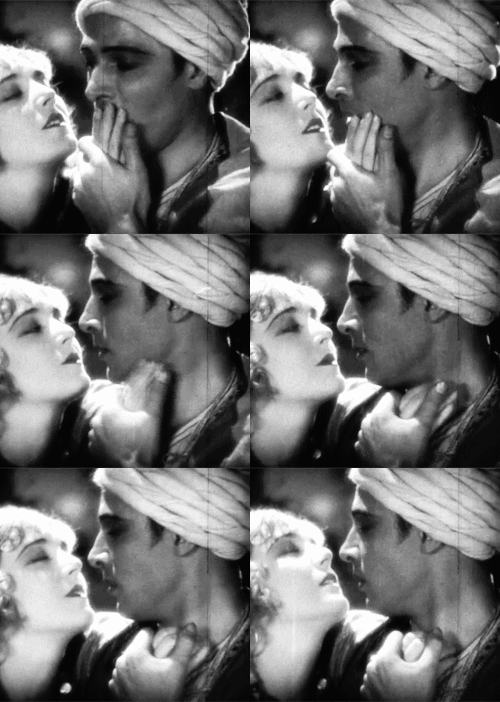
ANACHRONIST: Mrs. Hull definitely created a stir with her novel similar to 50 Shades but actually her success was more flamboyant. The Sheik, was first published in England in 1919 and quickly became an international blockbuster. They sold over 1.2 million copies worldwide and then some, especially after the film adaptation with Rudolph Valentino in 1921.Within the first year of its release, that movie exceeded $1 million in ticket sales and helped to solidify Valentino's image as one of the first male sex symbols of the screen. I suppose E.L. James would love to follow that kind of success but I would hate to see it repeated.


Wikipedia says The Sheik is the, “depiction of a strong, self-sufficient woman being tamed and subdued by a man who rapes her repeatedly.” Do you agree with this statement?

HEIDENKIND: Diana is certainly raped all through this novel and not just by Ahmed; but I don’t agree that she’s a strong woman, and I don’t think she was subdued, I think she was psychologically obliterated. I think she was all bluster and pride, but she had been pampered all her life and had nothing to shore up her self-identity when she lost everything: no faith, no loving family, no purpose or accomplishments. There’s that line she feeds to her brother before she leaves, “I will do what I choose when and how I choose, and I will never obey any will but my own.” That’s challenging the gods, girlfriend, and you’re about to get whacked. She doesn't even have the foresight to take reasonable precautions when she goes on a trip by herself to a place that’s not exactly Disneyland. Diana sets out a journey arrogant and conceited and the world ground that all down to dust, as it does. Kind of like the Odyssey, actually, only if Odysseus got Stockholm Syndrome and never made it home.

ANACHRONIST: I completely agree that Diana is hardly strong or self-sufficient to begin with. Yes, she is financially independent, yes, she flaunts her disregard for social proprieties wearing trousers, smoking publicly, rejecting suitors left right and centre. Still she is just a brat - without brains, imagination or at least a healthy dose of self-preservation.

You mentioned already challenging the gods which is the very idea that came to my mind as well; I think Diana also was attention-seeking, immature girl who loved challenging the society at large. In my opinion she did so because she didn’t know how to express her frustrations connected to the age of puberty and a transformation into an adult woman better. I suppose she emulated Diana/Artemis, the virgin goddess of hunt, but she has forgotten about getting some backbone in the process.

Funnily enough, with her ‘liberated’ attitudes Diana was scaring all those ‘civilised’ men around her to death (or maybe they were just too lazy or too stupid?)  until Ahmed saw her, understood and accepted her challenge. Mind you he did so only for his own selfish reasons and he chose a wrong way to deal with Diana. Rape only creates more issues, never helping to solve any problems.


What was the most uncomfortable scene for you?

HEIDENKIND: The one where they broke the horse, definitely. It was like watching a gang rape. Horrifying, and not the least because you KNOW it’s a foreshadow for what’s coming. Hull might as well have added a banner above the corral that read, “Diana, this is what is going to happen to you.”

ANACHRONIST: Breaking the horse was ugly indeed but I also hated the scene in which Ahmed killed Diana’s lovely mare, Silver Star, just because Diana didn’t want to slow down and he knew his horse wouldn’t be able to overtake her mount. It was such a waste of a beautiful animal and all because of the stupidity and foolhardiness of one she-brat. It was completely WRONG.

HEIDENKIND: That was horrible, too. The horses in this book were all-around treated pretty terribly, actually.


What did you think of Diana’s sudden realization that she loved the sheik?

sassy gay friend slow down crazy


HEIDENKIND: laff ←what I did. I saw it coming, so I was just like, “SLOW DOWN, Crazy.” What made it funny was the bigotry she threw into it. “I love him, that filthy, godless brute of a savage!” “...few weeks [ago], she would have shuddered with repulsion at the bare idea, the thought that a native could even touch her had been revolting...” Ha! Yeah, you’re totally in love. This is a great relationship.

ANACHRONIST: I actually snickered and guffawed  in the most unladylike manner. Diana brought it unto herself with her own stupidity and I wished her, apart from a nasty bout of calf love, Stockholm-syndrome flavoured,  also a bad case of rash on her lovely, white bum. And everywhere else.


What do you think were Hull’s intentions with this novel?

HEIDENKIND: I’m not entirely sure. I don’t think she set out to write a novel about love. In a way it’s like a female adventure novel, but the final message isn’t like something you would find in an adventure novel whether the protagonist is male or female. Instead of finding herself, Diana becomes completely dependent on Ahmed for her self-identity. Maybe it’s a metaphor for British colonialism?

ANACHRONIST: I think (and I might be wrong) that a) Mrs Hull was one bored woman and wife who dreamed of adventurous romance with a dash of masochism as a form of subconscious punishment for her unholy dreams b) she, the ‘good’ and ‘conventional’ girl, secretly despised and envied all the ‘bad’, ‘intelligent’, ‘independent’ girls so it was also her form of revenge c) she wanted to earn some money of course and here she proved to be a very shrewd businesswoman who succeeded admirably.


What’s the difference between the sheik, Ahmed Ben Hassan, and the men Diana knew in England?

HEIDENKIND: Well, Ahmed’s a “GODLESS SAVAGE,” obviously. Basically all the men in this book want Diana because she’s wild and untamable, but Ahmed is also wild and able to tame even the most stubborn of animals (as we saw at the corral scene), so only he is able to turn Diana into his bitch.

ANACHRONIST: Ahmed is a sadist who flaunts his proclivities - and he does so for a reason (I can’t say more as it would be a major spoiler). Civilised men Diana knew  just tended to hide those tendencies far better and were, I suppose, more lazy. Ahmed loved to tame his animals by breaking them; English gentlemen despised work in any form and preferred their wives or horses to be brought to them completely tamed and docile. Work is for ‘niggers’ right?(/sarcasm)

HEIDENKIND: That’s a great way to put it. Do you think Hull was using Ahmed as an example of a “real man,” then?

ANACHRONIST: Hard to say. There was certainly some fascination with his brutality and physical prowess so perhaps she indeed wanted to indicate he was more manly than his ‘civilised’ equivalents but to me he was one sick case of a sadist.


Which was more annoying in this novel, the misogyny or the racism?

HEIDENKIND: There’s a toss-up question for ya. I think the racism was more annoying, just because Diana was the only female character in the entire book, aside from that one woman Ahmed’s rival stabbed in the throat. So the misogyny felt as if it was contained to her, whereas the racism was obviously applied to all non-whites.

ANACHRONIST: I think it was a draw. The racism was pretty ugly but in perfect accordance with the period. The misogyny, especially when coming from a woman, was more difficult to swallow but also fully understandable.


What did you think of the ending in comparison to the rest of the book?

HEIDENKIND: The ending felt really long and drawn-out. After Diana was rescued from Ahmed’s rival, the story lost a lot of momentum, but we had to sit through pages of backstory about Ahmed, and then Diana spiraled into psycho panic mode because wasn't raping sleeping with her anymore. It seemed like a tortured attempt to provide a “happy ending.”

ANACHRONIST: HEA was silly because in real life there would be no HEA for two such deranged individuals as Ahmed and Diana. Sooner or later he would kill her - no matter whether with his kindness or his rage. Or she would kill herself.

the sheik movie gif


SPOILERS

highlight

to

view...


HEIDENKIND: I think what REALLY annoyed me about the HEA was the fact that it only happened because Ahmed was a “secret Christian.” If he’d been an actual Muslim, Diana would have returned to England and the story would be about a love that was never meant to be, or something like that. And fiction STILL follows that rule. I’m thinking of the The English Patient, for example.

ANACHRONIST: The English Patient is an excellent example. When it comes to our sheik It wasn’t only about his faith, it was also about his parents - Ahmed was in fact an aristocrat, well-educated and rich, who chose to stay among Arabs on the desert and follow their lifestyle. Such a plot twist showed that deep down Mrs Hull didn’t want to test the tolerance of her readers. If your character is a brutal savage AND a British peer you have to forgive him a lot because he is simply entitled to it. If he is only a native brutal savage, well...it’s better to kill him off or turn him into a baddie. Or both. What was the difference between Ahmed and that rival sheilk, Omair? Personally I saw none, apart from the fact that Omair was a real native. Now look at their fates.


Would you recommend The Sheik to others?

HEIDENKIND: Some others. I definitely think it was worth reading and that it deserves more attention than it has right now. But at the same time I think it has it a limited audience.

ANACHRONIST: It is a very interesting book from the history of literature’s point of view, especially if you are following the development of romantic novels. No, you won’t be entertained or awed by it, some parts will most probably make you sick, some will bore you to death but they will also make you understand a lot of current and past trends. A book only for discerning, motivated readers.


Download The Sheik by EM Hull at Project Gutenberg|Librivox

Thursday, June 6, 2013

Review: RED NAILS by Robert E. Howard

book cover Original Publication Date: 1936
 
Genre: fantasy
 
Topics: adventure, revenge


Review by heidenkind:


Valeria is a female pirate who is on the run after killing a man who tried to rape her. In the remote jungles of, I'm guessing here, the Yucatan, she meets Conan. After killing a dragon, Conan and Valeria find themselves in a strange and ominous walled city home to two warring clans: the Tecuhltli and Xotalanc. Valeria and Conan are welcomed by the rulers of the Tecuhltli and agree to help them defeat of the evil Xotalanc--in exchange for a reward of course--but only after they complete their task do they realize they might have made a deal with the devil.

This is another really good Conan the Barbarian book. I've read several since The People of the Black Circle, and while all of them have been enjoyable, most are pretty short and I don't have a lot to say about them. Red Nails stood out because of the female characters, the twisty turns, and its sheer awesomeness.

There are not one, but TWO central female characters in Red Nails. The first is Valeria, who is like a proto-Xena (total Xena Warrior Princess fan right here). She's tough and she doesn't take any shit from anyone, including Conan, who basically spends the entire book trying to get into her pants.

The second female character is Tascela, the queen of the Tecuhltli who immediately becomes enraptured with Valeria. I don't want to say what her deal is because that would spoil the story, but she's also a really interesting character with her own agenda, and she's a lot more than she appears.

Second of all, Red Nails is so twisty! I never could have predicted where the story was going at the beginning. Toward the end I was like, "Huh-wha?" but in a good way. It's only about 150 pages, but it has a full three acts, the glory and decimation of an entire civilization, AND Conan gets the girl (actually Conan isn't in the story that much, it's mainly Valeria's book, and she's the one who saves the day).

Third of all, this is an awesome adventure. I'd put it on par with Captain Blood or a movie like Romancing the Stone. But Robert E. Howard also isn't afraid to ask questions, like what is the nature of a society driven by war and turmoil? I loved the scene where Techotl, the person who brings Conan and Valeria into Tecuhltli, is like, "But wait, what are we going to do with ourselves once we kill all the Xotalanc?" GOOD QUESTION, Techotl.

So basically Red Nails is the literary equivalent of bacon. IT'S IRRESISTIBLE GOODNESS. Everyone likes bacon, even if it's not healthy for them. And the Conan books are pulpy awesomeness. I love Robert E. Howard so hard, you guys.*


Download Red Nails by Robert E. Howard at Project Gutenberg|Librivox


*Side note: Have you read Howard's Wikipedia page? They make him sound like Norman Bates if he'd written novels instead of killed people.


Wednesday, May 29, 2013

Review: THE THREE MUSKETEERS by Alexandre Dumas

book cover Original Publication Date: 1844

Genre: adventure

Topics: love, coming of age


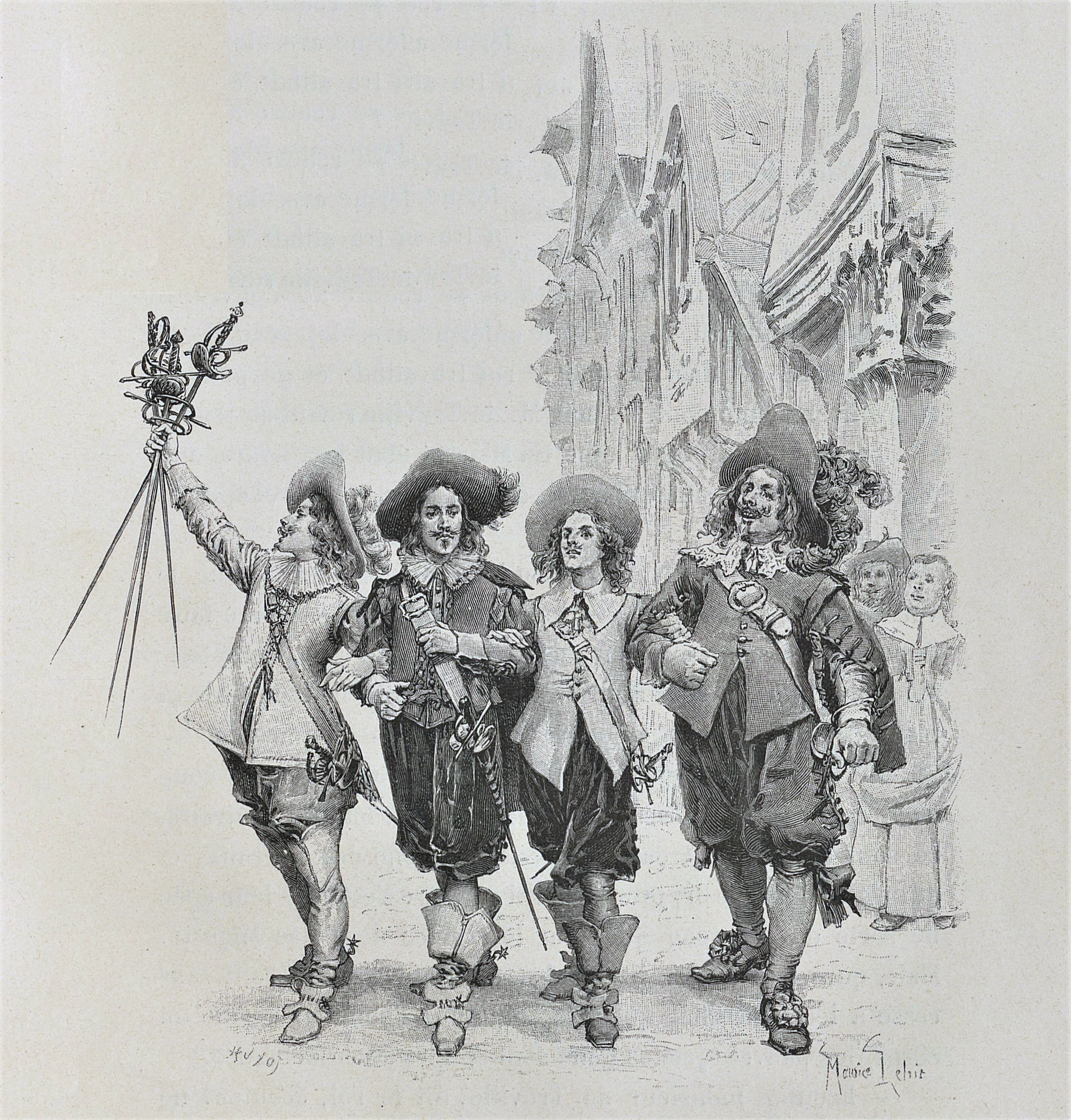
Review by heidenkind:

Less awesome alternative title: D'Artagnan, the Early Years

A young man from Gascony sets out for Paris with big dreams, namely to join the king's personal guards, the Musketeers. He finds he can't join the Musketeers, but he does befriend three of them: Athos, Porthos, and Aramis. D'Artagnan has one weakness, which is that he falls in love constantly with incredibly unsuitable women, and this winds up getting him and his friends into trouble of the most royal kind.

It took me about six weeks to make my way through this massive book—on audio—but honestly, it didn't FEEL like six weeks. Dumas does go off on one or two tangents, but for the most part the story is so tightly told that it felt like the book was flying by even though it was long. And honestly, if it had went on forever and ever, I WOULDN'T HAVE CARED! I would have happily listened to/read this novel unto eternity, because I loved these characters so much.

D'Artagnan is the main character of the novel (obviously), and I loved how he developed over the course of the story. At first he's very unsure and eager to prove himself, and therefore extremely defensive. He's willing to challenge anyone to a duel for any slight, real or imagined. But after he makes friends with the Musketeers, it quickly become clear he's the brains of the operation. He's super-smart and even wiley, but his heart's in the right place. Most of the time.

Athos is d'Artagnan's bestie. Everyone love Athos because of his Dark Past. I won't say any more about it for fear of spoilers, but he's an awesome character. The scene where he eats and drinks an inn keeper out of house and home while defending himself against all comers is PRICELESS, I tells ye.

Porthos is a playa playa and Aramis never really says anything, so.

I can see why English people love this book, because the only main English character, the Duke of Buckingham, is a total freaking badass and I would totally hit that.

Lady de Winter--ZOMG. LOVE HER LOVE HER LOVE HER LOVE HER. She's the best villainess I've encountered since Lady Audley. She's smart, and resourceful, and I really can't blame her for being pissed at Athos and d'Artagnan and the men folk in general, but she's also SO EVIL! But I love her!

I can't believe it took me this long to read The Three Musketeers just because I was intimidated by the length. Shame on me! It's not the length of the book but the story it tells, and this one tells a rollicking, swashbuckingly, non-stop story from beginning to end. I highly recommend you read it.


Download The Three Musketeers by Alexandre Dumas at Project Gutenberg|Librivox

Monday, May 13, 2013

Review: THE THIRTY-NINE STEPS, by J. Buchan


Original Publication Date: 1915


Genre: adventure, suspense

Topics: war, espionage, duty, man on the run


Review by : Patty @ A Tale of Three Cities


John Buchan is a well-known Scottish author who wrote The Thirty-nine Steps while recuperating from an illness.  The title of the book came from a flight of 39 steps found in this nursing home...


It is considered one of the first "shockers" - combining personal and political drama -, but I actually watched Hitchcock's film adaptation by the same name first:  though not one of his best and memorable, it was adventurous enough to let 1.5 hours pass by.   As I came across the book, though, I wanted to see whether the plot there would be "flat" compared to the film, or whether it would be just as thrilling?

The novel describes the "man on the run", which would later become something of a standard in films noirs. We always identify with him and follow his adventures, and rejoice in his redemption in the end...

I said I liked Hitchcock's version, but next to the actual book, it simply pales in comparison:  the book starts with a general overview of the political climate at the time - Europe is on the verge of war and various political alliances form and threaten others.  It was very interesting to see (this is 1915) how well aware Buchan was of the little intrigues that were formed and how the would contribute to the deterioration of society, and I could even detect some early comments against the Jews that I could well imagine continued, increased and contributed to another war as well...

But this is just the setting of the story.  Already from the beginning the plot does not resemble at all the film, and I find I like the book more:  we get to know a little about Hannay first and become aware of his weaknesses and we understand better all that will ensue.  The initial meeting with the victim that will trigger the rest of the plot is in the building where Hannay lives (it's a neighbour), and not in a theatre with a total stranger.  All is more believable in the book, and more focused on the details that will explain the steps to follow.

I continue reading and I start getting upset with Hitchcock.  He has managed to distort the plot in every possible manner.  And while I understand that in a black & white film one cannot see much of nature, Buchan's novel is full of beautiful descriptions of the Scottish landscape that provide the background elements for the chase, the capture, the escape and all other action scenes with Hanney.

This is a story of a bored man (well-off, naturally and recently back from Rhodesia) who seizes the opportunity to do something for his country and thus come to realise the greatest interest one can have:  the good of society in general.  The United Kingdom's military secrets are in danger of being communicated to the enemies and that can have disastrous consequences with regard to its role and position in an eventual war.   Given the time this novel is written, this was a well-received message for those directly involved with the war:  we need to go beyond our petty, individual interests and see how and where we can help for the general good. 

Of course, throughout all of his adventures, Hannay always emerges the winner:  I would not have expected anything else, and although I did miss some negative spots in the story, I understand the need for such a hero. He never questions his involvement, he actually does more than his fair share, and in the end it will be him to confront the conspirators.  The UK thus enters the 1st World War, with its military secrets intact and Hannay will enlist as a captain.

Despite dealing with war issues (not my favourity subject), I really enjoyed this book - especially after watching the movie adaptation and appreciating Buchan's penmanship.  But also because of the humanity that can be found in all of us (Hannay encounters some beautiful people along the way), and the lack of the necessary love interest that had to be present in the movie - the novel wins!


Download The Thirty-nine Steps by J. Buchan at Project Gutenberg|Librivox|

Wednesday, April 17, 2013

Review: THE PEOPLE OF THE BLACK CIRCLE by Robert E Howard

book cover Original Publication Date: 1934

Genre: fantasy

Topics: (pseudo)historical, magic, love, adventure


Review by heidenkind:

When the King of Vendyha is assassinated by the Black Seers of Yimsha, his sister Devi Yasmina is determined to seek vengeance. To that end, she wants to bribe Conan the Barbarian into hunting the seers down, but Conan ain't having none of that. Instead, he kidnaps the Devi like a boss and plans to use her as a hostage. But with a whole host of other people chasing after the Devi for their own ends, Conan's bound to get mixed up in her problems.

This book is pretty awesome. Basically I love everything about it: I love the cover, Conan, the story, the exotic setting, Yasmina, the over-the-top writing style, and the magic elements. But most of all I really love Conan. Eons back I watched maybe ten minutes' worth of Conan the Barbarian--the one with Arnold Schwarzenegger--and based on that movie I started The People of the Black Circle thinking Conan would be the stupidest, most uninteresting hero since Hercules. He isn't! He's actually really smart and dashing and very alpha-male-a-la-romancelandia. In fact, the whole book reminded me of a really kick-ass romance novel. Conan and Yasmina have some crazy chemistry going on; it's pretty hot. Here's my favorite passage from the book:

His wild blood had been stirred to its uttermost by all that had passed. He caught her to him in a grasp that would have made her wince at another time, and crushed her lips with his. She made no resistance; the Devi was drowned in the elemental woman. She closed her eyes and drank in his fierce, hot, lawless kisses with all the abandon of passionate thirst.

Haha! Okay, that's pretty pulpy. But I totally love it because I just knew that at some point there would be the crushing of lips and the lawless kisses.

Naturally I focus on the romance, but most of the story has to do with all the magicians out to get the Devi, and it is GREAT. There is so much delicious double-crossing and plotting going on. I sometimes get annoyed by stuff like that, but since it all focuses on the Devi, it enhances rather than distracts from the story. Also, Conan, who's very much removed from the court politics driving the plot, serves as a stabilizing force in the book. His needs and wants are pretty straight-forward and simple to understand, which was a much-needed balance to every other character.

So basically I was super-pleasantly surprised by The People of the Black Circle, and have subsequently downloaded ALL the Robert E. Howard books. I haven't been this excited about an author since I read The Man in Lower Ten by Mary Roberts Rinehart. If you like Edgar Rice Burroughs or romances with alpha heroes, I think you definitely want to read this one. It's really such a blast.


Download The People of the Black Circle by Robert E. Howard at Project Gutenberg|Librivox

Thursday, December 6, 2012

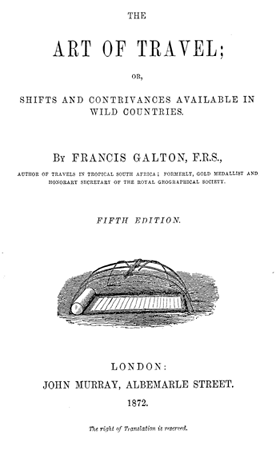
Guest Review: THE ART OF TRAVEL by Francis Galton

book cover
Original Publication Date: 1854

Genre: non-fiction

Topics: travel, how-to, adventure


Review by Liz Inskip-Paulk:

Subtitle: Shifts and Contrivances Available in Wild Countries

A how-to manual of how to explore countries back in the Victorian days.  Incredibly detailed and was THE go-to book for beginning explorers at the time.

Who should explore?

Qualifications for a Traveller [sic].--If you have health, a great craving for adventure, at least a moderate fortune, and can set your heart on a definite object, which old travellers [sic] do not think impracticable, then--travel by all means. If, in addition to these qualifications, you have scientific taste and knowledge, I believe that no career, in time of peace, can offer to you more advantages than that of a traveller [sic]. If you have not independent means, you may still turn travelling to excellent account; for experience shows it often leads to promotion, nay, some men support themselves by travel. They explore pasture land in Australia, they hunt for ivory in Africa, they collect specimens of natural history for sale, or they wander as artists.
In addition, the explorer does not necessarily need to be powerful – “it is rather those who take the most interest in their work that succeed the best…”.  Additionally, he needs to have Good Temper (as “tedious journeys are apt to make companions irritable”) and as for the problem of Reluctant Servants: “leaders should make great allowance for the reluctant co-operation of servants; they have infinitely less interest in the success of the expedition than their leaders…”

“Neither sleepy nor deaf men are fit to travel quite alone.”  (You need to have good hearing and be alert.)

If natives want to bring their wives, it’s fine as well:  “a woman will endure a long journey nearly as well as a man, and certainly better than a horse or bullock”… “It is in the nature of women to be fond of carrying weights; you may see them in omnibuses and carriages, always preferring to hold their baskets or their babies on their knees, to setting them down on the seats by their sides.”

Equipment suggestions range from large (rafts and pontoons for 1-2 men) to small (sealing wax and pens for writing letters). (Triple H pencils are the best tool though – less smudging when damp.) Don’t forget to take a small table or two and a stool, and do remember your protractor and your iron. (Unwrinkled clothes are important in the bush.)  A hare’s foot comes in handy for cleaning lenses and you can easily make your writing ink if need be from burnt sticks and a bit of milk. (Milk is always handy when you’re exploring, I think. :)

Pay for help from the locals in beads, but don’t forget that “there is infinite fastidiousness shown by savages in selecting beads…” The following colors are the most popular ones: dull white, dark blue, and vermilion red, all of a small size.

Food stores need to include an ass, a small mule, a horse, an ox and a camel but note that it is “very inconvenient” to take more than six pack animals that whenever one gets loose, the progress of the overall exhibition is seriously slowed.  This volume also contained copious information of the “theory of tea-making” including using a make-shift teapot (of course, since it’s English).

Huge detail down to how to label your medicine tins – always label the bottom of the tins as the lids can get mixed up.  A handy emetic is a “charge of gunpowder in a tumblerful  of warm water of soapsuds…” Satisfy your thirst by drinking water with a teaspoon – just as effective as drinking glassfuls and will “disorder the digestion very considerably less”…  Mercury (mixed with chewed up old tea leaves and added with spit) can make a good lice repellent when worn in a bag of material as a necklace, but only lasts about one month until it needs to be renewed.  Blisters in new boots can be prevented by putting raw egg into the boot to soften the leather. Oh, and cats can’t stand high altitude and it can be fatal for them (according to one Dr. Tschudi).

Oh, and if someone ends up being half-drowned, don’t hang them upside-down by their feet for the water to come out of their mouths. That’s ineffective.

An artery cut might be able to be stopped if you pour boiling grease into it (ouch), but this is a “barbarous treatment, and its success is uncertain…”

With regard to transporting fragile research instruments, Galton recommends entrusting them to “some respectable old savage, whose infirmities compel him to walk steadily. He will be delighted at the prospect of picking up a living by such easy service…”
Everything is included: how to measure how far your expedition has traveled (whether by wagon or a cantering horse), the lunar measurements of the night sky, the best way to climb trees or go down a cliff (but remember – “it is nervous work going over the edge of a cliff for the first time”), what size and shape to make an axe blade…”

It seems that almost everything (if not everything) has been covered in this book.  Make your own snow glasses using a piece of soft wood with a slit cut into it (a la Esquimaux [sic]).  Holding a horse’s tail as they walk ahead of you can help you up steep hillsides.  Bite a cow’s tail to make him/her stand up from lying position. 

An explorer traveling and making notes noted this about asses:

The instincts of the mulish heart form an interesting study to the traveller [sic] in the mountains. I would (were the comparison not too ungallant) liken it to a woman's; for it is quite as uncertain in its sympathies, bestowing its affections when least expected, and, when bestowed, quite as constant, so long as the object is not taken away.
And don’t, for God’s sake, wear linen. (It is “by universal consent a dangerous dress wherever there is a chance of much perspiration, for it strikes cold upon the skin when wet. The terror of Swiss guides…and of Italians…is largely due to their wearing linen shirts.” If you need a pith helmet, you can buy them in London under the Opera Colonnade in Pall Mall, and a dressing gown never goes unused. (“It is a relief to put it on in the evening…”)

If you’re stuck out in the cold without shelter, it’s recommended that you creep within the warm and reeking carcass of a recently-dead horse (a la Bear Grylls, although this particular case is referenced to Napoleon’s troops).  Speaking of animals, Galton also tells you how to avoid on-rushing animals attacking you (except a buffalo who “regularly hunts man, and is therefore peculiarly dangerous”...) Instructions are also included for crocodile-shooting. (You never know…)

And if you’re traveling to a “rich but imperfectly civilized country”, one option for making certain that you always have a small capital to fall back on to bury jewels in your flesh (the left arm is recommended at the spot chosen for vaccinations). You make a gash, put the jewel(s) in and allow the flesh to grow over them as it would a bullet. (You could also put the jewels into a small silver tube which might be less irritable to your body as it heals.)  Good idea if you’re concerned about robbery.

So – I bet you get the idea. This is THE manual for exploring for Victorian explorers. With so many topics and such detail, I don’t think it was a small book but I bet if you weren’t the poor person carrying it, that would be ok.  A fascinating read.

Don’t forget your pith helmet when you leave the house today.


Download The Art of Travel by Francis Galton from Project Gutenberg|Librivox

Sunday, October 14, 2012

Review: CAPTAIN BLOOD by Rafael Sabatini

book cover
Original Publication Date: 1922

Genre: adventure

Topics: pirates, politics, freedom, love


Review:

With a name like Peter Blood, a man has limited but awesome career choices. He could become a soldier, a doctor, a rebel, a killer, or an outlaw. Somehow this Peter Blood manages to be all five.

After soldiering under De Ruyter, Blood decides to put his bachelor's degree in medicine to good use (bachelor's degree! Education has really gone down in quality since the 17th century, people) and settle to a quiet life in Somerset as a physician. But fate has more adventures in store for our high-strung hero; after attending to a rebel wounded during the Monmouth Rebellion, Blood is arrested and accused of being a traitor. He's sentenced to death, but the sentence is commuted to slavery in Barbados. Blah blah blah, he captures a Spanish ship and becomes a pirate captain!

Honestly, I didn't enjoy Captain Blood as much as Scaramouche (review here). I didn't dislike it, but neither did I want to LIVE in it they way that I did Scaramouche. This mostly isn't the book's fault at all. I was listening to the Librivox version, and it wasn't the best production. I know they're volunteers and all, but it made listening to Captain Blood difficult at times. This novel definitely deserves a re-recording. Part of it also had to do with the fact that I had a lot of interest in and knowledge of Revolutionary France going into Scaramouche; my familiarity with the time period of Captain Blood (1680's, according to Wikipedia) is sketchy at best.

Aside from that, though, remember how I was just a tad touchy about the women in Scaramouche? Well, when it comes to female characters, Captain Blood is even worse. There's basically one female character, Arabella, and she's annoying as all heck. Basically her entire purpose in the book is to put the screws to Captain Blood and make him feel like a heel for being the most awesome pirate captain who ever liiiiiiiiived.

But there was also a lot to like in Captain Blood, namely: Peter Blood! How could you not love someone who 1., has an Irish accent; 2. speaks approximately a dozen languages; 3. quotes poetry; 4. stands up for his principles; and 5. tells hanging judges, generals, governors, and pirates to kiss his ass LIKE A BOSS.

like a boss

Another great thing about Peter Blood is that he gets all broody when Arabella doesn't pay attention to him. I love it when he gets all broody! Gah that Arabella, what is wrong with her?

So while I don't think Captain Blood is quite as good Scaramouche, it's still quite good. You should read it, and I will definitely keep reading Sabatini's work (except maybe not on Librivox).


You might also want to read:
Alex's review of Captain Blood here.
My review of Scaramouche here.

Download Captain Blood by Rafael Sabatini at Project Gutenberg|Librivox


Sunday, September 2, 2012

Review: SCARAMOUCHE by Rafael Sabatini

book cover
Original Publication Date: 1921

Genre: historical fiction

Topics: adventure, revenge, coming of age, French Revolution


Review:

"He was born with a gift of laughter and a sense that the world was mad."
--kick-ass opening sentence of Scaramouche
On the brink of the French Revolution, Andre-Louis Moreau is a cynical lawyer living in Brittany who doesn't care about politics AT ALL. His bestie, Philippe, does however, and is very involved with the political reformers of the literary cabinet. One night, the highest-ranking noble in the area, the Marquis de la Tour d'Azyr, provokes the egalitarian Philippe into a duel and kills him because he possesses a "dangerous gift of eloquence." After witnessing the murder, Andre-Louis swears to speak with the voice of his dead friend and seek justice through the destruction of the Marquis and his entire class. But how far will he go in his quest for vengeance?

I love Scaramouche! I really want to live in this novel. It's full of fabulous characters, adventure, romance, and it is definitely unputdownable. If you like reading about theater, history, men with gigantic feathered hats who bow over a lady's hand, sword fights, revenge tales, anything by Alexandre Dumas--The Count of Monte Cristo, The Three Musketeers, etc.--or a great story, you should definitely pick this book up. Even if you don't, I still think you should read it.

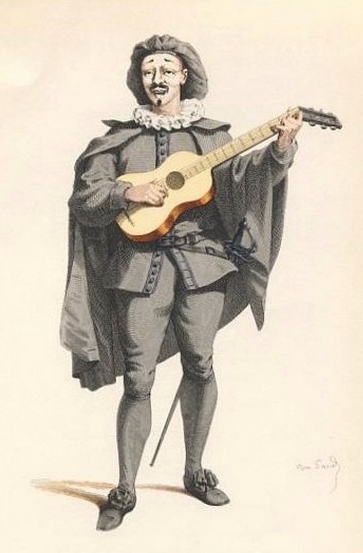
scaramouche
Maurice Sand as Scaramouche by Michel Levy Freres, 1860

What is a Scaramouche? you might be asking. Scaramouche is an olde-timey stock character from the Comedie Italienne, kind of like Harlequin. After Andre-Louis stirs things up in Rennes and Nantes, he has to get away from the local heat for a while; so he joins a troupe of players, where he takes on the role and the name of Scaramouche. What makes it a good name for him is that, as soon as he sets out to get justice for Philippe, Andre-Louis is playing a role--that of his friend, of Scaramouche, of a politician, etc. This is definitely an all-the-world's-a-stage sort of book, and Andre-Louis is pressed by necessity into taking on these roles; but there's also a sense that he doesn't know who he is (literally or figuratively) or what he wants until the end of the novel.

There's also a lot of conflict between generations in Scaramouche, which makes the Revolution the perfect setting for the story. Wherever Andre-Louis goes, he meets old men who are like, "Listen to your elders, young sir! That's not the way we do things around here. *huffle huffle huffle*" But Andre-Louis has his own ideas of the way things should be done (which are naturally much better than the old guys'), and the energy to put those ideas into the practice. In the same way Andre-Louis is inevitably going to get his way, France is going to fall to the force revolution.

But all that is just happening in the background. The center of the story is Andre-Louis, who tends to do bad things for the right reasons, and always seems to land on his feet. He's a strange mix of opposites--sarcastic and earnest, canny and dense, idealistic and unforgiving--but always likable and sympathetic. Rafael Sabatini takes every opportunity of making light of the people Andre-Louis meets--judges, politicians, writers, actors, academics--and it really is funny. You don't need to know anything about the French Revolution or the 18th century to recognize these characters and the humor and irony in Sabatini's prose.

As for the female characters, they wouldn't pass the Bechdel Test--this is definitely a male-centric book, and all the women fill the role of either mother, saint, or whore (in fact, that perfectly summarizes the three major female characters in this book)--but I did like all of them. They're all women who behave true to their class, but with their own motivations, and are pretty independent.

Basically, Scaramouche has everything you could possibly ever want in a novel. Have I mentioned you should most definitely read this book? You should.


You might also be interested in Alex's review of Captain Blood by Rafael Sabatini here.
Find Scaramouche on Librivox|Project Gutenberg

Monday, July 30, 2012

Review: The Woman in White

Original Publication Date:  1859

Genre:  Mystery, Romance, Sensation

Topics:  Inheritance, Dark Secrets

Review:  I listened to this book via the Librivox recording, and it was amazing.  I don't know how so many people worked together to make this book come to life, but I love that they put so much effort into it.  Each character has a different narrator on the audiobook, and each narrator creates a completely unique voice that really brings that character to life.


I don't even know how to describe what this book is about.  There's a drawing teacher, Walter Hartwright, who meets a woman dressed all in white one night on the road.  He helps her get where she needs to go and then continues on his own way.  But he soon realizes that his life is tied by fate to that of the woman in white, who knows about all sorts of secrets and wicked deeds and horrible pasts that will impact the lives of those closest to him.  And it's up to Walter and his completely awesome sidekick Marian, a brave and loyal woman who has the misfortune of being quite ugly, to save the day so that Walter can live happily ever after with the beautiful, rich princess of his choosing, Marian's half-sister, Laura.


Honestly, in reading this book, I can't help but think that Collins really wanted to make Marian the heroine but somehow settled for Laura.  It's pretty clear that Collins has zero interest in Laura.  She's good, she's kind, she's pretty, she can play the piano, but that's about it.  Collins gives practically everyone in the story at least one chapter to tell their side of the story, but he gives Laura nothing.  In contrast, Marian the Awesome gets a significant portion of the story dedicated to her narrative.  I will go to my grave (or at least, will go to the point at which I become quite foggy about this book's particulars) thinking that Hartwright was in love with one sister in his heart but just didn't realize it because he was so blinded by physical beauty.  But lucky for him, he gets to spend his days with both sisters, so life is quite grand for him.


My only other exposure to Collins had been the book Armadale, and I admit that I wasn't a fan of that one at all.  I really disliked Lydia Gwilt and she was the narrator for the majority of the book.  Here, I got to see Collins' skill with POV - he is excellent at making each character unique - and was also quite wrapped up in a complicated story with many twists and turns.

This is one of those books that, for me, was so helped by the audiobook.  I feel like it would have taken me forever to pick up a book that was almost 700 pages of Victorian overreaction and fainting and virtuous women, but in audio form, it was completely doable.  The Librivox team behind this edition is really, really good.  If you enjoy sensation novels or mystery novels or novels about unconventional heroines, then I highly recommend this one to you.  It's good stuff!

I listened to this free recording of the book.

Sunday, July 1, 2012

Review: THE FORTIETH DOOR by Mary Hastings Bradley

book cover
Original Publication Date: 1920

Genre: adventure

Topics: love, destiny


Review:

An American archaeologist with the appropriately dashing name of Jack Ryder prefers mummies over conversing with living people, until his friend Jinny forces him to go to a masquerade ball. There he meets a mysterious woman wearing veils, which he assumes is her costume (clearly he didn't get the memo about "sexy" being the keyword in women's costumes). They dance together and fall in love, but when Jack walks the woman home, he realizes she's a Muslim, and would therefore never be allowed to date a Westerner. Or date at all, really. Depressed, he returns to his mummies, only to find evidence that Aimée isn't the daughter of a Turk, but a Frenchman (she's a secret Christian! hardy har). Quote-unquote evidence in hand, he sets out to rescue her from the clutches of the man her stepfather has promised her to, Hamdi Bey.

As soon as I read Chris' review of The Fortieth Door (review here) and she mentioned there was a mummy, I knew I had to read it. HAD TO. It's basically a retelling of Romeo & Juliet--from the ball where Jack and Aimée meet to Aimée's fake death. For the most part I really enjoyed this novel, even though there were times when the dialog went on and on drove me crazy. The setting was absolutely fabulous; and even though Mary Hastings Bradley is obviously very critical of the way Eastern women are treated and makes Aimée Western to what I thought was an improbable degree, I loved reading about her wedding, which was definitely the highlight of the book.

Bradley lived in Egypt and while this IS the type of book where all the Arabs and Africans are evil, at the same time I think you can tell she had an admiration and respect for the culture. Although the British run Egypt, Bradley doesn't pretend they're the only people who inhabit it--the country is filled with Turks, Ethiopians, French, Egyptians, Muslims and Christians who all have to put with each other. And if the behavior of Jack Ryder is anything to go by, Americans can be pretty difficult to put up with.

As for the story, it's a freaking blast. Not that it necessarily makes sense--I'm still not sure how Jack added one and one together and came up with "Aimée isn't really a Turk and I need to rescue her," but whatever. Dashing archaeologist guy is gonna do what he's gonna do! Honestly, I really liked all the characters, including Jack, and especially the villain, Hamdi Bey. He was moustache-twirlingly awesome. Now THERE'S a villain, bishes.

The Fortieth Door is kinda like Brigadoon--you just have to go with it. In fact, I can't BELIEVE this book hasn't been made into a musical yet. They wouldn't even have to write new songs for it, they could just use ones that already exist. Imagining the characters in the book I'm reading dancing around and singing amuses me muchly.

Can you tell I had fun reading this book yet? I truly think The Fortieth Door is a perfect summer read. It has everything: romance, mummies, illegal activities, dungeons, men in kilts, cheesy show tune potential. It goes by really fast and you don't even have to pay that close attention to most of it--in fact, it's probably better if you don't. But it is really entertaining. I think Chris' speculation that Bradley was the Dan Brown of her time pretty much sums this book up.

Wednesday, June 27, 2012

Bab: A Sub-Deb


Original Publication Date:  1916

Genre:  Humor, Coming-of-Age, Romance, America

Topics:  Gilded Age, Debutantes, Lives of the Rich

Review:

Bab:  A Sub-Deb is about Barbara Archibald- a beautiful, slightly ditzy, 17-year-old society miss who is quite annoyed that her "barely older" but officially "out" to society sister Leila gets all the attention (and new clothes and party invites) while Bab must suffer through boarding school for two more years before she can become a debutante.  She is, in her own words, a sub-deb, and it's a rough life.  The problem is that Bab is a very pretty girl who draws all sorts of male attention and gets into a ridiculous number of scrapes and then does her very best to get out of them without any help.  She rarely succeeds at this goal, but gosh, it's fun to watch her try.

The result is a terrifically entertaining romp through pre-WWI (and WWI), upper crust America, with good-hearted, naive "naturaly truthful, as far as possible" Bab, who can't spell to save her life, as our rusted tguide.  From the first adventure (making up a fake fiancee who, to her horror, comes to life and into her life) to the last (saving her father's weapons munitions factory from German spies), I was thoroughly and wildly entertained, often laughing out loud and noting down my favorite lines.

The best thing about Bab is that she balances so well between being a very realistic, overly dramatic teenager and being one of the funniest and most endearing narrators you've ever encountered.  I generally hate ditzy girls in books because they are so overblown and ridiculous.  But I love Bab, even though (or perhaps because) she says things like:
"I shall now put down the events of the day, as although the Manual says nothing of keeping a record, I am sure it is always done. Have I not read, again and again, of the Captain's log, which is not wood, as it sounds, but is a journal or Dairy?"  
I think that's because even though Bab is a little naive, you know that she is also a very resourceful and extremely determined girl.  Even as she gets into mishap after hilarious mishap, she always bounces back and does her best.  She also has fantastically clever methods for getting her own way.  "All is going well, unless our Parents refuse, which is not likely, as we intend to purchase the Tent and Unaforms before consulting them.  It is the way of Parents not to care to see money wasted."

I can tell this is a review that will be littered with quotes everywhere, but I really want you to get a feel for just how wonderful Bab is.  For example, here's a scene Bab describes when she feels that her whole family turned on her when she most needed them (spelling errors and capitalizations are original to the text):
Father was the first down.  HE CAME DOWN WHISTLING.
It is perfectly true.  I could not beleive my ears.
He approached me with a smileing face.
"Well, Bab," he said, exactly as if nothing had happened, "have you had a nice day?"  He had the eyes of a bacilisk, that creature of Fable.
"I've had a lovely day, Father," I replied.  I could be bacilisk-ish also.
I love the way Bab interacts with her family, whom she loves even though she doesn't think they understand her.  "It is always thus in my Familey. They joke about the most serious things, and then get terrably serious about nothing at all, such as overshoes on wet days, or not passing in French grammer, or having a friend of the Other Sex, etcetera."  She particularly loves her father, who is her "only Male Parent and very dear."

I also appreciated how Bab, like all 17-year-olds, confronts some universal fears even in the midst of her crazy escapades.  For example, Bab spends a lot of time contemplating whether she has the capacity to love, "not the ordinery atachment between two married people.  I mean Love - the reel thing."  She sometimes feels like she is a cold-hearted woman because she doesn't feel strongly for any man in her acquaintance.  This is a very real worry for her, and it hints at the broader question of how much a beautiful girl of the early 20th century is allowed to flirt with boys without being deemed a flirt or an ice princess.  But Bab makes sure we don't become too philosophical by ending her contemplation of romance in her life with this rejoinder:  "The terrable thought has come to me that I am fickel.  Fickel or polygamus - which?"

My favorite theme of this book, though, was how feminist it became, without losing the humor and consistency of the character.  Honestly, if Rosie the Riveter were to be made flesh and blood, I think she would come to life as Barbara Archibald.  Bab immediately becomes involved in the war effort, leading a group of girls to form a sort of drill team, learning flag signals, practicing target shooting, and pressuring the young men in their lives to enlist in the war.  Mary Roberts Rineheart was very involved in the war effort, actually going to the front as a reporter, so it was very telling to see her take this light-hearted book and infuse it with some very strident patriotism.  This sometimes bordered on disturbing as Bab suspected all immigrants of being anti-American.  For example, she has a heated exchange with a servant who hails from Germany, and says, "The Emblem of my Country, and I trust of yours, for I understand you are naturalized, although if not you'd better be, floating in the breese AFTER SUNSET."

It's a very humorous exchange in which Bab is bested by said naturalized servant, but also quite telling when you know how Americans acted towards foreigners (particularly the Japanese) during the world wars.

But really, these hints of the very true and difficult problems faced by women and immigrants in the United States during the early 20th century only served to reinforce my love of this book.  It is not only thoroughly entertaining and absolutely hilarious, but it also touches on issues and situations that have universal resonance.  I loved every bit of it, and if I could quote the whole book to you here in this review in the hopes of getting you to download it, I would.  But instead, I will leave you with this slightly longer section:
"Mother, were you ever in Love?" "Love! What sort of Love?"
I sat up and stared at her.  "Is there more than one sort?" I demanded.
"There is a very silly, schoolgirl Love," she said, eyeing me, "that people outgrow and blush to look back on."
"Do you?"
"Do I what?"
"Do you blush to look back on it?"
Mother rose and made a sweeping gesture with her right arm.  "I wash my hands of you!" she said. "You are impertanent and indelacate. At your age I was an inocent child, not troubleing with things that did not concern me. As for Love, I had never heard of it until I came out."
"Life must have burst on you like an explosion," I observed. "I suppose you thought that babies——"
"Silense!" mother shreiked..
I highly recommend that you read this book any time you feel the need for a pick-me-up or a big, hearty laugh.  It's so much fun, and I hope you love it as much as I did.