Showing posts with label historical. Show all posts

Tuesday, June 23, 2015

Review: The Black Tulip by Alexandre Dumas

Original Publication Date: 1850

Genre: Historical romance

Topics: Love, tulips, false imprisonment, political shenanigans, obsession, jealousy, bad neighbours.


Review by : Chrisbookarama

What do you like in a fast paced historical romance? Political intrigue? False imprisonment? Tulip breeding? Err…sure.

The Black Tulip has all the hallmarks of an Alexandre Dumas novel. We have a hero who has been falsely accused of treason and imprisoned for life. However, instead of plotting a complicated revenge to visit upon his unknown enemy, he grows a very expensive flower. As you do!

It all starts in the Netherlands with a harrowing scene where brothers Cornelius and Johan DeWitt are torn apart (literally) by an angry mob for consorting with the French in 1672. Of course there is a very important correspondence between the King of France and Cornelius DeWitt that could destroy the life of whoever happens to have it in their possession. That hapless innocent is Cornelius’s godson, tulip grower Dr Cornelius van Baerle.

The second Cornelius has nothing going on in his life except growing tulips and he is good at it. He is so good at it, in fact, his neighbour and tulip fancier, Isaac seethes in jealousy. Isaac spies on Cornelius 24/7 and when he sees him receive a package from his godfather, he rats on Cornelius to the authorities.

Cornelius is so wrapped up in breeding a perfect black tulip, the first of its kind and worth 100000 florins, that he has no idea he is in danger. He’s forgotten all about the package his godfather asked him to keep. Cornelius is tried, convicted as a co-conspirator, and thrown into prison.

But it’s not all bad news, Cornelius has two things to live for: the love of the beautiful Rosa, daughter of the jailer Gyrphus, and the three tulip bulbs he smuggled into the prison. Together, Cornelius and Rosa grow the tulips, and their love (aw), while outside forces threaten to separate them.

You would think a novel about tulips would be as boring as all get-out, but nope. There were moments when, even though I knew there’d be a happy ending, my heart was thudding in anxiety. I wanted to shout at Cornelius and Rosa to PAY MORE ATTENTION! Stuff is going down! The whole time Cornelius and Rosa have the key to his freedom, but he’s too preoccupied by his flowers and she doesn’t have the ability.

Character development isn’t Dumas’s strong suit. The good guys are so Good and the bad guys just evil. Gryphus is ridiculously backward; Isaac is obsessed. Rosa is an angel because she is blonde, wide eyed, and pretty, though a bit coquettish because she’s A Girl! She’s instinctively good, even though her only role model is Gryphus.

Cornelius is a Tulip Geek. He collects them, grows them, breeds them. He’s not a swashbuckler like Monte Cristo, the Musketeers, or Georges. In modern romance speak, he’s a Beta hero. I don’t think he even left his house before his arrest. It was all tulips, all the time. Rosa complains that he loves his flowers more than her. I’d have to agree with her. He never really grows in that regard. He loves Rosa, but maybe not as much as his bulbs.

There is another character behind the scenes pulling the strings on a whim: William of Orange. He has the power, if he cared, to stop the events that were put in motion. I don’t know anything about the real man, but the character he plays here is one who only steps in when he feels like it. Maybe Dumas is trying to show that our lives are at the mercy of the more powerful. Or maybe he just likes torturing his readers.

rupaul

Since most of the action happens in the prison, Cornelius doesn’t have much opportunity to commit physical acts of heroism. His heroism lies in his intelligence. He must use his skill to grow the tulip in secret. He teaches Rosa what she needs to know and gives her a chance to pull herself out of poverty and ignorance. It’s Rosa who saves the day. Rosa does what needs to be done and acts bravely at the end of the novel. She’s got moxie!

If you can’t tell, I LOVED The Black Tulip. It’s an old fashioned romance. (The phrase “heaving bosom” is actually in the book.) There is intrigue and drama. And that ending! Oh, it’s a killer! At times, it’s over the top, but fun. At a little over 200 pages, it’s a doable alternative to The Count of Monte Cristo, if you're pressed for time.

Download The Black Tulip by Alexandre Dumas at Project Gutenberg|Librivox|

Wednesday, November 5, 2014

Review: THE BLACK MOTH by Georgette Heyer

book cover Original Publication Date: 1921

Genre: Historical, adventure

Topics: Love, honor, betrayal, #eighteenthcenturyaristocratproblems


Review by heidenkind:


Several years ago, Jack Carstares took the blame when his brother, Richard, cheated at cards. Now Richard manages the family estates and Jack, exiled in shame from society, roams the roads of England as the most bespoke and gentlemanly highwayman in the land. What earthly force could possibly make Jack leave behind his life of adventure, admit his brother was the actual cheater, and return to the fold? Love of course!

The Black Moth was Georgette Heyer's first novel, and is the only one of her books in the public domain. It's also the first Heyer novel I've managed to read (I tried one or two, but I have to admit my heart wasn't in it and I returned them to the library unfinished), and I was shocked at how much I enjoyed it. I was expecting it to be a rather dull romance novel, but it's not—it's an adventure that is SUPER DRAMATIC.

Heyer wrote The Black Moth to entertain her brother during a long illness, and if his taste in books was anything like mine is, she definitely succeeded. The Black Moth has EVERYTHING: kidnapping, highwaymen, cheating, a villain you love to hate because he's the only character with a sense of humor, secret earls, a shrieking harpy of a wife, heiresses, star-crossed lovers, duels, sword fights, fashion, a put-upon manservant/sidekick, love affairs... I could go on. Is it crazy over-the-top? YES. Does it go too far at times? YES. Do I think it's Heyer's best work? I certainly hope not. BUT—did I enjoy the hell out of it? YUP.

My favorite character by far was Tracy Belmanoir, the eponymous "black moth" and brother-in-law to Richard Carstares. It was Tracy who discovered Richard cheating at cards, and he's been using that knowledge to coerce Richard into all sorts of things ever since. It's also Tracy who drives the action through much of the book. He's a boss! He gets all the best lines and mopey Richard hates him so much it's hard not to be fond of the guy.

The way women are presented in The Black Moth is also pretty refreshing. You've got Lavinia, Richard's wife, who's a nitwit and constantly talks in exclamation marks. It's! Very! Annoying! But you also have several women characters who are powerful and smart and get things done, like Lady O'Hara, who's very sexually aggressive and awesome. Diana Beauleigh is the damsel in distress, but she's also willing to press the issue of Jack's affections. Her aunt, Elizabeth, is a super-smart older lady who could give Miss Marple a run for her money.

Is The Black Moth a perfect book? Hells no. But if you can enjoy it for what it is—a fun, silly historical romp—you'll get a kick out of it.


Download The Black Moth by Georgette Heyer at Project Gutenberg|Librivox|University of Pennsylvania Library

Thursday, April 10, 2014

Egyptian Ideas of the Future Life by Sir E.A. Wallis Budge

book cover Original Publication Date: 1908

Genre: Nonfiction

Topics: Egyptology, historical, religion, cultures

Review by : Becca Lostinbooks


Sir Budge was a noted Egyptologist and philologist who worked for the British Museum.  In this particular work, Budge offers a concise, scholarly exposition into the Ancient Egyptian belief system including the gods and goddesses and the judgement of the dead. He also covers the meaning of the afterlife for ancient Egyptians and its ramifications for Egyptian society.

Like many anthropologists, sociologists, and researchers throughout history, there is a comparison of the Ancient Egypt's belief system with Christianity.  I imagine this is to put the findings in a context that not only Budge could understand, but that the average historian at the time could understand.  Budge concludes that the gods and goddesses- that to the Western eye looks like polytheism- are actually manifestations of one God.  My brother-in-law, who grew up in India and learning Hinduism, explained Hinduism in this way, as well.   Whether these are accurate descriptions or merely a way for people of traditionally monotheistic religions to wrap their brains around the numerous deities, I am not 100 percent confident.  Budge gives several examples from Egyptian religious texts to back this up, but without having read the entirety of these texts it is uncertain to me if these are taken out of context or not.

Budge goes on to discuss the Egyptian belief in the god of resurrection, Osiris, as well as other gods, or manifestations, including Ra, Temu, Nu, Isis, Seb, and Horus.  In the fourth section, Budge gets to the Judgment of the Dead, the explanation of mummification, funerary rites, the treasure in the tombs, and the Book of the Dead, and how all of this was essential to an Egyptian's next life. This section was the most compelling to me, as I find the rituals and beliefs of the Ancient Egyptians completely fascinating.  

Though a more recent text would proof itself to be more thorough and accurate, as the more history is investigated the more there is uncovered, overall, Egyptian Ideas of the Future Life by Sir Wallis Budge was an interesting look into the Egyptians' beliefs and practices and I enjoyed reading it.


Download Egyptian Ideas of the Future Life by Sir E.A. Wallis Burdge at Project Gutenberg.

Monday, November 11, 2013

Happy Birthday, Anna Katherine Green

Today is—or would be, if she was still alive—Anna Katharine Green's birthday. Green was the first woman to publish a mystery novel (The Leavenworth Case in 1878), and her books tend to be really weird. I don't know why I keep reading them, but I find them bizarrely fascinating. Like watching a Japanese game show: you have a general sense of what's going on, but you can also tell there are things getting lost in the translation. Except in Green's case, the translation is one of time rather than language.

By coincidence, I'm taking a class on historical fiction through Coursera right now called Plagues, Witches, and War: The Worlds of Historical Fiction, and Anna Katharine Green is one of the major authors featured. Apparently she was not just the first woman to publish a mystery novel, but was also the first person to write a historical mystery! Mind: blown.

The book in question is titled The Forsaken Inn; and yes, it's already on my Kindle. I thought it would be fun to include the instructor, Bruce Holsinger's, lectures on it here (I really hope the videos work):


Green was a realist? HOLY SHIT YOU GUYS, her books make so much sense now (I'm kidding, they still don't make sense). As a side note, Holsinger's obvious enjoyment of Green's very Victorian writing style is kind of adorkable.


One of the most interesting things I'm learning from this class is how much information can be found in the title pages of old books. They're like the metadata files of books in paper!

Anyway, happy birthday to Green, a very interesting and innovative author in her time period. Nice to see her getting some more attention!


Wednesday, April 17, 2013

Review: THE PEOPLE OF THE BLACK CIRCLE by Robert E Howard

book cover Original Publication Date: 1934

Genre: fantasy

Topics: (pseudo)historical, magic, love, adventure


Review by heidenkind:

When the King of Vendyha is assassinated by the Black Seers of Yimsha, his sister Devi Yasmina is determined to seek vengeance. To that end, she wants to bribe Conan the Barbarian into hunting the seers down, but Conan ain't having none of that. Instead, he kidnaps the Devi like a boss and plans to use her as a hostage. But with a whole host of other people chasing after the Devi for their own ends, Conan's bound to get mixed up in her problems.

This book is pretty awesome. Basically I love everything about it: I love the cover, Conan, the story, the exotic setting, Yasmina, the over-the-top writing style, and the magic elements. But most of all I really love Conan. Eons back I watched maybe ten minutes' worth of Conan the Barbarian--the one with Arnold Schwarzenegger--and based on that movie I started The People of the Black Circle thinking Conan would be the stupidest, most uninteresting hero since Hercules. He isn't! He's actually really smart and dashing and very alpha-male-a-la-romancelandia. In fact, the whole book reminded me of a really kick-ass romance novel. Conan and Yasmina have some crazy chemistry going on; it's pretty hot. Here's my favorite passage from the book:

His wild blood had been stirred to its uttermost by all that had passed. He caught her to him in a grasp that would have made her wince at another time, and crushed her lips with his. She made no resistance; the Devi was drowned in the elemental woman. She closed her eyes and drank in his fierce, hot, lawless kisses with all the abandon of passionate thirst.

Haha! Okay, that's pretty pulpy. But I totally love it because I just knew that at some point there would be the crushing of lips and the lawless kisses.

Naturally I focus on the romance, but most of the story has to do with all the magicians out to get the Devi, and it is GREAT. There is so much delicious double-crossing and plotting going on. I sometimes get annoyed by stuff like that, but since it all focuses on the Devi, it enhances rather than distracts from the story. Also, Conan, who's very much removed from the court politics driving the plot, serves as a stabilizing force in the book. His needs and wants are pretty straight-forward and simple to understand, which was a much-needed balance to every other character.

So basically I was super-pleasantly surprised by The People of the Black Circle, and have subsequently downloaded ALL the Robert E. Howard books. I haven't been this excited about an author since I read The Man in Lower Ten by Mary Roberts Rinehart. If you like Edgar Rice Burroughs or romances with alpha heroes, I think you definitely want to read this one. It's really such a blast.


Download The People of the Black Circle by Robert E. Howard at Project Gutenberg|Librivox

Monday, November 19, 2012

Kwaidan: Stories and Studies of Strange Things

Original Publication Date:  1904

Genre:  Mystery, Folk Tales 

Topics:  Ghosts, Spirits, Japanese Culture

        
Review:  I spent a lot of time scouring Librivox before settling on Kwaidan.  I was looking for books about non-Western countries that were written in English so that I could add some multi-cultural action to this blog!  I found two books that qualified in my first search, Kwaidan being one of them.  While it's not written by a Japanese author, Lafcadio Hearn did read a lot of Japanese texts and spend a good amount of time in Japan.  He also was a completely fascinating person in his own right.

Kwaidan is a collection of many short stories, fables, and folk tales from Japan.  One of the best parts of reading folk tales is seeing the similarities and differences that exist between cultures.  For example, many folk tales from around the world seem to address the cross-over from living to dead.  In this collection, the story of Hoichi the Earless is the one that most stood out - Hoichi is a blind monk who is a master musician and every evening, he is called to play for a lively lord.  But Hoichi soon learns that he has been led to the graveyard every night and that his life is in great danger unless he can outwit the ghosts that haunt him.

Another story I really enjoyed in this collection was "The Dream of Akinosuke," which reminded me a little bit of The Life of Pi, mainly because readers are brought back to reality near the end of a beautiful and lovely story and are left mystified as to what really happened.

I tend not to remember the details and intricacies of folk tales very well.  I always enjoy the act of reading them, but I don't remember much about them after the fact.  Even now, the stories shared in this collection are fading from my mind.  But they were a treat to read, and the narrators for the stories were good at telling their tales.

One thing that was a little odd about this book was that the last three chapters were not really folk tales - instead, they were about insects (butterflies, ants, and mosquitoes).  Hearn gives some context as to the superstitions around these insects and then goes off into somewhat random tangents on his thoughts about each of them.  I'm sure I would have appreciated this in a book on natural history or science or, well, insects, but in a collection of folk tales, it felt a little out of place.

Overall, though, I am quite happy with this selection - it was fun to read about things that go bump in the night in Japan and listen to stories that were quite foreign to me.

Sunday, September 2, 2012

Review: SCARAMOUCHE by Rafael Sabatini

book cover
Original Publication Date: 1921

Genre: historical fiction

Topics: adventure, revenge, coming of age, French Revolution


Review:

"He was born with a gift of laughter and a sense that the world was mad."
--kick-ass opening sentence of Scaramouche
On the brink of the French Revolution, Andre-Louis Moreau is a cynical lawyer living in Brittany who doesn't care about politics AT ALL. His bestie, Philippe, does however, and is very involved with the political reformers of the literary cabinet. One night, the highest-ranking noble in the area, the Marquis de la Tour d'Azyr, provokes the egalitarian Philippe into a duel and kills him because he possesses a "dangerous gift of eloquence." After witnessing the murder, Andre-Louis swears to speak with the voice of his dead friend and seek justice through the destruction of the Marquis and his entire class. But how far will he go in his quest for vengeance?

I love Scaramouche! I really want to live in this novel. It's full of fabulous characters, adventure, romance, and it is definitely unputdownable. If you like reading about theater, history, men with gigantic feathered hats who bow over a lady's hand, sword fights, revenge tales, anything by Alexandre Dumas--The Count of Monte Cristo, The Three Musketeers, etc.--or a great story, you should definitely pick this book up. Even if you don't, I still think you should read it.

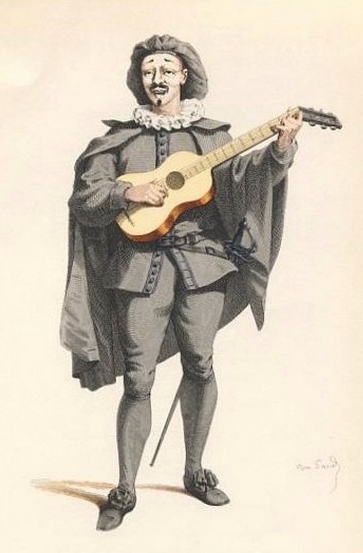
scaramouche
Maurice Sand as Scaramouche by Michel Levy Freres, 1860

What is a Scaramouche? you might be asking. Scaramouche is an olde-timey stock character from the Comedie Italienne, kind of like Harlequin. After Andre-Louis stirs things up in Rennes and Nantes, he has to get away from the local heat for a while; so he joins a troupe of players, where he takes on the role and the name of Scaramouche. What makes it a good name for him is that, as soon as he sets out to get justice for Philippe, Andre-Louis is playing a role--that of his friend, of Scaramouche, of a politician, etc. This is definitely an all-the-world's-a-stage sort of book, and Andre-Louis is pressed by necessity into taking on these roles; but there's also a sense that he doesn't know who he is (literally or figuratively) or what he wants until the end of the novel.

There's also a lot of conflict between generations in Scaramouche, which makes the Revolution the perfect setting for the story. Wherever Andre-Louis goes, he meets old men who are like, "Listen to your elders, young sir! That's not the way we do things around here. *huffle huffle huffle*" But Andre-Louis has his own ideas of the way things should be done (which are naturally much better than the old guys'), and the energy to put those ideas into the practice. In the same way Andre-Louis is inevitably going to get his way, France is going to fall to the force revolution.

But all that is just happening in the background. The center of the story is Andre-Louis, who tends to do bad things for the right reasons, and always seems to land on his feet. He's a strange mix of opposites--sarcastic and earnest, canny and dense, idealistic and unforgiving--but always likable and sympathetic. Rafael Sabatini takes every opportunity of making light of the people Andre-Louis meets--judges, politicians, writers, actors, academics--and it really is funny. You don't need to know anything about the French Revolution or the 18th century to recognize these characters and the humor and irony in Sabatini's prose.

As for the female characters, they wouldn't pass the Bechdel Test--this is definitely a male-centric book, and all the women fill the role of either mother, saint, or whore (in fact, that perfectly summarizes the three major female characters in this book)--but I did like all of them. They're all women who behave true to their class, but with their own motivations, and are pretty independent.

Basically, Scaramouche has everything you could possibly ever want in a novel. Have I mentioned you should most definitely read this book? You should.


You might also be interested in Alex's review of Captain Blood by Rafael Sabatini here.
Find Scaramouche on Librivox|Project Gutenberg

Thursday, July 12, 2012

Review: IVANHOE by Sir Walter Scott

book cover
Original Publication Date: 1820

Genre: historical fiction

Topics: romance, honor, chivalry


Review:

You may have noticed I haven't been posting reviews for a while. That was because I was slogging through this monster. When will I ever learn to stay away from romantic tomes? Probably never.

Wilfred of Ivanhoe is a Saxon knight returning from the Crusades to reclaim his inheritance and his true love, Rowena. Conflicts in England, however, make his journey a difficult one.

I decided to read Ivanhoe a long time ago--after seeing the miniseries starring Ciaran Hinds, actually. I'm glad I saw that miniseries, because I'm not sure I would have made it through this book without it. Walter Scott is not one of those writers who believes that less is more; instead, he writes Ivanhoe as if the whole time he's thinking to himself, "Hm, how can I tell this story in the most indirect and meandery way possible?" The first chapter opens with, like, 10 pages about the Norman and Saxon languages. KILL ME NOW. And then there's another ten pages describing one guy's clothes. Unnecessary clothing descriptions happen to be one of my major annoyances in life.

Fortunately, the story moves pretty quickly to a tournament with all the major characters present, including Isaac of York, the badass Brian de Bois-Guilbert, and a mysterious knight who refuses to be identified. Once the tournament starts, Ivanhoe becomes really fun. Ivanhoe does a GREAT job of transporting you to 12th-century England. This book has everything you could possibly want in a novel about medieval Britain: Prince John, Richard the Lionhearted, jousting, a fool, Robin Hood (have I mentioned I'm a trifle obsessed with Robin Hood?), Templars, folk songs, witch trials, romance, family squabbles, and people coming back from the dead. It even has the scenes you would expect to see in a book like this, such as Robin Hood participating in an archery competition and splitting another guy's arrow. I have no idea how historically accurate Ivanhoe is; but it FEELS 100% historically accurate. Which for the purposes of fiction is just as good, if not better.

Ivanhoe himself isn't really in the book that much. Instead, for me Ivanhoe is all about Brian de Bois-Guilbert, the Templar knight who sees the Jewess Rebecca and decides he HAS to have her because she is beautiful. But I think more importantly, she's attractive to him because she's good, even though he never says so. Unfortunately, she's just not that into him. Because she's an IDIOT.

And speaking of the female characters in Ivanhoe, there are only two of them: Rowena and Rebecca, both of whom seem like they could easily step into an Edward Burne-Jones painting. So yes, this is definitely a "guys" book. But it's a guy's book that that favors the autonomy of people regardless of gender or class, and that promotes the chivalric code. It is definitely an Enlightenment reinterpretation of the Middle-Ages, but romantic and inspiring for all of that. As Ivanhoe explains at one point, "We live not--we wish not to live--longer than while we are victorious and renowned--" These boys are balls-to-wall warriors, but with manners and respectful of their mamas. What's not to like?

Do I think Ivanhoe is worth the haul? It definitely has its moments. I think as long as you don't mind spending a month reading a single book, and have a weakness for romantic literature, you'll want to give it a try. I can definitely understand now why this book has endured and inspired artists for nearly two centuries.

Fun things I learned from Wikipedia:
  • The name Cedric comes from Ivanhoe. Walter Scott actually meant to name Ivanhoe's dad Cerdic but misspelled it. For 800+ pages.
  • The term freelance also comes from Ivanhoe--Maurice de Bracy says he offered the services of his "Free Lances" to King Richard.
  • The idea that Robin Hood came from a town called Locksley is something Scott concluded in his research for this novel and put it into the book. No references to "Robin of Locksley" exist before Ivanhoe.

Thursday, March 8, 2012

Guest Review: THE SCARLET PIMPERNEL by Baroness Emmuska Orczy

book cover
Original Publication Date: 1905

Genre: Adventure, historical fiction

Topics: the French Revolution, trust, rule of law


Review by Kay of Kay's Bookshelf:

Summary: A novel about a brave and noble Englishman who, together with his little group of faithful friends, repeatedly risked his life saving French aristocrats from the guillotine. The success of their enterprise is based on the fact that no one knows the identity of the leader. Now, however, a French agent knows just the way to unmask him: he makes one of the ladies at the English court an offer she cannot refuse — either she finds out who the famed hero is, or her brother dies.

General impression: I don’t know what to make of this. I feel like it has this great potential and yet all the interesting parts are missing.

Setting: The year is 1792, a short while after the French revolution. Beheadings happen every day, as the people, drunk on their new-found freedom, are also thirsty for revenge on their former oppressors. On the other side of the channel, the English are horrified at the news of the bloodshed. The King, the Prince of Wales, and the rest of the political leaders are as yet undecided whether they should openly condemn France’s behavior or just keep quiet, not to risk a conflict. However, a bunch of English young people have decided to do more that just decry the situation: they spend their time working up schemes to smuggle the unfortunate “aristos” from their now hostile motherland to the safety of the British soil. Their leader, who calls himself The Scarlet Pimpernel (after a humble little red roadside flower), is a paragon of resourcefulness and a master of disguise — which is how he managed to keep his identity hidden for so long.

It is obvious that the author herself is firmly on the aristocrats’ side, being openly against the ‘regular people’. The former are gracious, well bred, and the ones we root for; the latter are dirty and mean. The reason for that became obvious when I read about the author’s early life: of noble descent herself (her father was a Baron, her mother a Countess), she and her family left her native Hungary in 1868 as they were afraid of a peasants’ revolution.

Characters: As a sidenote, the dialogue was awfully sprinkled with interjections. It felt like there hardly ever was a sentence without a “Lud!” or “Zooks!” or “Bah!” or “Odd’s fish!” or something such. While at times there was indeed the need to show someone’s surprise, or Marguerite’s pretend flippancy, having basically every character exclaim something every few minutes became tiring after a while.

As for the characters, I felt them more cardboard-y than anything else. Marguerite St. Just/Blakeney, for example, is not only a very beautiful woman but is also considered the wittiest in Europe(!). Alas, this last part remains unproven, although we spend about half the book reading her inner thoughts. All she thinks about is the fact that she loves the hero, and oh, how she betrayed him — but she loves him so much! More and more every passing minute! And to think she has betrayed him! Him whom she loves so much! — and so on and so forth. Surely, she does show courage (or is it merely recklessness?) when she follows the love of her life straight to France, where it wasn’t safe for her, but then, other than following the soldiers she does absolutely nothing to actually help. This is one of the missing parts I complained about in the beginning — the fact that we, the readers, are not actually shown the rescue operation — which happens to be the most interesting part of the book, as the Pimpernel has pledged his honor to rescue some French aristocrat, and he does not know that the area is surrounded with soldiers. The pages that should deal with that are dedicated to Marguerite’s thoughts, and as she follows the soldiers she can only see what they see — which is naturally nothing, else the rescue would not have taken place. We only find out about what happened near the very end, in a few sentences, as the brave rescuer explains to Marguerite how he accomplished the feat. But I would have liked to see it myself, to hold my breath and keep my fingers crossed all throughout :(

The Scarlet Pimpernel is a very romantic, dashing hero: a noble, mysterious man who risks his life in order to save others’. He also possesses an insurmountable pride, that sometimes gets the best of him, an intensity of feeling of the kind one sees only in books1, a presence of mind that never betrays him and a rather superhuman physical strength. Oh, and of course he’s good looking too. And a good actor with a gift for accents, which is how he manages to fool the French police for so long. There isn’t anything this guy can’t do, which is why after a point he stops being an actual person, becoming a sort of parody instead. A male Mary Sue, if you wish. And to think that, for all his perfection, we didn’t get to see him being a hero. I imagine the book would have been so much interesting had it been told from his POV. *sigh*

As a bit of trivia, the villain, the French agent that spares no efforts in his hunt for the Scarlet Pimpernel is actually a real-life character, although the author is said to have stretched history around him quite a bit.

Relationships: Ah, yet another one of those parts I found sorely lacking. As the book opens, Marguerite St. Just has been Lady Blakeney for about a year. She despises her husband, which she finds dull and incapable of passion. This despite the fact that his intense passion for her was the very reason she married him in the first place (in short, he was very much in love with her, but she had some secret and he judged her for it, and she was too proud to explain her reasoning to him, so apparently he stopped loving her, just like that). I would have liked to see their courtship, to see them as a couple, as when the book opens they are very much apart.

And then one evening all of a sudden Marguerite talks to her husband (had they never talked before?). And his behavior gives away the fact that he still loves her, and all of a sudden Marguerite realizes that, wait, she loves him too! Despite the fact that up until then she barely looked at him, and that she mocked him on every occasion. Despite the fact that a bit earlier we’re told how she married him because she thought that he loved her so much she could grow to love him in return. And now she realizes she had loved him all this while? This would have been easier to believe if I had seen her ever caring for him before — in a scene before their marriage, perhaps — but as it were it seemed somewhat of a stretch.

Thoughts on the ending: I was particularly amused by one of the last few sentences:

But it is on record that at the brilliant wedding of Sir Andrew Ffoulkes, Bart., with Mlle. Suzanne de Tournay de Basserive, a function at which H. R. H. the Prince of Wales and all the ELITE of fashionable society were present, the most beautiful woman there was unquestionably Lady Blakeney, whilst the clothes of [The Scarlet Pimpernel] were the talk of the JEUNESSE DOREE of London for many days.

The Scarlet Pimpernel has many manly qualities, probably all of them. He has a soft spot however, and that is his love for expensive clothes. As such, a truly happy ending for him could not have existed without everyone’s admiring his clothes, right? :)

Other than that everything’s pretty textbook stuff, the good and the brave are rewarded, the evil plans are foiled. I don’t think anyone expected otherwise. :)

Recommend it to? People interested in the classics, I guess. It has a 4.05 rating on Goodreads, so the vast majority of people seems to have liked it.