Showing posts with label destiny. Show all posts

Monday, April 15, 2013

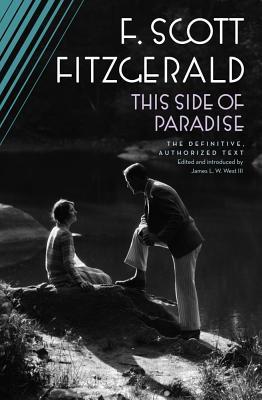
Review: THIS SIDE OF PARADISE by F. Scott Fitzgerald

Original Publication Date: 1920

Genre: fictional autobiography

Topics: coming of age, status, personal quest

Review by : Patty @ A Tale of Three Cities


Having read The Great Gatsby and fallen in love with Fitzgerlad's story-telling, I couldn't help but wonder whether this was a one-off experience.  
I was so mesmerised by the techniques he used, that I wanted to have more of it - and so chose to read This side of Paradise, Fitzgerald's first novel, semi-autobiographical, and the book that shot him to fame.  

Would I distinguish his brilliance already there? Would I feel the "lost generation" he so eloquently spoke about?
Fitzgerald was in his early 20s when his wrote this book, and used elements from his personal experience to draw the character of Amory Blaine: a well-off, spoilt-rotten mama's boy who grows into a sad, lonely young man, never meant to find happiness...


Having first read the Great Gatsby inevitably puts this book in a stricter, harsher light.  The writer is not yet master of his skill, so the book reads really like a very, very long description - a diary of the main character and everything that happens around him.  This is very analytical and, as it also happens to be autobiographical of Fitzgerald, it was interesting to witness first-hand his character - or lack thereof.

Because Amory is not someone who will have to strive to get ahead in life:  he's from a well-off family, with a father semi-absent and a mother who's just enjoying her personal crises.  I could sense the boredom oozing from every corner of the book and I felt really lucky I did not have such an upbringing:  Blaine cannot escape his destiny.  He's handsome, intelligent and lazy in terms of actually doing something:

"Amory wondered how people could fail to notice that he was a boy marked for glory, and when faces of the throng turned toward him and ambiguous eyes stared into his, he assumed the most romantic of expressions and walked on the air cushions that lie on the asphalts of fourteen"
I was almost ready to dismiss Amory, because I was slightly getting tired about all his "adventures" in prep school.  I could understand his quest to fit in with all the other members of high society, but I was losing interest - fast.  The drama boy was growing into a drama young man:

"I want to be admired"

But, as life proves over and over again, Amory will have to face difficulties in his life - he will eventually lose his great love to money (which, in the meantime, his family has lost), he will fail to find success in work, he will even try to "advocate" Socialism in the hope to profit from an eventual revolution.  Slowly, however, he will realise what his true self is. He's lost everything that would matter in an earlier stage - status, love, money - but now he's come to terms with what really is of essence.  

The book ends with an enigmatic claim Amory makes:  he now knows himself 
"but that is all --"
The dash at the end of that sentence, and not a full stop, is really what marks for me the turning point for Amory.  He's hit bottom, he has accepted his true self, he can no longer hide - and he's now ready to move on...

I would not say I enjoyed This Side of Paradise as much as The Great Gatsby.  While it's not a bad book, I found the inexperience of the pen failed to attract my attention. It is nevertheless a sincere portrayal of Fitzgerald, capturing his youth and his personal quests, and it made me appreciate Gatsby even more...


Download This Side of Paradise by F. Scott Fitzgerald at Project Gutenberg|Librivox|

Monday, July 30, 2012

Review: The Woman in White

Original Publication Date:  1859

Genre:  Mystery, Romance, Sensation

Topics:  Inheritance, Dark Secrets

Review:  I listened to this book via the Librivox recording, and it was amazing.  I don't know how so many people worked together to make this book come to life, but I love that they put so much effort into it.  Each character has a different narrator on the audiobook, and each narrator creates a completely unique voice that really brings that character to life.


I don't even know how to describe what this book is about.  There's a drawing teacher, Walter Hartwright, who meets a woman dressed all in white one night on the road.  He helps her get where she needs to go and then continues on his own way.  But he soon realizes that his life is tied by fate to that of the woman in white, who knows about all sorts of secrets and wicked deeds and horrible pasts that will impact the lives of those closest to him.  And it's up to Walter and his completely awesome sidekick Marian, a brave and loyal woman who has the misfortune of being quite ugly, to save the day so that Walter can live happily ever after with the beautiful, rich princess of his choosing, Marian's half-sister, Laura.


Honestly, in reading this book, I can't help but think that Collins really wanted to make Marian the heroine but somehow settled for Laura.  It's pretty clear that Collins has zero interest in Laura.  She's good, she's kind, she's pretty, she can play the piano, but that's about it.  Collins gives practically everyone in the story at least one chapter to tell their side of the story, but he gives Laura nothing.  In contrast, Marian the Awesome gets a significant portion of the story dedicated to her narrative.  I will go to my grave (or at least, will go to the point at which I become quite foggy about this book's particulars) thinking that Hartwright was in love with one sister in his heart but just didn't realize it because he was so blinded by physical beauty.  But lucky for him, he gets to spend his days with both sisters, so life is quite grand for him.


My only other exposure to Collins had been the book Armadale, and I admit that I wasn't a fan of that one at all.  I really disliked Lydia Gwilt and she was the narrator for the majority of the book.  Here, I got to see Collins' skill with POV - he is excellent at making each character unique - and was also quite wrapped up in a complicated story with many twists and turns.

This is one of those books that, for me, was so helped by the audiobook.  I feel like it would have taken me forever to pick up a book that was almost 700 pages of Victorian overreaction and fainting and virtuous women, but in audio form, it was completely doable.  The Librivox team behind this edition is really, really good.  If you enjoy sensation novels or mystery novels or novels about unconventional heroines, then I highly recommend this one to you.  It's good stuff!

I listened to this free recording of the book.

Sunday, July 1, 2012

Review: THE FORTIETH DOOR by Mary Hastings Bradley

book cover
Original Publication Date: 1920

Genre: adventure

Topics: love, destiny


Review:

An American archaeologist with the appropriately dashing name of Jack Ryder prefers mummies over conversing with living people, until his friend Jinny forces him to go to a masquerade ball. There he meets a mysterious woman wearing veils, which he assumes is her costume (clearly he didn't get the memo about "sexy" being the keyword in women's costumes). They dance together and fall in love, but when Jack walks the woman home, he realizes she's a Muslim, and would therefore never be allowed to date a Westerner. Or date at all, really. Depressed, he returns to his mummies, only to find evidence that Aimée isn't the daughter of a Turk, but a Frenchman (she's a secret Christian! hardy har). Quote-unquote evidence in hand, he sets out to rescue her from the clutches of the man her stepfather has promised her to, Hamdi Bey.

As soon as I read Chris' review of The Fortieth Door (review here) and she mentioned there was a mummy, I knew I had to read it. HAD TO. It's basically a retelling of Romeo & Juliet--from the ball where Jack and Aimée meet to Aimée's fake death. For the most part I really enjoyed this novel, even though there were times when the dialog went on and on drove me crazy. The setting was absolutely fabulous; and even though Mary Hastings Bradley is obviously very critical of the way Eastern women are treated and makes Aimée Western to what I thought was an improbable degree, I loved reading about her wedding, which was definitely the highlight of the book.

Bradley lived in Egypt and while this IS the type of book where all the Arabs and Africans are evil, at the same time I think you can tell she had an admiration and respect for the culture. Although the British run Egypt, Bradley doesn't pretend they're the only people who inhabit it--the country is filled with Turks, Ethiopians, French, Egyptians, Muslims and Christians who all have to put with each other. And if the behavior of Jack Ryder is anything to go by, Americans can be pretty difficult to put up with.

As for the story, it's a freaking blast. Not that it necessarily makes sense--I'm still not sure how Jack added one and one together and came up with "Aimée isn't really a Turk and I need to rescue her," but whatever. Dashing archaeologist guy is gonna do what he's gonna do! Honestly, I really liked all the characters, including Jack, and especially the villain, Hamdi Bey. He was moustache-twirlingly awesome. Now THERE'S a villain, bishes.

The Fortieth Door is kinda like Brigadoon--you just have to go with it. In fact, I can't BELIEVE this book hasn't been made into a musical yet. They wouldn't even have to write new songs for it, they could just use ones that already exist. Imagining the characters in the book I'm reading dancing around and singing amuses me muchly.

Can you tell I had fun reading this book yet? I truly think The Fortieth Door is a perfect summer read. It has everything: romance, mummies, illegal activities, dungeons, men in kilts, cheesy show tune potential. It goes by really fast and you don't even have to pay that close attention to most of it--in fact, it's probably better if you don't. But it is really entertaining. I think Chris' speculation that Bradley was the Dan Brown of her time pretty much sums this book up.