Showing posts with label politics. Show all posts

Tuesday, June 23, 2015

Review: The Black Tulip by Alexandre Dumas

Original Publication Date: 1850

Genre: Historical romance

Topics: Love, tulips, false imprisonment, political shenanigans, obsession, jealousy, bad neighbours.


Review by : Chrisbookarama

What do you like in a fast paced historical romance? Political intrigue? False imprisonment? Tulip breeding? Err…sure.

The Black Tulip has all the hallmarks of an Alexandre Dumas novel. We have a hero who has been falsely accused of treason and imprisoned for life. However, instead of plotting a complicated revenge to visit upon his unknown enemy, he grows a very expensive flower. As you do!

It all starts in the Netherlands with a harrowing scene where brothers Cornelius and Johan DeWitt are torn apart (literally) by an angry mob for consorting with the French in 1672. Of course there is a very important correspondence between the King of France and Cornelius DeWitt that could destroy the life of whoever happens to have it in their possession. That hapless innocent is Cornelius’s godson, tulip grower Dr Cornelius van Baerle.

The second Cornelius has nothing going on in his life except growing tulips and he is good at it. He is so good at it, in fact, his neighbour and tulip fancier, Isaac seethes in jealousy. Isaac spies on Cornelius 24/7 and when he sees him receive a package from his godfather, he rats on Cornelius to the authorities.

Cornelius is so wrapped up in breeding a perfect black tulip, the first of its kind and worth 100000 florins, that he has no idea he is in danger. He’s forgotten all about the package his godfather asked him to keep. Cornelius is tried, convicted as a co-conspirator, and thrown into prison.

But it’s not all bad news, Cornelius has two things to live for: the love of the beautiful Rosa, daughter of the jailer Gyrphus, and the three tulip bulbs he smuggled into the prison. Together, Cornelius and Rosa grow the tulips, and their love (aw), while outside forces threaten to separate them.

You would think a novel about tulips would be as boring as all get-out, but nope. There were moments when, even though I knew there’d be a happy ending, my heart was thudding in anxiety. I wanted to shout at Cornelius and Rosa to PAY MORE ATTENTION! Stuff is going down! The whole time Cornelius and Rosa have the key to his freedom, but he’s too preoccupied by his flowers and she doesn’t have the ability.

Character development isn’t Dumas’s strong suit. The good guys are so Good and the bad guys just evil. Gryphus is ridiculously backward; Isaac is obsessed. Rosa is an angel because she is blonde, wide eyed, and pretty, though a bit coquettish because she’s A Girl! She’s instinctively good, even though her only role model is Gryphus.

Cornelius is a Tulip Geek. He collects them, grows them, breeds them. He’s not a swashbuckler like Monte Cristo, the Musketeers, or Georges. In modern romance speak, he’s a Beta hero. I don’t think he even left his house before his arrest. It was all tulips, all the time. Rosa complains that he loves his flowers more than her. I’d have to agree with her. He never really grows in that regard. He loves Rosa, but maybe not as much as his bulbs.

There is another character behind the scenes pulling the strings on a whim: William of Orange. He has the power, if he cared, to stop the events that were put in motion. I don’t know anything about the real man, but the character he plays here is one who only steps in when he feels like it. Maybe Dumas is trying to show that our lives are at the mercy of the more powerful. Or maybe he just likes torturing his readers.

rupaul

Since most of the action happens in the prison, Cornelius doesn’t have much opportunity to commit physical acts of heroism. His heroism lies in his intelligence. He must use his skill to grow the tulip in secret. He teaches Rosa what she needs to know and gives her a chance to pull herself out of poverty and ignorance. It’s Rosa who saves the day. Rosa does what needs to be done and acts bravely at the end of the novel. She’s got moxie!

If you can’t tell, I LOVED The Black Tulip. It’s an old fashioned romance. (The phrase “heaving bosom” is actually in the book.) There is intrigue and drama. And that ending! Oh, it’s a killer! At times, it’s over the top, but fun. At a little over 200 pages, it’s a doable alternative to The Count of Monte Cristo, if you're pressed for time.

Download The Black Tulip by Alexandre Dumas at Project Gutenberg|Librivox|

Sunday, January 27, 2013

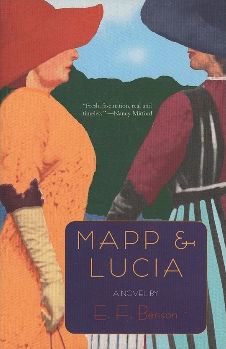
Guest Review: MAPP AND LUCIA by EF Benson

book cover Original Publication Date: 1920-1939
 
Genre: comedy
 
Topics: society, English village politics


Review by Liz Inskip-Paulk (http://ravingreader.wordpress.com/):

Burying into Benson…

I’ve been diving into the fictitious and rather perfect world of an English country village and its inhabitants the last few weeks, this one of Risholme, the home of Lucia and her gang and all the machinations involved in their social shenanigans.

E. F. Benson (1867-1940) wrote a series of novels with the group title of “Mapp and Lucia”, all revolving around the social goings on of a group of (mostly? all?) upper-middle/upper class villagers who are vying with each other as to who should “rule village society”. Lucia rules the roost so far in the series, but she’s had some serious challenges from Daisy et al. especially when she left for London for a while.

I am up to number 3 in the Benson series now* although I did read a couple of them (accidentally) out of order just to get a taste of things, and if you are after a light frothy read about domestic community social politics, then these Lucia books are *perfect* for that. (It could be argued that the Mapp and Lucia books are a more domestic version of Wodehouse’s Bertie and Wooster, I suppose.)

Lucia is the de facto “head” of the village, although in her absence, the inhabitants grouse about her leadership style, and it is this tension that provides the ongoing theme throughout the Mapp/Lucia series. Benson provides an anonymous omniscient and rather camp narrator to tell the story, and this works very well as it allows the reader to see the different PoVs involved in the tangled weave of local politics (socially speaking) through a rather witty lens.

Clearly, the world of Risholme is idealized and epitomizes the idea of “traditional English village” more than real life, but they are rather fun to read. A slightly snarky sense of humor pervades the story, which removes some of the seriousness of the events, and they are really funny in places.

The Benson Mapp/Lucia series is relatively easy to get hold of on-line -- he was a prodigious author, writing a large body of work including fiction, non-fiction, articles and essays -- but it is for Lucia that he remains most famous for.

The Mapp/Lucia series are a treat to read, but like anything sweet, will need to be spread out to get the most fun from it. At the same time, though, I recommend that you don’t leave huge gaps between each title so you can keep the key characters straight.

Take a visit to Risholme and see for yourself!

E. F. Benson’s Mapp and Lucia series:

  • Queen Lucia (1920)
  • Miss Mapp (1922)
  • Lucia in London (1927(
  • Mapp and Lucia (1931)
  • Lucia’s Progress (1935) (also known as The Worshipful Lucia)
  • Trouble for Lucia (1939)


Download the Mapp & Lucia Series by EF Benson at Librivox|Project Gutenberg

Monday, January 14, 2013

Review: THE WINDOW AT THE WHITE CAT by Mary Roberts Rinehart

white cat cover

Original Publication Date: 1910

Genre: mystery

Topics: politics, crazy old ladies, amateur sleuths, lawyers


Review by heidenkind:

Jack Knox is an attorney who, for some strange reason, is constantly asked to investigate things. First the beautiful Margery Fleming walks into his office, asking him to find her father, a disreputable politician (or just politician, as adding "disreputable" as an adjective seems repetitive). Then Margery's two maiden aunts, Lavinia and Jane, start having problems: Lavinia finds her pearls missing and Jane disappears, just as Margery's dad is found dead. Somehow Jack bumbles his way into a solution to both mysteries.

The Window at the White Cat definitely isn't one of Mary Roberts Rinehart's best mysteries, although I did enjoy it. On the surface it has a lot of elements in common with The Man In Lower Ten (review here): a bachelor lawyer who investigates crime and sneaks around dark houses at night; a beautiful woman with a problem whom he's clearly attracted to; and the atmosphere of an olde-timey movie. However, Jack (and really none of the other characters, either, excluding Aunt Lavinia) isn't as charming and interesting as Lollie, the two mysteries don't work that well together, and the book is about twice as long as it should be.

Still, reading The Window at the White Cat wasn't a horrible way to spend a few days. I think my favorite parts of the book were Jack's visits to the Aunts' house, which reminded me of the movie Arsenic and Old Lace (but without the trips to Panama). Crazy old ladies FTW! I also kind of liked the peek into 1910's politics, if only because it's pretty clear the general opinion of politicians has not changed that much in the last century.

While The Window at the White Cat isn't a novel I would unreservedly recommend (unlike The Man In Lower Ten), it's okay. I do have to say that I love Rinehart's titles though: they sound very odd and nonsensical until you read the book, and then they're PERFECT. Here the White Cat is a political club. You'll have to read the rest of the book to find out how the window fits in!


You might also be interested in:

  • Chris' review of The Window at the White Cat here.
  • Melody's review at Redeeming Qualities.
  • My review of The Man In Lower Ten here.
  • My review of The After House by Mary Roberts Rinehart here.
  • Aarti's review of Bab: A Sub-Deb by Mary Roberts Rinehart here.


Download The Window at the White Cat by Mary Roberts Rinehart at Project Gutenberg|Librivox

Sunday, January 6, 2013

Review: THE MAN WHO WAS THURSDAY by GK Chesterton

book cover
Original Publication Date: 1908

Genre: spy/thriller

Topics: religion, reality, politics


Review by heidenkind:


Gregory is an anarchist poet living in London. But then some guy named Gabriel Syme shows up who's ALSO an anarchist poet. Naturally Gregory is threatened by Syme, who is not only honing in on his market but probably better at both poetry and anarchy. So, to prove that he's the REAL anarchist poet, Gregory invites Syme to a meeting of anarchists, where he expects to be elected as the regional anarchist representative, known as Thursday. That's when the twists begin.

The Man Who Was Thursday is seriously one of my favorite reads of the year. Have you ever seen Dark City with Rufus Sewell, or read The Manual of Detection by Jedediah Berry? Well, The Man Who Was Thursday is kind of like that, BUT BETTER. Wikipedia calls it a "metaphysical thriller" and I TOTALLY agree with that description (even if it's slightly anachronistic). The novel has the same sensibility as metaphysical paintings by Giorgio de Chirico, from labyrinthine streets to mysterious towers and creepy figures like the man in The Child's Brain, whom I can totally picture as Sunday. Have I mentioned that I wrote my master's thesis on Giorgio de Chirico? Well, I did; and as a result I've read a lot of surrealist novels in my time, including de Chirico's own Hebdomeros. All of those books were strange, and some of them were nonsensical; but none of them were entertaining or as clever as The Man Who Was Thursday. I have a feeling de Chirico could only wish he'd been able to write a book as a good as this (fortunately he created a lot of awesome paintings, instead).

the child's brain
"The Child's Brain" by Giorgio de Chirico (title probably changed by Andre Breton, the first owner). 1917. National Museum, Stockholm.

All of this probably makes The Man Who Was Thursday sound really inaccessible and difficult to understand. It isn't. When the novel starts out, it seems like a very typical spy thriller. Syme is completely unlikable and Gregory is surprisingly sympathetic. Then everything gets turned on its head: Syme becomes AWESOME (seriously, he may be one of my favorite fictional characters of all time), and the story completely sucks you in. Still, I was only at about the halfway point before I started wondering to myself, "Is this a dream?" (The subtitle of the novel is kind of a hint that it is, but GK Chesterton is clever about twisting the meaning of the word so you're not sure.) By that point I was invested in the characters and the world and willing to go along with whatever Chesterton tossed my way.

Plus, The Man Who Was Thursday is FUNNY. There are lots of laugh-out-loud scenes, my favorite being the duel between Syme and a French anarchist. The anarchists are honestly kind of silly and hilarious. And interspersed with fun adventure are moments that are very creepy and uncanny. It's all woven together in a way that's interesting and clever and entertaining.

Probably the only thing I could say against The Man Who Was Thursday is that there is literally one woman in the entire book. But for some reason that didn't really bother me as much as it has with other books, maybe because the book is curiously asexual--I'm not sure I ever thought of the characters as "men," just characters--or perhaps because the world of novel is so fully realized that I feel like having the expectation for female characters would be nonsensical in the context of the story.

I'm still not entirely sure what the ending of The Man Who Was Thursday was supposed to mean, probably because I don't really know enough about the novel's contemporary context. Or maybe the meaning is supposed to be completely ambiguous. Either way, I enjoyed the hell out of this book and I think other people will too, especially if you like spy stories or mysteries that are slightly strange or uncanny.


Download The Man Who Was Thursday by GK Chesterton at Project Gutenberg|Librivox

Sunday, October 14, 2012

Review: CAPTAIN BLOOD by Rafael Sabatini

book cover
Original Publication Date: 1922

Genre: adventure

Topics: pirates, politics, freedom, love


Review:

With a name like Peter Blood, a man has limited but awesome career choices. He could become a soldier, a doctor, a rebel, a killer, or an outlaw. Somehow this Peter Blood manages to be all five.

After soldiering under De Ruyter, Blood decides to put his bachelor's degree in medicine to good use (bachelor's degree! Education has really gone down in quality since the 17th century, people) and settle to a quiet life in Somerset as a physician. But fate has more adventures in store for our high-strung hero; after attending to a rebel wounded during the Monmouth Rebellion, Blood is arrested and accused of being a traitor. He's sentenced to death, but the sentence is commuted to slavery in Barbados. Blah blah blah, he captures a Spanish ship and becomes a pirate captain!

Honestly, I didn't enjoy Captain Blood as much as Scaramouche (review here). I didn't dislike it, but neither did I want to LIVE in it they way that I did Scaramouche. This mostly isn't the book's fault at all. I was listening to the Librivox version, and it wasn't the best production. I know they're volunteers and all, but it made listening to Captain Blood difficult at times. This novel definitely deserves a re-recording. Part of it also had to do with the fact that I had a lot of interest in and knowledge of Revolutionary France going into Scaramouche; my familiarity with the time period of Captain Blood (1680's, according to Wikipedia) is sketchy at best.

Aside from that, though, remember how I was just a tad touchy about the women in Scaramouche? Well, when it comes to female characters, Captain Blood is even worse. There's basically one female character, Arabella, and she's annoying as all heck. Basically her entire purpose in the book is to put the screws to Captain Blood and make him feel like a heel for being the most awesome pirate captain who ever liiiiiiiiived.

But there was also a lot to like in Captain Blood, namely: Peter Blood! How could you not love someone who 1., has an Irish accent; 2. speaks approximately a dozen languages; 3. quotes poetry; 4. stands up for his principles; and 5. tells hanging judges, generals, governors, and pirates to kiss his ass LIKE A BOSS.

like a boss

Another great thing about Peter Blood is that he gets all broody when Arabella doesn't pay attention to him. I love it when he gets all broody! Gah that Arabella, what is wrong with her?

So while I don't think Captain Blood is quite as good Scaramouche, it's still quite good. You should read it, and I will definitely keep reading Sabatini's work (except maybe not on Librivox).


You might also want to read:
Alex's review of Captain Blood here.
My review of Scaramouche here.

Download Captain Blood by Rafael Sabatini at Project Gutenberg|Librivox


Tuesday, September 25, 2012

Review: MYSTERY AT GENEVA AN IMPROBABLE TALE OF SINGULAR HAPPENINGS by Dame Rose Macaulay

book cover
Original Publication Date: 1922

Genre: mystery, in the loosest sense of the word

Topics: politics, gender, society


Review:

Henry Beechtree is a reporter for the British Bolshevist, an early-twentieth century version of Fox News. He's in Geneva covering the meeting of the League of Nations, but delegates keep disappearing. Who could be responsible? Henry thinks he knows.

Mystery at Geneva was not at all what I was expecting. Rose Macaulay opens the novel by stating,
As I have observed among readers and critics a tendency to discern satire where none is intended, I should like to say that this book is simply a straightforward mystery story, devoid of irony, moral or meaning. It has for its setting an imaginary session of the League of Nations Assembly, but it is in no sense a study of, still less a skit on, actual conditions at Geneva, of which indeed I know little, the only connection I have ever had with the League being membership of its Union.
She then proceeds to spend the next 280-ish pages ridiculing nationalism, gender assumptions, religion, politics, reporting, and other aspects of European society, as well as going into extreme detail describing the League of Nations and how it's like a high school full of cliques and hypocrisy.

As for plot, it wouldn't be accurate to say there isn't one, but if you're reading it you will wonder if there is. Only about 10% of the book has anything to do with an actual mystery. This is not a novel of international intrigue; it's a book where guys sit around discussing subjects in such a way as to highlight how ridiculous they are. Occasionally a League delegate disappears and people are like, "Hey, that's upsetting. We should figure out what happened," then they go right back to pointless talking. Metaphor much?

This sounds exactly like the sort of thing that would normally drive me crazy--I HATE mysteries that aren't mysterious--yet somehow I actually enjoyed myself. Macaulay is funny, and it's kind of fascinating to me how the more things change, the more they stay the same. She could just as easily be pointing out the failings of the UN and modern journalism. Plus, her tangents against gender assumptions are pretty awesome. Here's one passage I thought was interesting:
It may be observed that there are in this world mental females, mental males, and mental neutrals. You may know them by their conversation. The mental females, or womanly women, are apt to talk about clothes, children, domestics, the prices of household commodities, love affairs, or personal gossip. Theirs is rather a difficult type of conversation to join in, as it is above one's head. Mental males, or manly men, talk about sport, finance, business, animals, crops, or how things are made. Theirs is also a difficult type of conversation to join in, being also above one's head. Male men as a rule, like female women, and vice versa; they do not converse, but each supplies the other with something they lack, so they gravitate together and make happy marriages. In between these is the No-Man's Land, filled with mental neutrals of both sexes. They talk about all the other things, such as books, jokes, politics, love (as distinct from love affairs), people, places, religion (in which, though they talk more about it, they do not, as a rule, believe so unquestioningly as do the males and the females, who have never thought about it and are rather shocked if it is mentioned), plays, music, current fads and scandals, public persons and events, newspapers, life, and anything else which turns up. Their conversation is easy to join in, as it is not above one's head.
Wow, that was a long thought! Now you have an idea of what I mean about the characters going on and on about things. Here's another excerpt that I liked:
Deeply Henry, going about his secret and private business, intent and absorbed, pondered this question of News, what it is and what it is not. Crime is News; divorce is News; girl mothers are News; fabric gloves and dolls' eyes are, for some unaccountable reason, News; centenaries of famous men are, for some still stranger reason, News; railway accidents are News; the wrong-doing of clergymen is News; strangest of all, women are, inherently and with no activities on their part, News, in a way that men are not... To be News in oneself, without taking any preliminary action—that was very exciting for women... All sorts of articles and letters appear in the papers about women. Profound questions are raised concerning them. Should they smoke? Should they work? Vote? Take Orders? Marry? Exist?
All this discussion about gender becomes very pertinent by the end of the book, and The Mystery at Geneva has an ending I honestly didn't see coming. On one hand, I thought it was a great twist. On the other, I'm not sure it effectively supports the point Macaulay was trying to make about gender definitions being total bull crap.

Mystery at Geneva is no Riddle of the Sands (review here)--this is not an international spy thriller. It's social commentary. If I had been reading it, I might have started to lose patience; but since I was listening to it on audio, I kind of just let it go and enjoyed the exquisite irony of Macaulay's writing. That being said, I can see why this novel is a forgotten classic: it's obscure, a bit preachy, long-winded, and the plot is literally a joke. But weirdly I had fun with it.


Get Mystery at Geneva: An Improbable Tale of Singular Happenings by Dame Rose Macaulay at Librivox|Project Gutenberg|Internet Archive