Showing posts with label madness. Show all posts

Wednesday, April 30, 2014

Review: Herbert West, Reanimator

reanimator

 Original Publication Date: 1922

Genre: Horror, Science Fiction

Topics: Reanimation, scientific experimentation, God complex, unreliable narrators, the undead


Review by Chrisbookarama:

Herbert West, Reanimator is one of the few H.P. Lovecraft stories in the public domain. It was first published as a series for Home Brew in 1922. In it, the narrator tells of the experiments conducted by Herbert and witnessed by himself alone. The narrator’s story is told in six parts. At the beginning of each instalment, he sums up what’s happened in the previous ones. Just in case you didn’t save enough pennies for the last issue of Home Brew you won’t be lost. Herbert is a doctor of the mad scientist variety. He concocts a special solution that he injects into his deceased human subjects in the hopes of bringing them back to life. He and the narrator must continually find “fresh” bodies to reanimate. The results aren’t pretty. Basically, these guys are making homemade zombies.

Let’s talk about the narrator for a moment. This guy’s story is sketchy. He says he was afraid of Herbert. He “shudders” at some of the things he does, but he still hangs out with him. He knows the guy has no scruples and committed at least one murder. Why doesn’t he catch a train to As Far From Herbert As Possibleville? Does he owe Herbert money? I think he’s way more into it than he says.

As for the experiments, I would think that after the first couple of times I created an uncontrollable monster, I’d reconsider the whole endeavour. Herbert wants to reanimate a human with the former intellect intact but all he makes are Hulk Monsters. His obsession with finding the right solution and obtaining enough bodies to test those solutions turns him into a monster himself. Herbert finds opportunities for body snatching disguised as a physician treating the sick or wounded. He even resorts to murder. Herbert’s reasons for reanimating corpses don’t stem from some noble cause like curing his poor old mother or anything. It’s just scientific curiosity. While the narrator believes in the soul, Herbert doesn’t. The soul isn’t a factor. The bodies just aren’t fresh enough, in his opinion.

Be warned that H.P. Lovecraft’s terrible racism and xenophobia reveals itself big time about halfway through the story. You’ll be happy to know, however, that we’re all human-flesh eating monsters under the reanimated skin.

Herbert West, Reanimator is an interesting literary artifact as it’s an early zombie story. In it, the undead run amuck munching on the living, until they are destroyed and disposed of. The viral zombie trope appears later in the literary canon (I Am Legend’s zombie-vampire is the first one I can think of). Herbert has the power to create the undead through his solution only, the bite of his creation will not infect others. The creature will live through various states of decomposition, until shot and “killed.” The 1985 film Re-Animator is based on Lovecraft’s story.

This was a Librivox recording by Phil Chenevert. He doesn’t have quite the chilling voice I’d expect for this story. The audio version is about 90 minutes long.

Download Herbert West- Reanimator by H.P. Lovecraft at Librivox

Thursday, November 21, 2013

Review: THE STRANGE CASE OF DR. JEKYLL AND MR. HYDE by Robert Louis Stevenson

book cover Original Publication Date: 1886

Genre: mystery, horror

Topics: madness, good vs evil, society


Review by heidenkind:

Mr. Utterson, a London lawyer, is concerned that his friend, Dr. Jekyll, has developed a relationship with an unsavory character named Mr. Hyde, especially as Hyde has been connected with several incidents of violence and assault. Eventually Jekyll assures Utterson he's cut off all ties with Hyde, but the mystery of Hyde's connection to Jekyll persists, especially after Jekyll disappears.

A few weeks ago, I got it into my head that I was going to read The Strange Case of Dr. Jekyll and Mr. Hyde. This is a book I'd had no interest in reading before; and, considering I DNF'd Treasure Island earlier this year, I didn't have super-high hopes for it. I was pleasantly proved incorrect—I loved Jekyll and Hyde, and this novel will definitely land on my short list of favorite reads of the year.

Robert Louis Stevenson had me from the very beginning of the story with his comparison of Utterson—a completely conventional, moderate, and reasonable man—to that of his friend and distant relative, Mr. Enfield, a "well-known man about town":

It was a nut to crack for many, what these two could see in each other, or what subject they could find in common.

In this way Stevenson immediately sets us up for a story about the multiple sides of men's characters—for, if Utterson was completely mild-mannered and Enfield completely dissolute, how would they manage to enjoy one another's company so much? Clearly there's a little of Utterson in Enfield and vice versa.

Fittingly, it is through Enfield that the character of Hyde is introduced, seen in a disreputable part of town knocking over a little girl. Utterson also knows Hyde, or knows of him, because Hyde is mentioned in the will of his friend, Dr. Jekyll. Like Utterson, Jekyll is an upstanding gentleman whose friends are "all intelligent, reputable men and all judges of good wine." So what would Jekyll have to do with a reprobate like Hyde? Utterson wonders.

Obviously we all know the answer to that question, even if we haven't read the book. But the real issue driving the story is WHY—what would drive Jekyll to even conceive of a way to isolate a part of his personality and then switch from one to the other?

Jekyll and Hyde was not what I was expecting based on the adaptations I've seen. It's more of a detective story than a horror story, and neither Jekyll nor Hyde are as good or evil as they've been portrayed. Is Hyde really evil, or is he just uncivilized? He knocked over the girl by accident, and he did offer recompense to her family. It seems like Hyde's demonic nature is more perception than reality; as soon as people see him, they detest him. According to Enfield,

I had taken a loathing to my gentleman at first sight. So had the child's family, which was only natural. But the doctor's case was what struck me. He was the usual cut-and-dry apothecary, of no particular age and colour, with a strong Edinburgh accent, and about as emotional as a bagpipe. Well, sir, he was like the rest of us; every time he looked at my prisoner, I saw that Sawbones turn sick and white with the desire to kill him.

How else is a person supposed to react when people treat them like that?

Jekyll wasn't the mild-mannered shy physician I anticipated, either: he's a gentleman bachelor NOW, but it's stated that in his youth he was "wild," and there's a certain "slyness" about his face.

It's for these reasons that I don't see The Strange Case of Dr. Jekyll and Mr. Hyde as being a tale of good versus evil—instead, it's a cautionary tale about conformity. Jekyll wants to be normal and to fit in with those men who are respectable and intelligent, so he tries to remove the part of himself they would shun if they knew about it. Whether it's addiction, the id, or a demon, Hyde represents whatever society rejects. In Jekyll's attempt to conform to society's definition of a gentleman doctor, he in turn rejects the part of himself that society finds distasteful, and in the process he destroys himself.

The Strange Case of Dr. Jekyll and Mr. Hyde is one of those deceptively simple novels, like Animal Farm, that's a good story and also makes you think. It's accessible to people of all ages and backgrounds and can be read simply as a great story, an indictment of Victorian society as a whole, or anywhere in between. Definitely a book I think is a must-read.


Download The Strange Case of Dr. Jekyll and Mr. Hyde by Robert Louis Stevenson at Project Gutenberg|Librivox|Internet Archive

Tuesday, December 18, 2012

Review: THE YELLOW WALLPAPER by Charlotte Perkins Gilman

book cover
Original Publication Date: 1892

Genre: short story

Topics: feminism, madness


Review by heidenkind:

THE PAPER, THE OMINOUS WALLPAPER.

A young wife is sentenced to forced inactivity by her husband and doctor because she has a predilection for hysterics. Left alone in a room with incredibly ugly wallpaper, she gradually goes mad.

For the longest time I was under the impression The Yellow Wallpaper was a novel--so much has been written about it, much more than the actual story itself, which is actually pretty short. But The Yellow Wallpaper definitely packs a punch. I don't know about y'all, but if I was trapped in a room all day, I'd definitely go crazy, with or without ugly wallpaper. Although the wallpaper certainly wouldn't help.

yellow wallpaper comic

The wallpaper, of course, is a metaphor. Personally I think it represents the outside world. At first the narrator wants to change the wallpaper, but her hubby is like, "If we change the wallpaper in here, then we'll have to change in it the kitchen, and the living room, and the dining room [strange that he assumes she'll want to redecorate rooms she's not allowed to go into]; besides, we're just renting this house! Can't you deal with the wallpaper for a little while longer?" No one give this guy a copy of If You Give a Mouse a Cookie, he'd go crazy with it. Since his wife can't exercise any control over her own small sphere and change the wallpaper that she hates, she retreats into her own mind.

I also found the role of Jennie really interesting in this story. Apparently she's the housekeeper or some sort of servant, but she's allowed much more leeway than the narrator is. Was Charlotte Perkins Gilman making some sort of statement about class and the oppression of women? If she was saying lower class women enjoyed more freedom than upper-class women, I'd have to say that's patently ridiculous. However, Gilman might simply be making a statement about the importance of women contributing to society through work.

This was a very well-written story that fostered a feeling of paranoia and reminded me a lot of The Bell Jar, which I read in high school. It has a Gothic feeling to it, what with the untrustworthy servants and suspicious husband, and ominous house. I kind of wish we'd read this in high school instead of The Bell Jar.


Download The Yellow Wallpaper by Charlotte Perkins Gilman at Librivox|Project Gutenberg

Thursday, August 2, 2012

Review: LADY AUDLEY'S SECRET by Mary Elizabeth Braddon

book cover
Original Publication Date: 1862

Genre: sensation

Topics: gender, class, mystery, madness


Review:

Lady Lucy Audley is the pampered, childishly innocent wife of Lord Audley. Could such a woman retain dark secrets and go to desperate lengths to keep them? Answer: probably, yes.

Lady's Audley's Secret is a super-soapy novel, but that's part of what makes it fun. I have to be honest and say one of my favorite things about Lady Audley's Secret is that all the male characters are idiots.
  • Sir Michael Audley is an idiot because he thinks a beautiful 20-year-old governess is going to marry a 60-year-old man with a grown daughter for anything other than his money and status.
  • George Tallboys is an idiot because he thinks he can abandon his wife and kid without a word for years and she's just going to wait for him to come back.
  • Luke Marks is a mean idiot.
  • Lt. Maldon is a drunk idiot.
  • Robert Audley is completely lazy and determinedly oblivious, so you could say he plays at being an idiot.
Lady Audley also plays at being an idiot, but she, like the rest of the female characters in Lady Audley's Secret, has a more realistic grasp of the situation in which she finds herself than her male counterparts. Perhaps it's because they're both expected to suppress their intelligence and be idle that Robert is the only guy who eventually gets a clue about Lady Audley.

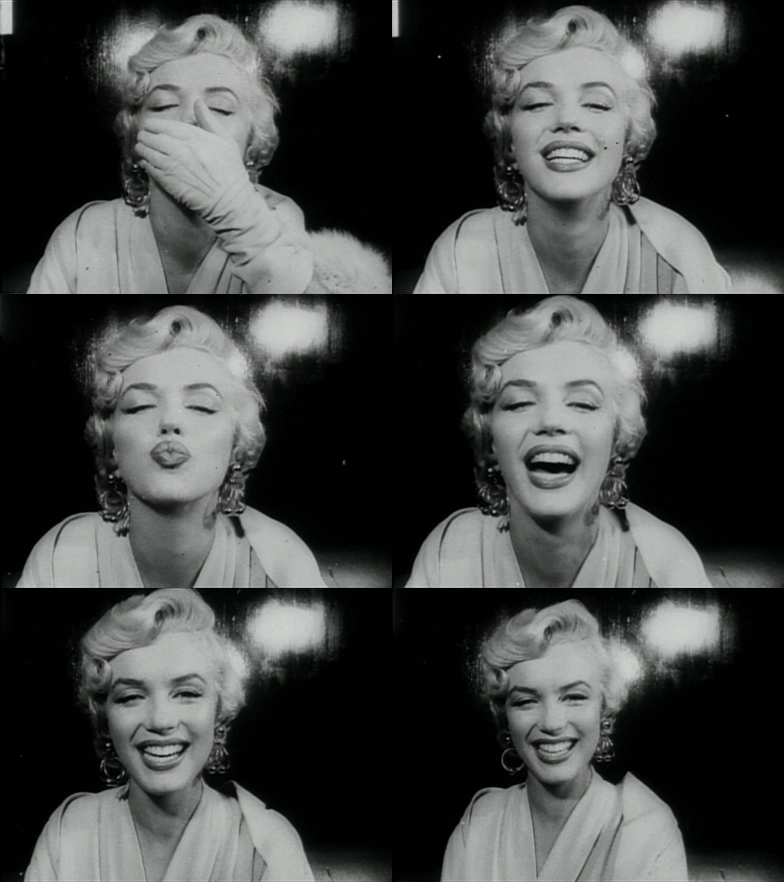
I love Lady Audley. And I kinda hate her. She's one of THOSE women--you know, the kind other women find really easy to hate, because she attracts all the men-folk, but as soon as you put her with a bunch of other women butter wouldn't melt in her mouth. Mary Elizabeth Braddon's descriptions of her as a beautiful blonde with a childishly innocent demeanor made Lady Audley seem like an evil Marilyn Monroe. At the same time, she's really smart (even though she doesn't act like it--perhaps that's her real secret) and I kind of admired her moxie. All the men wronged in the novel deserved whatever they got; and it's not like she didn't warn them, either.

marilyn monroe
Evil Marilyn gives you kisses.

This isn't the type of book where you have to guess at Lady Audley's secret--that's obvious by Chapter Two. Instead, the tension comes from waiting for the other shoe to drop. Add to that a woman, or several, who may be up to no good, and Lady Audley's Secret is rather Hitchcockian. I loved the suspense and the humor in the novel, especially from Robert Audley ("Don't be German, Alicia." LOL Still laughing about that, I have no idea why), who is pretty dang funny.

All that being said, once Robert Audley figures out the 411, Lady Audley's Secret loses steam. Robert spends a lot of time whining about why HE has to be the one to investigate, and even more time talking to himself about gender and social inequality. I'm all for equality, but I don't want to hear Robert Audley talk to himself about it for ten chapters, thanks. I also thought the conclusion was only possible because of inconsistencies with the character of Lady Audley herself--the point was that she was smart! Like, Irene Adler smart. But at the end, Lady Audley does a lot of stupid things she shouldn't have done if her character was consistent.

Still, I really liked this book. It's bordering on trashy, but it's super-fun and entertaining, and I got a kick out of the main characters. I'm glad I chose Lady's Audley's Secret to be my first Victorian sensation novel!


Find Lady Audley's Secret by Mary Elizabeth Braddon at Librivox|Project Gutenberg|GirleBooks


Monday, July 30, 2012

Review: The Woman in White

Original Publication Date:  1859

Genre:  Mystery, Romance, Sensation

Topics:  Inheritance, Dark Secrets

Review:  I listened to this book via the Librivox recording, and it was amazing.  I don't know how so many people worked together to make this book come to life, but I love that they put so much effort into it.  Each character has a different narrator on the audiobook, and each narrator creates a completely unique voice that really brings that character to life.


I don't even know how to describe what this book is about.  There's a drawing teacher, Walter Hartwright, who meets a woman dressed all in white one night on the road.  He helps her get where she needs to go and then continues on his own way.  But he soon realizes that his life is tied by fate to that of the woman in white, who knows about all sorts of secrets and wicked deeds and horrible pasts that will impact the lives of those closest to him.  And it's up to Walter and his completely awesome sidekick Marian, a brave and loyal woman who has the misfortune of being quite ugly, to save the day so that Walter can live happily ever after with the beautiful, rich princess of his choosing, Marian's half-sister, Laura.


Honestly, in reading this book, I can't help but think that Collins really wanted to make Marian the heroine but somehow settled for Laura.  It's pretty clear that Collins has zero interest in Laura.  She's good, she's kind, she's pretty, she can play the piano, but that's about it.  Collins gives practically everyone in the story at least one chapter to tell their side of the story, but he gives Laura nothing.  In contrast, Marian the Awesome gets a significant portion of the story dedicated to her narrative.  I will go to my grave (or at least, will go to the point at which I become quite foggy about this book's particulars) thinking that Hartwright was in love with one sister in his heart but just didn't realize it because he was so blinded by physical beauty.  But lucky for him, he gets to spend his days with both sisters, so life is quite grand for him.


My only other exposure to Collins had been the book Armadale, and I admit that I wasn't a fan of that one at all.  I really disliked Lydia Gwilt and she was the narrator for the majority of the book.  Here, I got to see Collins' skill with POV - he is excellent at making each character unique - and was also quite wrapped up in a complicated story with many twists and turns.

This is one of those books that, for me, was so helped by the audiobook.  I feel like it would have taken me forever to pick up a book that was almost 700 pages of Victorian overreaction and fainting and virtuous women, but in audio form, it was completely doable.  The Librivox team behind this edition is really, really good.  If you enjoy sensation novels or mystery novels or novels about unconventional heroines, then I highly recommend this one to you.  It's good stuff!

I listened to this free recording of the book.

Thursday, May 10, 2012

Short Story Review: The Black Cat by Edgar Allan Poe

book cover
Original Publication Date: 1843

Genre: horror

Topics: madness, unintended consequences, guilt


Review:

The Black Cat is probably Edgar Allan Poe's most famous short story. I know it was one of the two Poe stories that was in my English textbook in middle school (and the fact that I remember it should tell you a lot about what an impression it made upon me as a kid). Basically it's about a guy who's a mean drunk and winds up killing a faithful pet, his cat. He later suspects the cat has come back to life to haunt him and this leads him to make some rather poor decisions.

After re-listening to this on Librivox (read by the boss Ralph Snelson) as an adult, I have to say I didn't really enjoy reading it. It's way cynical, and also a little predictable (I have read it before, but still). It's very well-written, of course, but it's not the type of story you come away from with the thrill of being scared silly--more like the sense that it's time to take a good long look in the mirror. Still, you should read it if you haven't.

And now it's time to play What Is the Cat a Metaphor For?! Here are my ideas:

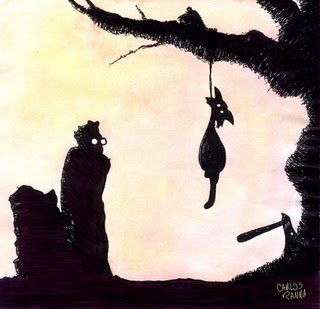
black cat hanging
Theory #1: Slavery

When the narrator hangs the cat, he says

Who has not, a hundred times, found himself committing a vile or a silly action, for no other reason than because he knows he should not? Have we not a perpetual inclination, in the teeth of our best judgment, to violate that which is Law , merely because we understand it to be such? This spirit of perverseness, I say, came to my final overthrow. It was this unfathomable longing of the soul to vex itself - to offer violence to its own nature - to do wrong for the wrong's sake only - that urged me to continue and finally to consummate the injury I had inflicted upon the unoffending brute. One morning, in cool blood, I slipped a noose about its neck and hung it to the limb of a tree; - hung it with the tears streaming from my eyes, and with the bitterest remorse at my heart; - hung it because I knew that it had loved me, and because I felt it had given me no reason of offence; - hung it because I knew that in so doing I was committing a sin - a deadly sin that would so jeopardize my immortal soul as to place it - if such a thing wore possible - even beyond the reach of the infinite mercy of the Most Merciful and Most Terrible God. (excerpt from Literature Network)
The hanging of the cat resembles a lynching in that it's an act of revenge, but not against any wrongdoing on the part of the cat--rather, the cat represents what the narrator should and could have a partnership and friendship with, yet he can't because every time he sees it, he's reminded of what a terrible person he's become, by his own hand. So he lashes out. Even after the cat is dead, the narrator still fears that it will bring a reckoning he knows he deserves.

the black cat by aubrey beardsley
Aubrey Beardsley's illustration of the Black Cat
Theory #2: The Wife

It's probably more likely that the cat is a metaphor for the narrator's wife. She's the one who gets the cat for him, and early on the cat is likened to a witch by the wife herself ("I'm not a witch, I'm your wife!"), which seems to plant the seeds of his later attitude toward the cat. The wife shares his love of animals, and when the narrator starts drinking, he admits to beating both her and their pets. And of course there's the fact that in his attempts to kill the cat--again--the narrator actually ends up killing his wife.


Have you read The Black Cat?