Showing posts with label edgar allan poe. Show all posts

Sunday, April 20, 2014

Happy Mystery Day!

c auguste dupin

Fun fact: Today, April 20th, is the 173rd anniversary of the publication of the first detective story, The Murders in the Rue Morgue by Edgar Allan Poe! Poe's detective, C. Auguste Dupin, inspired Arthur Conan Doyle's Sherlock Holmes.

To celebrate the birth of the mystery novel, curl up with Poe's Dupin stories: The Murders in the Rue Morgue, The Mystery of Marie Rogêt, and The Purloined Letter.

You can also check out my review of the Dupin series, or find out more about the first mysteries.

Monday, May 28, 2012

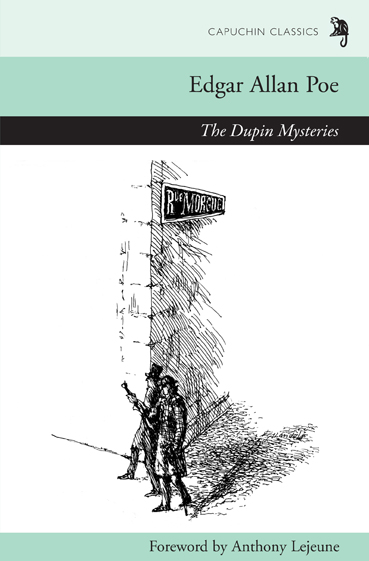
The Dupin Mysteries by Edgar Allan Poe

book cover
Original Publication Date: The Murders in the Rue Morgue, 1841; The Mystery of Marie Rogêt, 1842/43; The Purloined Letter, 1844

Genre: mystery

Topics: intellect versus brutality, morality


Review:

Edgar Allan Poe's C. Auguste Dupin stories are said to be the first mysteries, establishing the basic tenants of the genre. So I thought I should read them.

The Murders in the Rue Morgue starts off the trilogy. Since this story "established a genre," I was expecting a lot out of it. It was... okay. A little odd, really. It starts off with a treatise about logic and chess, then introduces Dupin, who is seen through the eyes of the narrator. The narrator is a normal guy (I assume he's American) who moved to Paris and needed to find an apartment. He met Dupin by chance, moved in with him, and the two became fast friends. Sound familiar--like the set-up to, say, A Study in Scarlet? There are even more similarities between Dupin and Sherlock Holmes.

The murder mystery itself deals with two women--one old, one young--who were found brutally murdered in their apartment. What makes the mystery twisty enough to call in Dupin is that several witnesses heard other voices in the room with the two women, even though no one saw anyone leaving their apartment and the door was still locked on the inside. One voice was variously described as having nearly every accent in Europe, so where could the murderer possibly be from?

Dupin is VERY Sherlockholmes-esque (or perhaps we should say Sherlock Holmes is very Dupin-esque). He can extrapolate specific conclusions about people based on the smallest piece of evidence, like a ribbon. Unlike Holmes, however, Dupin isn't a know-it-all. He never claims to have facts--he makes it very clear he's guessing, and his guesses just happen to be correct most of the time. He doesn't take money for his investigations and instead seems to be doing what he's doing for the pure reasons of exercising his intellect in the pursuit of clearing an innocent man's name.

Although The Murders in the Rue Morgue wasn't the greatest, I do have to say I did not see the solution to the mystery coming AT ALL. And monkeys are way scary.

illustration from the mystery of marie roget

The Mystery of Marie Rogêt is longer than The Murders in the Rue Morgue, and much worser. At first I thought it was going to be awesome, because there was more of a set-up regarding the victim of the crime--a perfumer clerk who (naturally) is female. After disappearing unexpectedly for about a month, she returns to her job claiming she'd been to visit a sick aunt. A few weeks later, she disappears again, and later her body is found in Seine.

The mystery itself is based on the real-life murder case of Mary Cecelia Rogers, which remains one of the most puzzling unsolved crimes in New York City history. THAT mystery is really interesting; The Mystery of Marie Rogêt--or at least the solving of it--is not. Basically Dupin reads the newspaper accounts aloud, debunks whatever they say, then theorizes what might have happened based on what they say, without ever finding the murderer. It's like a novelist imagining what might have happened to a murder victim, which I suppose is what was actually happening here. But the characters themselves never DO anything; they don't even move from the table. IT IS SO BORING. I honestly didn't think Poe was even capable of writing something this boring. I think it's safe to say that unless you're a hard-core EAPic, you can skip this one.

a doubly purloined letter

The Purloined Letter is the last story in the trilogy, the shortest, and the best. As in the last two stories there's a lot of dialog, but the dialog is more clever, as is the twist at the end.

Dupin and the narrator are hanging out in their apartment one night, when Dupin is visited by the Prefect of Police, a man he obviously thinks is an idiot. The narrator describes the Prefect as having, "a fashion of calling every thing 'odd' that was beyond his comprehension, and thus lived amid an absolute legion of 'oddities.'" Oh snap! The Prefect is in search of a letter stolen by a Minister D. that contains compromising information. Try as he might, though, he and his police can't find it anywhere in the minister's rooms.

This mystery is notably different from the last two in several respects: for one, there's no beautiful dead woman. For another, Dupin actually accepts payment for solving the mystery, whereas in the last two mysteries he was simply exercising his intellect. I suppose that makes sense, since finding the letter didn't seem to pose much of a challenge for him. And lastly, Dupin deliberately matches wits with Minister D., whom some have suggested is actually his brother (kind of like Holmes and Mycroft?). I have have to admit that, listening to this on audio, it's easy to confuse D. with Dupin sometimes, because they do share similar personality traits.


For the most part, I really enjoyed Poe's Dupin mysteries (except for The Mystery of Marie Rogêt, that was horrible). Dupin's not a terribly fleshed-out character, and the mysteries are very intellectual and too theoretical sometimes, but overall this was a really fun, short read. I'm happy to finally be familiar with the start of the mystery novel!


You might also enjoy:


Download Poe's short story collections at Project Gutenberg|Librivox

Thursday, May 10, 2012

Short Story Review: The Black Cat by Edgar Allan Poe

book cover
Original Publication Date: 1843

Genre: horror

Topics: madness, unintended consequences, guilt


Review:

The Black Cat is probably Edgar Allan Poe's most famous short story. I know it was one of the two Poe stories that was in my English textbook in middle school (and the fact that I remember it should tell you a lot about what an impression it made upon me as a kid). Basically it's about a guy who's a mean drunk and winds up killing a faithful pet, his cat. He later suspects the cat has come back to life to haunt him and this leads him to make some rather poor decisions.

After re-listening to this on Librivox (read by the boss Ralph Snelson) as an adult, I have to say I didn't really enjoy reading it. It's way cynical, and also a little predictable (I have read it before, but still). It's very well-written, of course, but it's not the type of story you come away from with the thrill of being scared silly--more like the sense that it's time to take a good long look in the mirror. Still, you should read it if you haven't.

And now it's time to play What Is the Cat a Metaphor For?! Here are my ideas:

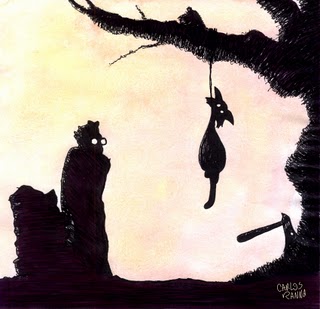
black cat hanging
Theory #1: Slavery

When the narrator hangs the cat, he says

Who has not, a hundred times, found himself committing a vile or a silly action, for no other reason than because he knows he should not? Have we not a perpetual inclination, in the teeth of our best judgment, to violate that which is Law , merely because we understand it to be such? This spirit of perverseness, I say, came to my final overthrow. It was this unfathomable longing of the soul to vex itself - to offer violence to its own nature - to do wrong for the wrong's sake only - that urged me to continue and finally to consummate the injury I had inflicted upon the unoffending brute. One morning, in cool blood, I slipped a noose about its neck and hung it to the limb of a tree; - hung it with the tears streaming from my eyes, and with the bitterest remorse at my heart; - hung it because I knew that it had loved me, and because I felt it had given me no reason of offence; - hung it because I knew that in so doing I was committing a sin - a deadly sin that would so jeopardize my immortal soul as to place it - if such a thing wore possible - even beyond the reach of the infinite mercy of the Most Merciful and Most Terrible God. (excerpt from Literature Network)
The hanging of the cat resembles a lynching in that it's an act of revenge, but not against any wrongdoing on the part of the cat--rather, the cat represents what the narrator should and could have a partnership and friendship with, yet he can't because every time he sees it, he's reminded of what a terrible person he's become, by his own hand. So he lashes out. Even after the cat is dead, the narrator still fears that it will bring a reckoning he knows he deserves.

the black cat by aubrey beardsley
Aubrey Beardsley's illustration of the Black Cat
Theory #2: The Wife

It's probably more likely that the cat is a metaphor for the narrator's wife. She's the one who gets the cat for him, and early on the cat is likened to a witch by the wife herself ("I'm not a witch, I'm your wife!"), which seems to plant the seeds of his later attitude toward the cat. The wife shares his love of animals, and when the narrator starts drinking, he admits to beating both her and their pets. And of course there's the fact that in his attempts to kill the cat--again--the narrator actually ends up killing his wife.


Have you read The Black Cat?

Monday, April 9, 2012

Short Story Review: The Oval Portrait by Edgar Allan Poe

book cover
Original Publication Date: 1842

Genre: horror

Topics: art, obsession, death


Review:

Another Librivox short story! First of all, I have to give a shout-out to the narrator of this short story, Ralph Snelson, who is the bossest narrator I've ever encountered in a Librivox audiobook. Keep up the good work, my man! The story is really good, too.

The Oval Portrait is one of Edgar Allan Poe's shortest stories, but it packs a punch. The narrator is recovering from injuries in Italy, and finds himself in a room filled with paintings. Suddenly he comes upon a portrait "in the style of Sully" that takes him aback with its "absolute life-likeliness". The rest of the story is an account of the creation of painting--basically, an artist painted his wife, but every brush stroke stole a bit of her life until the painting was complete and she was nothing but an empty shell.

fanny kemble by thomas sully
Thomas Sully, Portrait of Fanny Kemble, 1834

As someone who knows a bit about art, I found this kind of chilling. There are plenty of tales about artists falling in love with their work or their subjects, one of the most famous being the tale of Apelles and Campaspe. Campaspe was Alexander the Great’s courtesan and the most beautiful woman in Ancient Greece. Apelles, the ancient world's greatest painter, was commissioned to paint Campaspe's portrait by Alexander; but while painting her Apelles fell in love. He knew that the day he finished the painting, he and Campaspe would have to part, so he delayed as long as he could; but finally Alexander asked for her portrait. After taking one look at the portrait, however, Alexander knew Apelles loved Campaspe more than he ever could, so he offered the painter a trade: he’d take the portrait and in exchange, Apelles could have the living and breathing woman.

Renaissance artists like Leonardo da Vinci and Raphael were obsessed with Apelles and strove to imitate him, despite the fact that none of his works of art survive. Because of the legend of Apelles and Campaspe, Leonardo said the "Modern Apelles" would be able to paint an image of a woman so realistic it would inspire desire in the viewer. This was the driving force behind many of the Renaissance's most famous works of art, including Botticelli's Venus and the Mona Lisa. Ever seen a Raphael portrait and noticed the eyes follow you no matter where you stand in the room? That's a little trick he developed to make his paintings of women seem as if they were alive.

madonna of the chair
Raphael, Madonna of the Chair, 1515, Pitti Palace, Florence

Considering the portrait that the narrator in The Oval Portrait sees is formatted like many of Raphael's Madonna paintings, and the story is set in Italy, I think Poe had to be deliberately drawing on this tradition. But Poe, being the morbid bastard he was, gives it a twist by making the artist steal the life of the woman he loves in order to create a beautiful work of art. Instead of the painting representing his love for the subject, as in the story of Apelles, it represents monomania and selfishness. Poe himself believed that the most beautiful poetry was that about the death of a woman--I bet he was AWESOME in relationships.

The Oval Portrait inspired many other works, including The Picture of Dorian Grey. This is a great short story and I highly recommend you check it out!


Find The Oval Portrait at Classic Lit