Showing posts with label science fiction. Show all posts

Wednesday, April 30, 2014

Review: Herbert West, Reanimator

reanimator

 Original Publication Date: 1922

Genre: Horror, Science Fiction

Topics: Reanimation, scientific experimentation, God complex, unreliable narrators, the undead


Review by Chrisbookarama:

Herbert West, Reanimator is one of the few H.P. Lovecraft stories in the public domain. It was first published as a series for Home Brew in 1922. In it, the narrator tells of the experiments conducted by Herbert and witnessed by himself alone. The narrator’s story is told in six parts. At the beginning of each instalment, he sums up what’s happened in the previous ones. Just in case you didn’t save enough pennies for the last issue of Home Brew you won’t be lost. Herbert is a doctor of the mad scientist variety. He concocts a special solution that he injects into his deceased human subjects in the hopes of bringing them back to life. He and the narrator must continually find “fresh” bodies to reanimate. The results aren’t pretty. Basically, these guys are making homemade zombies.

Let’s talk about the narrator for a moment. This guy’s story is sketchy. He says he was afraid of Herbert. He “shudders” at some of the things he does, but he still hangs out with him. He knows the guy has no scruples and committed at least one murder. Why doesn’t he catch a train to As Far From Herbert As Possibleville? Does he owe Herbert money? I think he’s way more into it than he says.

As for the experiments, I would think that after the first couple of times I created an uncontrollable monster, I’d reconsider the whole endeavour. Herbert wants to reanimate a human with the former intellect intact but all he makes are Hulk Monsters. His obsession with finding the right solution and obtaining enough bodies to test those solutions turns him into a monster himself. Herbert finds opportunities for body snatching disguised as a physician treating the sick or wounded. He even resorts to murder. Herbert’s reasons for reanimating corpses don’t stem from some noble cause like curing his poor old mother or anything. It’s just scientific curiosity. While the narrator believes in the soul, Herbert doesn’t. The soul isn’t a factor. The bodies just aren’t fresh enough, in his opinion.

Be warned that H.P. Lovecraft’s terrible racism and xenophobia reveals itself big time about halfway through the story. You’ll be happy to know, however, that we’re all human-flesh eating monsters under the reanimated skin.

Herbert West, Reanimator is an interesting literary artifact as it’s an early zombie story. In it, the undead run amuck munching on the living, until they are destroyed and disposed of. The viral zombie trope appears later in the literary canon (I Am Legend’s zombie-vampire is the first one I can think of). Herbert has the power to create the undead through his solution only, the bite of his creation will not infect others. The creature will live through various states of decomposition, until shot and “killed.” The 1985 film Re-Animator is based on Lovecraft’s story.

This was a Librivox recording by Phil Chenevert. He doesn’t have quite the chilling voice I’d expect for this story. The audio version is about 90 minutes long.

Download Herbert West- Reanimator by H.P. Lovecraft at Librivox

Wednesday, April 2, 2014

Review: THE PIRATES OF ERSATZ by Murray Leinster

book cover Original Publication Date: 1959

Genre: science fiction

Topics: Pirates, economics, civilization, technology, coming-of-age, adventure


Review by heidenkind:

ersatz (adjective): 1. (of a product) made or used as a substitute, typically an inferior one, for something else; 2. not real or genuine.

Bron Hoddan is not a pirate, but he comes from pirates. Instead of following in his family's footsteps, he's decided to try to make his fortune honestly, as an engineer on the most civilized planet in the galaxy, Walden. Unfortunately, the people of Walden aren't interested in his inventions, and when Bron tries to press the issue, they arrest him for creating death rays. WHOMP WHOMP. Fed up with Walden, Bron escapes with the help of the most awesome ambassador ever. But it's only when he meets a band of outcasts like himself that he has an opportunity to accomplish great things, grow rich, marry some delightful girl, and be a great man... somewhere.

I decided to listen to The Pirates of Ersatz because it's narrated by Elliot Miller, the same Librivox narrator who read The Poisoned Pen. Also: Pirates! Who doesn't love pirates? Those lovable scamps. Even though these aren't "real" pirates, they certainly do act like them most of the time. That being said, The Pirates of Ersatz is mainly an adventure novel and coming-of-age tale: Bron goes to a wild, uncivilized world called Zan and discovers his place in the world.

Some of the more interesting parts of the novel are where the characters posit theories about civilization and economics that, despite the fact that they're coming at me from a serialized science fiction novel, I kiiiiind of buy into? Like, even if they're not true, THEY SHOULD BE. Here are some of my favorites:

"Do you realize," [the ambassador] asked, "that the whole purpose of civilization is to take the surprises out of life, so one can be bored to death? ...Government, in the local or planetary sense of the word, is an organization for the suppression of adventure. Taxes are, in part, the insurance premiums one pays for protection against the unpredictable."

"I tell y', piracy's what keeps the galaxy's business thriving! Everybody knows business suffers when retail trade slacks down. It backs up the movement of inventories. They get too big. That backs up orders to the factories. They lay off men. And when men are laid off they don't have money to spend, so retail trade slacks off some more, and that backs up inventories some more, and that backs up orders to factories and makes unemployment and hurts retail trade again...
"But suppose somebody pirates a ship? The owners don't lose. It's insured. They order another ship built right away. Men get hired to build it and they're paid money to spend in retail trade and that moves inventories and industry picks up. More'n that, more people insure against piracy. Insurance companies hire more clerks and bookkeepers. They get more money for retail trade and to move inventories and keep factories going and get more people hired.... Y'see? It's piracy that keeps business in this galaxy goin'!"

Okay, twist my arm, I'll take up piracy. There are similar passages about technology and engineering, since Bron is an engineer. If you're thinking they slow down the story, you'd be right. But there's not a lot of them, and they do become relevant later on.

Aside from Murray Leinster's economic theorizing, there's a lot to like about The Pirates of Ersatz. Both of the characters quoted above—the Ambassador and Bron's grandfather—are awesome, as is Fani, the woman who's obviously sweet on Bron (obvious to everyone except him). And then there's Bron himself—he's like a sci-fi version of Robin Hood (have I mentioned I'm a sucker for Robin Hood stories?). He's definitely a reluctant hero, but he can think himself out of nearly any situation and he uses his powers to steal from the rich and give to the poor. And hey, it's all insured anyway, right? The scene where Bron and his pirates land on Walden to raid a suburb is priceless. You kind of have to read this book just for that.

The Pirates of Ersatz is a fast, fun read with ironic overtones (obviously—it's a book about pirates that aren't really pirates, what can one expect?). It certainly won't change your life, but if you're in the mood for an adventure along the lines of A Princess of Mars by Edgar Rice Burroughs, I highly recommend it.


Download The Pirates of Ersatz by Murray Leinster at Project Gutenberg|Librivox

Friday, March 28, 2014

Review: YOUTH, by Isaak Asimov

Original Publication Date: 1952
Genre: fantasy
Topics: fantasy, aliens


Review by : Patty @ A tale of three cities


When the world quietens down after a long and intense day, I want a book that is nothing too elaborate or big - just simple, good writing and a reasonable length to help me relax.

Such a read is Youth, by Isaak Asimov.  Written in the 1950s, it is of the futuristic genre but with no fanfare.  It rather reminded me of the Twilight Zone programme that I so enjoyed in my own youth...

The plot is fairly straightforward:  life in a distant future, where our present and recent past is considered as the "beforethewars" era (I really enjoyed that word, nothing fancy but leaving so much to the imagination...).  The main characters involve two scientists, who try to take up contact with aliens in a foreign planet, with the view to take up trade relations. Already I'm amazed at the little bits of wisdom that I read in between this simple story:
... was it reasonable to destroy almost all their tremendous civilization in atomic warfare over causes our historians can no longer accurately determine?

With them, we get to see their respective sons, longing for a future of their own, preferably in a circus.  They in turn discover some uncommon-looking creatures they think could be their ticket into this wonderful life - so they keep them in a cage and try to take good care of them.

The book is short and more than enough for a 2-hour travel in Brussels.  I really enjoyed the language used, but also some of the messages used.  While waiting for a signal from the aliens, the two scientists start debating about whether the aliens could in fact be hostile.  The pessimist of the two explains why he sees things this way:


The world has been at peace too long.  We are losing a healthy sense of suspicion

Linking it with the Twilight Zone, I came to a point where the twists are non-ending - who's watching whom here:  the scientists the children, the children the little creatures, or the children the scientists who are in truth the little creatures?  One can come to their proper interpretation of the story, but one thing is certain:  for such a tiny size, this book certainly stayed in my mind long after I had read it...   


 Download Youth by Isaak Asimov at Project Gutenberg|Librivox|

Thursday, July 25, 2013

Review Round-Up

I haven't posted a review here in a while, not because I'm not reading but because I don't have a lot to say about most of the books I've come across in the last few weeks. I've abandoned most of them, but even those I've managed to finish have been meh. Just in a reading slump, I guess. I did find The Wheel Spins (book The Lady Vanishes was based on) interesting, but it's not in the public domain. I have some brief thoughts on the following novels, though, which might be worth checking out if you're interested.


The Hour of the Dragon by Robert E. Howard

book cover Original Publication Date: 1935-1936

Genre: fantasy

Topics: war, sorcery, revenge, quest, adventure


Review by heidenkind:

Conan is the King of Aquilonia after killing the previous ruler. You know that's not going to last long, and it doesn't: a group of conspirators raise the evil sorcerer Xaltotun from the dead so they can depose Conan and put some other guy on the throne. Due to luck and a slave girl with a crush, Conan manages to escape with his life, but can't regain his throne without a magical stone called the Heart of Ahriman.

This is the first and only novel-length Conan the Barbarian story Howard wrote. I didn't dislike it, but it also wasn't as amazeballs as some of the shorter stories I've read by him. There was only one major female character, who was kind of boring, and I found Xaltotun more interesting than Conan. I did think Howard did a great job of making Conan seem more human in this story, but where were the crazy twists?? The Hour of the Dragon was just too long and felt slightly draggy.

Download The Hour of the Dragon by Robert E. Howard at Project Gutenberg|Librivox


Miss Pim's Camouflage by Lady Dorothy Stanley


Original Publication Date: 1918

Genre: science fiction/fantasy

Topics: World War I, espionage, old lady, germanic horde


Review by heidenkind:

Miss Pim is a middle-aged spinster who feels nearly invisible. Then, one day, she doesn't just feel invisible—she becomes invisible! Soon all the guys at the War Office are feeling her invisible body up and then she's off to France to work as a spy, with the ultimate goal of assassinating the Kaiser.

I really loved the concept of this novel. Old lady adventures for the win! However, there was just wayyyyy too much anti-German propaganda in this book. I mean, I know me some anti-German propaganda (it's impossible to avoid in early 20th century English novels, and even some American novels), but in the case of Miss Pim's Camouflage it was so insanely over-the-top I felt like it overshadowed the story completely.

Interesting side note: if Google is to be trusted, Dorothy Stanley was also a successful painter known as Dorothy Tanner.

Download Miss Pim's Camouflage by Lady Dorothy Stanley at Google Books|Librivox


Aucassin et Nicolette


book cover Original Publication Date: 12th or 13th century

Genre: chantefable (combination sung poetry and verse)

Topics: love, honor, chivalry


Review by heidenkind again:

Aucassin is the son of a count and he really wants to marry a girl named Nicolette, but his dad's like, "Yeahhhhh, Nicolette is pretty and all, but she's a slave and not really appropriate marriage material. How about this nice princess?" And Aucassin's like, "This isn't the 11th century anymore, Dad, I can do what I want. I hate you!" So the count locks Aucassin in his room the dungeon and sends Nicolette away to a nasty viscount. Will these two crazy kids ever get together?

At first I really enjoyed this poem because Aucassin was an idiot. It was quite entertaining. But then Aucassin also turned out to be really mean. I can handle stupid, and I can handle nasty, but stupid AND nasty? I was kind of hoping he'd take a short plunge into a long spear, but instead he and Nicolette ended up getting together through a series of coincidences that were eye-rollingly unbelievable. But Wikipedia says it's meant to be a parody, so maybe that was the point? Either way, Aucassin was too annoying for me.

Download Aucassin et Nicolette at Project Gutenberg|Librivox

Tuesday, February 26, 2013

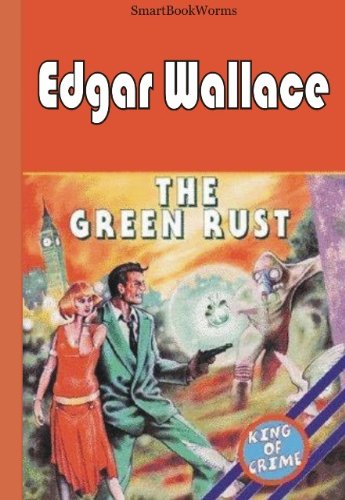
Review: THE GREEN RUST by Edgar Wallace

book cover Original Publication Date: 1919

Genre: science fiction

Topics: Germanic horde, WMDs


Review by heidenkind:

What is the green rust? I don't know. No one knows! It's the McGuffin, okay? It's a bad thing that will destroy THE WORLD, and the nasty Dr. Van Heerden is determined to unleash it... just as soon as he marries Oliva Cresswell. But will Oliva chose him or the mysterious Mr. Beale? Questions!

The Green Rust is the first book I've read by Edgar Wallace, who I take it was the James Patterson of his time (wrote tons of books, was worth millions of dollars). It was soooo pulpy, you guys. If Wallace can find a way to go for shock value, even if it makes no sense in the context of the story, he will do it. For example, the first few chapters run like this: Chapter one, an old billionaire struggles to share his final words, but dies just before he can get them out. But does he die? No, he was murrrrderrred! Chapter two: evil dude is evil and like five guys break into Oliva Cresswell's apartment, why? Who knows. But one of them shows her the green rust!
"What is the Green Rust—what can it do? she asked in bewilderment.
"I hope we shall never know," he said, and in his clear eyes was a hint of terror.

Dun dun dun! Chapter three: Oliva goes to work as normal, because that's what you do when your apartment has been broken into multiple times in one night and you've been shown the green rust, whatever it is--and is fired for no reason! Then three people accost her on the street and offer her jobs involving very little work and double her last salary. Wut?

And you know how Stephen King once said the road the hell is paved with adverbs? Well, if that's true I think Wallace might at the very least be in purgatory, because The Green Rust is flush with adverbs along the lines of, '"Gross!" Oliva exclaimed disgustedly.' Oh, she's disgusted? Wouldn't have guessed that one just from the dialog, thanks.

All that being said, though, I really enjoyed this novel. It's totally cheesy and predictable, but it's also super fun. It has the same sensibility as Scooby Doo or Flash Gordon. Yeah, maybe the writing isn't the best, but the characters are likable: Beale is such an appealing hero, even showing suggestions of being a feminist by referring to Oliva as a partner and saying he never thought of her as a victim. And Van Heerden is so over-the-top evil I couldn't help but warm up to him. Like a German Grumpy Cat (technically he's Dutch, by the way, but hey, close enough).

After Oliva escapes Van Heerden, the book became all about Beale finding the green rust and putting a stop to it, or something, and the story slowed down to a crawl because I didn't really care about the green rust. Other than that, though, I thoroughly enjoyed The Green Rust for what it was, which is over-the-top pulpy entertainment. Worth the read if that sort of thing appeals to you, I think.


Download The Green Rust by Edgar Wallace at Project Gutenberg|Librivox