Tuesday, March 27, 2012

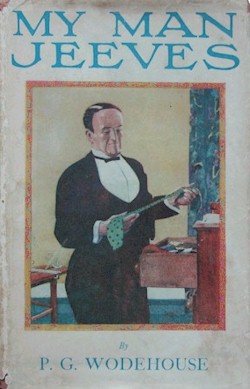
Guest Review: MY MAN JEEVES by PG Wodehouse

book cover
Original Publication Date: 1919

Genre: mystery, humor

Topics: class, coming of age


Review by Patty from A Tale of Three Cities:

I hadn't realised that one of my favourite great TV series I've watched over and over again, Jeeves and Wooster, was actually based on the books by PG Wodehouse.  My Man Jeeves would be my first in this collection to devour and feel good about it.

This is a collection of  short stories that starts with the known couple of Wooster and his butler extraordinaire Jeeves.  Primarily describing their adventures in the US, the stories capture the caricatures of the ever so slightly neurotic Wooster on the one hand and of the charismatic and suave Jeeves, trying desperately to get and keep his master out of trouble.

There is an expected template of story--once you get to understand the steps to it, all other stories are in the same format.  Not that repetition takes away anything from the pure enjoyment, far from it!  Wodehouse gets us back to the early 20th century at the upper-class establishments, where the young (nobility, but of a lesser importance) adults take advantage of their station and get into all types of mischief - getting into girl trouble, depending on the relative's financial contribution, trying to make it into the world as a professional -  there is always something for every taste.

The stories are written in a style as if the narrator (in most of the stories Wooster) is a pal of ours and he's talking to us about his misfortunes--the language is very simple and slightly slang, with a quick tempo so as to ensure an easy and comfortable reading--ideal for when tired, but more so when under the weather. Together with a nice hot cup of tea (and some cookies), these stories are bound to cheer me up any time!

I particularly enjoyed those situations where Wooster tries to by-pass Jeeves' recommendations.  This will cause a strain in the relationship and lead to farcical circumstances -- but in the end, and in appreciation of Jeeves' solving yet another direful case, Wooster will succumb to Jeeves' original recommendation.

The character of Wooster is developed to resemble a teenager, having a go at criticising everyone and everything, but always in a good-natured manner.  He's still naive, tries to do the "honourable" thing and help his friends in need.  To that he almost always relies on the help of Jeeves, whom he clearly admires:
"There is no doubt that Jeeves is in a class of his own. In the matter of brain and resource I don't think I have ever met a chappie so supremely like mother made"

The stories also reminded me of the so-called "screwball comedies" during the 1930's and 1940's--there as here, the storyline is light but not silly, fast-paced, and the situation will inevitably lead to a happy end (after many, many intermediate steps, of course). 

I would say that Wodehouse has managed to capture the essence of the avant-garde (of mischievous youngsters) of his generation and give a faithful description of  challenges they faced.  This, together with the inimitable style of tempo, caricature and empathy, he has established himself in this genre even in our times...

Monday, March 26, 2012

Short Story Review: The Mysterious Mummy by Sax Rohmer

book cover
Original Publication Date: 1903

Genre: mystery

Topics: honor among thieves, capers


Review:

In the Great Portland Square Museum, the fabulously expensive Rienzi Vase goes missing. Does its theft have anything to do with a mysterious mummy that seemed to appear out of nowhere and disappear just as suddenly the night of the theft? And why would a mummy steal a vase?

I decided to try out some short story collections from Librivox, and hit upon a delightful one of short mysteries. The title and start of The Mysterious Mummy are something of a red herring, as the story doesn't have anything to do with mummies, but really focuses on the theft of the vase--obviously a mummy didn't steal anything, but how does it fit into the theft? There's a How To Steal a Million-esque twist in the middle that really made this story fun.

I found it interesting that Sax Rohmer draws a parallel between theft and museums in this story--not just theft from museums, but the theft museums perpetrate. The Great Portland Square Museum is filled with valuable objects looted from Egypt, Italy, and Asia. The fact that the museum owes something but refuses to pay up makes the theft of the Rienzi Vase seem a tale of heroism rather than misdemeanor.

I think if you haven't read Rohmer before, this is a good place to start--the Fu Manchu novels, which he's most famous for, are fun, but pretty racist. At six pages or so, this little brain puzzle is more of a amuse bouche than a mystery, but it's worth checking out if you enjoy stories like To Catch a Thief and The Thomas Crown Affair.


The Mysterious Mummy is readily available on the interwebs, including at Arthur's Classic Novels.

Thursday, March 22, 2012

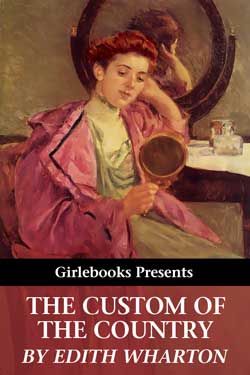
Review: The Custom of the Country by Edith Wharton

Photobucket
Original Publication Date: 1913

Genre: Fiction

Topics: women, marriage, society, social status, social climbing, old money, noveau riche, old New York


Review: I don't know why The Custom of the Country isn't a more popular Edith Wharton novel. Oh wait, I do: Undine Spragg. I could see why Undine might turn off readers. She makes Scarlett O'Hara look like Mother Theresa. I love a good b..., um, witchy character and she is that through and through.

The story starts with Undine Spragg dragging her socially awkward parents around New York. Undine's father is a very wealthy man after a series of successful financial deals in their hometown of Apex. Undine is determined to climb the social ladder of New York. She uses her beauty to entice a member of one of the Old Families of New York, Ralph Marvell, into marrying her. She's on top.

The trouble with Undine is that she is never satisfied. Once she gets what she wants, she no longer wants it. Life with Ralph isn't what she thought it would be. He has his own ideas about family and propriety. On top of that, Ralph is poor by Undine's standards. To keep up with Undine's ridiculous overspending, Ralph works like a dog, yet combined with a generous allowance from her father, it's not enough. Undine manages to convince Ralph that she must go to Paris, alone, and like an idiot, he lets her. While in Europe, Undine lives the high life and sends the bills home. Then she starts getting ideas and sets her sights on European aristocracy.

Undine is the type of person that could fall into poo and come out smelling like a rose. She has the most incredible luck. In fact, she is the complete opposite of another Wharton character Lily Bart from The House of Mirth. Just when I thought it was all over for her, something would just fall into her lap! It's almost admirable how she can size up a situation and figure out how it can benefit her. She has a lot of her father in her and if she had been a man, she'd easily be a millionaire. However, Undine is a cold-hearted, selfish, shallow person. She has no feelings for anyone but herself. She doesn't care what pain her actions cause other people, from her parents to her husband to her son. She leaves a trail of bodies in her wake. Though I believe that if someone told Undine this, she'd be genuinely surprised.
The Custom of the Country is a story for the 21st century as well as the 20th. Anyone who has seen an episode of My Super Sweet 16 has seen a Undine in the making. She's never been told no by her parents and won't take no for an answer from anyone else. Everything she wants or owns has to be better than what anyone else has. She's a victim of her upbringing. At times, I felt that if Undine had been expected to be more than an accessory to a man she would have been a better person. A character named Charles Bowen, who considers himself an amateur sociologist, makes this observation to a friend:
"I want to get a general view of the whole problem of American marriages."
Mrs. Fairford dropped into her arm-chair with a sigh. “If that’s what you want you must make haste! Most of them don’t last long enough to be classified.”
"I grant you it takes an active mind. But the weak point is so frequently the same that after a time one knows where to look for it.” 
“What do you call the weak point?”

He paused. “The fact that the average American looks down on his wife.”

Mrs. Fairford was up with a spring. “If that’s where paradox lands you!”

Bowen mildly stood his ground. “Well–doesn’t he prove it? How much does he let her share in the real business of life? How much does he rely on her judgment and help in the conduct of serious affairs? Take Ralph for instance–you say his wife’s extravagance forces him to work too hard; but that’s not what’s wrong. It’s normal for a man to work hard for a woman–what’s abnormal is his not caring to tell her anything about it.”

“To tell Undine? She’d be bored to death if he did!”

“Just so; she’d even feel aggrieved. But why? Because it’s against the custom of the country. And whose fault is that? The man’s again–I don’t mean Ralph I mean the genus he belongs to: homo sapiens, Americanus. Why haven’t we taught our women to take an interest in our work? Simply because we don’t take enough interest in THEM.”

Charles has a point but Undine has no interest in Ralph's affairs. She's interested in her own. Undine treats her marriages like business deals; it's not personal. The men are useful until they outlive their purpose, then they are discarded and she's onto the next one. In a way you can't blame her, it's the only career she can have.

The Custom of the Country is a feminist novel in a way but it's also a satirical look at wealth: the rising nouveau riche of America and the fading old families of New York and Europe. They are all subject to their own follies.

I could go on more but I'll stop there. This is now my favorite Edith Wharton novel. It's entertaining and even shocking.

Highly recommended

I read this free edition of The Custom of the Country from girlebooks.

This review was originally published on Chrisbookarama.

Wednesday, March 21, 2012

Random Wednesday: BUNNY RABBIT'S DIARY by Mary Frances Blaisdell

book cover
Original Publication Date: 1915

Genre: children's book

Topics: anthropomorphizing, adventure


Review:

In the interest of reading more obscure books for this blog, I decided to randomly select a few books and highlight them in a feature called Random Wednesday! To select the book, I randomly chose a letter of the alphabet, went to the Project Gutenberg page with all the author names starting with that letter, divided the page in to eighths and randomly chose a section, and then selected a book based on the title.

My first choice was Bunny Rabbit's Diary by Mary Frances Blaisdell, because I like bunnies (yes, I am THAT much of a grown-up). It's an illustrated children's book basically in the style of Wind in the Willows or Peter Rabbit. I'm not a huge fan of either, to be honest, but they're both a damn sight better than this book, which is snoregastic.

For a present, Bunny Rabbit received a journal made out of leaves and wrote down all his adventures with the other animals. Then he stuck it in a tree, where the author found it and transcribed it. How did Blaisdell read the tiny rabbit writing? I don't know.

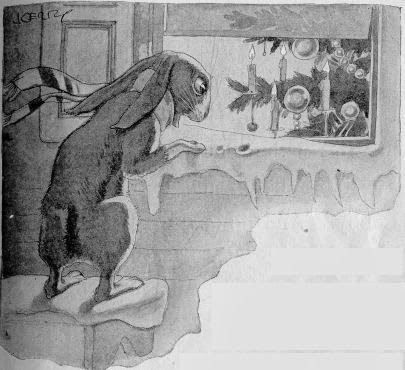
The problem is, as Bunny Rabbit himself observed, he doesn't know how to write stories (also: why is he writing his own stories in the third person? Another mystery). All the stories are good beginnings, but they never go anywhere. For example, one time Bunny Rabbit and his other bunny friend are hanging out in a tree, when they see two humans. The humans want to cut down a tree! Bunny Rabbit wonders why, and a sparrow tells him it's for Christmas, and explains what a Christmas tree is. Bunny Rabbit is intrigued, so he follows the humans to their house to see a Christmas tree for himself.

bunny rabbit seeing a christmas tree


The end.

See what I mean? This is the START of a story. In any other decent book I can think of, this would be the set up for a series of hi-larious hijinks undoubtedly involving either a cat or dog, trashcans, being chased around the kitchen by a knife-wielding cook, and the children wanting to adopt him as a pet. In Bunny Rabbit's Diary, it's THE ENTIRE STORY.

I was also less than impressed with the illustrations.

So, if you're in the mood to read a book about a rabbit, I'd stick with Peter Rabbit.

Sunday, March 18, 2012

Review: Letters on an Elk Hunt

Letters on an Elk Hunt
Original Publication Date:  1914

Genre:  History, Memoirs

Topics:  American History, Wild West, Women

Review:
I read Letters of a Woman Homesteader last year and really, really enjoyed it.  I fell in love with Elinore Pruitt Stewart (except for the disturbing, lightly-treated racism she sometimes had a tendency to display) and her ability to find humor in so many of life's everyday situations.  Also, the woman is able to shoot her own dinner and ride into a snowstorm on her horse, which is pretty amazing.

Letters on an Elk Hunt is a sequel to Letters of a Woman Homesteader.  It's a series of letters written in 1914 from Elinore Stewart to her lifelong friend.  This book is much shorter, though, as it only describes Elinore's life over a span of several weeks relating to the build-up to, experience of and falling action after an elk hunt.

I mentioned in my previous review that I wasn't sure how much of the story Elinore related was fact and how much was fiction.  This came even more to the fore in Letters on an Elk Hunt, just because every single story arc that Elinore introduced was completed very neatly in the span of the book.  For example, there is one mysterious but very kind girl that travels with the hunting team for quite a while.  Everyone likes her but knows very little about her (a fact that Elinore sets up very well in early letters).  But then, conveniently, just before this girl is to leave them, she takes Elinore and another woman aside and spills her guts to them, telling her about why she came west, what she hopes to do and who she hopes to find.  And then, the next day, all her wishes come true.  It is a lovely story and I hope that it's true, but even if it is, I can't imagine that it occurred in such a perfect story arc as in the manner that Elinore presented it.

I didn't enjoy this book as much as I did the first volume of letters, but I think that's mainly because the book is much shorter.  The narrative style is just as engaging, the humor just as light and easy to catch, and the characters just as interesting.  And once again, I was just so struck by how different the lifestyle for homesteaders was.  For example, this entire hunting party of probably five people descended on a complete stranger's home.  This man was getting ready for his mother to come from the East Coast to live with him, and so he left the hunting party alone in his home to go to town (a trip of two or three days) to pick her up.  The hunting party then set to work completely cleaning his house, redecorating, sewing bonnets and knitting blankets for the mother, and even putting together two chests of drawers for the bedrooms.  All in two days.  For a man they had just met, who had trusted them enough to leave them alone in his home.  It was just absolutely amazing to me, and I couldn't help but feel wistful and sad that those sorts of communities don't exist any more.  It's not even a community, really- it seems more to be this mindset of, "We're all out in this difficult, remote area of the world together and we've got to help each other out."  Reading this book, it felt so much less isolated than living alone in a big city.

I'm sure that Elinore was idealizing her life a lot and it's very possible that she embellished her stories, too.  She makes very brief mention of World War I, but it hardly touches her life (granted, it barely touched any American's life in 1914).  But I so enjoyed reading her letters and learning about what life was like just 100 years ago.  Now I've gone and downloaded a ridiculous number of memoirs that describe life on the American frontier!  So... get ready for many more reviews on this topic over the coming months :-)

Thursday, March 15, 2012

Wishlist: The First Mysteries

illustration from murder in the rue morgue
1876 illustration from Murder In the Rue Morgue


Trying to figure out what constitutes the earliest mystery novel can be like trying to dig a hole in the sand: no matter how deeply you go, you never seem to reach the bottom. Part of the problem is, what does one really mean by "mystery novel"? Detective fiction, crime fiction, a novel in which a mystery is solved? Depending on how you define the genre, early mysteries might include Oedipus Rex by Sophocles, "The Three Apples" from Arabian Nights, or Chinese gong an stories.

However, mystery novels as most of us understand them today more or less started in the 19th century. Some very early examples:

  • Mademoiselle de Scuderi by ETA Hoffmann (1819)--A poetess discovers who is murdering people and stealing their jewelry in this Louis XIV-era novella. However, Mlle Scuderi doesn't exactly solve the murders, so whether or not this can be really be called a detective novel is debatable. [available to read online here]
  • The Rector of Veilbye by Steen Steensen Blicher (1829)--A Danish novella based on a true murder case. [can be found in this mystery compendium at Project Gutenberg|Librivox]
  • Murders in the Rue Morgue by Edgar Allan Poe (1841)--This is usually considered THE very first detective mystery. Poe established the formula for the mystery genre, as well as created a memorable detective, C. Auguste Dupin (who was based on Eugène François Vidocq, real-life director of the Sûreté Nationale, the founder of the first private detective agency, and the father of modern criminology as well as the French police). Dupin also appeared in The Mystery of Marie Rogêt and The Purloined Letter. However, since these stories are short, can they really be called "novels"? [Project Gutenberg|Librivox]
  • Notting Hill Mystery by Charles Felix (1862)--This serialized mystery appears to be the first British detective novel. It centers around an insurance investigator who believes a baron killed his wife. Fun fact: Daphne du Maurier's grandfather illustrated the story. [available to read in original serialized format at Internet Archive]
  • Monsieur Lecoq by Emile Gaboriau (1868)--This is often cited as the first French mystery novel, with a detective who was also based on Vidocq. Like his real-life counterpart, Lecoq is adept at disguises and applies the scientific method in unraveling crimes. [Project Gutenberg|Librivox]
  • The Woman in White (1858) and The Moonstone (1868) by Wilkie Collins--Although more properly classified as a sensational novel, in my opinion, The Woman in White has a central mystery and is usually cited as one of the first British mysteries. The Moonstone is more of a proper mystery and contains plot elements like red herrings, a locked room, false suspects, and a professional investigator. TS Eliot called it, "the first, the longest, and the best of modern English detective novels," and Dorothy L. Sayers called it, "probably the very finest detective story ever written." [Project Gutenberg|Librivox]
  • The Leavenworth Case by Anna Katherine Green (1878)--As far as I've been able to find, this is the first detective novel by a female writer. The detective, a Mr. Gryce, attempts to figure out who shot the wealthy Mr. Leavenworth in the back of the head. [Project Gutenberg|GirleBooks|Librivox]
Have you read any of these early mystery novels? What did you think of them?

Tuesday, March 13, 2012

Short Story Review: Xingu by Edith Wharton

Photobucket
Original Publication Date: 1916

Genre: Humorous short story

Topics: Society, manners, ladies' clubs, book clubs, authors,


Review: Guess what? Edith Wharton is funny! Not slap you in the face with a fish funny, but funny.

In the short story Xingu, six society ladies get together regularly to broaden their minds. It's a culture club they've named the Lunch Club. You can't just show up to a meeting and become a member, oh no, you must be recommended by someone important. While each lady has issues with one or more of the other members, they universally agree that Mrs Roby was a mistake. And she came so highly recommended, by a professor no less. Tsk-tsk.

Occasionally, they have in experts to give talks and contribute to the discussion. The ladies are all a-twitter over their next guest, author of The Wings of Death, Osric Dane. Mrs Ballinger will play hostess to the great lady, even though Mrs Plinth has a superior house (with a footman, thank you very much). The big day comes and the author arrives but she looks down her nose at the group leaving the ladies at a loss for words. They don't know what to do, until Mrs Roby starts talking about Xingu.

So what is Xingu? Don't Google it! (like I did) Really, don't. You'll find out what it is eventually. It's a lot of fun reading how the ladies bluff their way through the discussion. It reminds me of those people who lie about reading Ulysses to impress others. Not one of those women know what Xingu is, Mrs Rory excepted, but they are trying hard to convince each other they know exactly what it is.

I've always thought that Edith Wharton was part author, part sociologist. I can imagine her sitting in the background during a party with a notebook murmuring, "Interesting..." to herself as she scribbled notes about all the guests. She has the group dynamic down. Mrs Plinth is the bully, she likes to have her own way. Mrs Ballinger, founder of the Lunch Club, is her biggest competition, even though she only has two parlour-maids. Mrs Leveret will change her opinion to suit her audience, and Miss Van Vluyck and Laura Glade make the remainder of the group. The outsider is Mrs Roby.

Clearly Mrs Roby is the Cady Heron within this group of Mean Girls. However, she has enough confidence in herself to say what's on her mind. When Mrs Plinth tells her "No one reads Trollope now." She replies that she's just started and he amuses her. "Amusement," said Mrs Plinth,"is hardly what I look for in my choice of books." Mrs Plinth would not make a very good book blogger as she "so much disliked being asked her opinion of a book. Books were written to be read; if one read them what more could be expected?" That line made me laugh. I can't help but think that Edith Wharton had personal experience with a Mrs Plinth.

As for Osric Dane, she's one of those insufferable literati who think everyone else is an idiot- think Franzen and Oprah's Book Club. For a moment I was totally in the Lunch Club's corner. Then Mrs Roby has her revenge at last once the topic turns to Xingu.

Xingu is not the usual heavy fare from Edith Wharton and it's a nice change. I recommend it.